30 Forbidden Self-Defense Moves (That Could Save Your Life)
0
Angle Off·Master Yourself
Disclaimer: These techniques are for lawful self-defense only. Use responsibly — only when necessary to protect yourself…
Translation: angle off
The Angle Off subfamily covers defensive footwork techniques where the fighter steps to the side at an angle rather than retreating straight backward, simultaneously avoiding the attack and creating a new positional angle relative to the opponent. [1] Angling off is considered superior to straight retreating because it removes the defender from the line of attack while placing them in a position to counter from the opponent's blind side or flank. [1],[2] The technique requires precise timing — the step must occur as the opponent commits to their attack, so they are unable to adjust their trajectory. [2],[3]
Angle-based footwork defence is fundamental in boxing and was refined by fighters like Muhammad Ali and Pernell Whitaker. [1]
Angling is used by elite MMA strikers. [1]
No images yet for this technique.
Sign in to suggest an image.
Disclaimer: These techniques are for lawful self-defense only. Use responsibly — only when necessary to protect yourself…
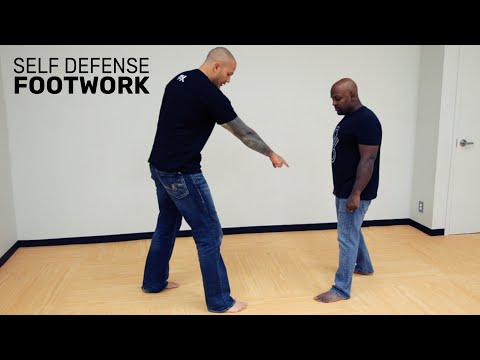
Get the full course "SELF DEFENSE WITH KEVIN GOAT" here: https://bit.ly/3fsYseV If you practiced nothing but footwork y…
No instructional courses yet for this technique.
Sign in to suggest a course.
Risk of injury to the person this technique is applied to
Evasion techniques avoid contact entirely; lowest injury risk of all techniques
Skill level needed to execute this technique reliably
Whether this technique is allowed under major competition rule sets
Boxing (Edwin Haislet, 1940)
Alias sources — [1] Championship Fighting (Dempsey, 1950) [2] Boxing Mastery (Hatmaker, 2004) [3] Tao of Jeet Kune Do (Lee, 1975)
Effectiveness sources — [1] Boxing: The Complete Guide to Training and Fitness (Hatmaker, 2004) [2] Mastering Jujitsu (Gracie & Danaher, 2003)
Standard katakana transliteration of Western martial arts terminology (外来語) — used in Japanese MMA, boxing, and BJJ communities
Alias sources — [1] Championship Fighting (Dempsey, 1950) [2] Boxing Mastery (Hatmaker, 2004) [3] Tao of Jeet Kune Do (Lee, 1975)
Effectiveness sources — [1] Boxing: The Complete Guide to Training and Fitness (Hatmaker, 2004) [2] Mastering Jujitsu (Gracie & Danaher, 2003)
agility, quick directional changes, balance in motion
light feet, strong calves and ankles
calves, tibialis anterior, quadriceps, hip stabilisers
Every move, in any martial art, shares a few universal traits. Mix and match below to pinpoint the right tool — or compare equivalents across styles.
The Angle Off subfamily covers defensive footwork techniques where the fighter steps to the side at an angle rather than retreating straight backward, simultaneously avoiding the attack and creating a new positional angle relative to the opponent. Angling off is considered superior to straight retreating because it removes the defender from the line of attack while placing them in a position to counter from the opponent's blind side or flank.
Angling off has been taught in boxing and fencing for centuries as a fundamental principle of defensive movement. The concept of moving offline — stepping off the centreline of attack — is a core principle shared across boxing, fencing, and Filipino martial arts.
Unified MMA: legal — Legal defensive technique; WBC/Boxing: legal — Legal — blocking and evasion are core boxing skills; WKF: legal — Legal — blocking is a fundamental karate skill; Kyokushin: legal — Legal; WT: legal — Legal; WAKO: legal — Legal; K: legal — 1/GLORY — Legal; IFMA: legal — Legal
Danger rating 1/10. Low — evasion techniques avoid contact entirely; lowest injury risk of all techniques
The standard setup chain: Anticipate the Attack → Execute Defence → Recover Stance → Counter or Disengage.
Standard counters include: Timing — attack when the defence is recovering or between movements / Feint — use deception to create openings in the defensive structure / Angle Change — attack from an unexpected angle that the defence does not cover.
Common variants: Standard defence (primary defensive technique from the most common position); Reactive defence (triggered by the opponent's attack, minimal movement for …); Proactive defence (anticipating the attack and positioning to neutralise it …); Counter defence (using the defensive movement to create an immediate count…).
Angling is used by elite MMA strikers.
Top errors to watch for: Stepping too far off-angle — a 45° step is sufficient; 90° takes you too far / Not pivoting after the step — you must turn to face the opponent from the new angle / Angling off without attacking — the new angle is wasted if you don't counter from it / Always angling to the same side — alternate angles to remain unpredictable.
The Angle Off is also known as Anguru Ofu, Stepping Off Line, Angle Step, Shifting.