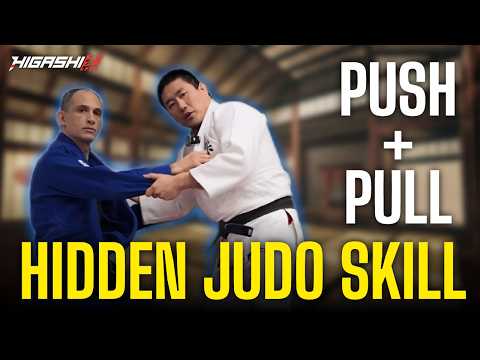
Hidden Judo Skill: Push and Pull Power! | #nyc #judo #shintarohigashi
0
Push Off·Shintaro Higashi
If you’re new to judo or BJJ, you’ve probably heard a thousand different “tips”: drill more, tap early, relax, don’t mus…
Translation: push off
The Push Off subfamily covers defensive techniques where the fighter uses an explosive backward step or push to create distance from an advancing opponent. [1] The push off is a reactive defence used when the opponent closes distance rapidly and the defender needs to create immediate separation. [1],[2] Unlike a retreating step which is measured and controlled, the push off uses explosive force to cover more distance quickly, often combined with a frame or stiff arm against the opponent's body. [2],[3]
The push-off creates distance by pushing against the opponent's body or guard to create space. [1]
Push-off techniques are found in boxing, Muay Thai, and MMA. [1]
Used in boxing and MMA competition. [1]
No images yet for this technique.
Sign in to suggest an image.
If you’re new to judo or BJJ, you’ve probably heard a thousand different “tips”: drill more, tap early, relax, don’t mus…
No instructional courses yet for this technique.
Sign in to suggest a course.
Risk of injury to the person this technique is applied to
Evasion techniques avoid contact entirely; lowest injury risk of all techniques
Skill level needed to execute this technique reliably
Whether this technique is allowed under major competition rule sets
Boxing (Edwin Haislet, 1940)
Alias sources — [1] Boxing Mastery (Hatmaker, 2004) [2] Jiu-Jitsu University (Ribeiro, 2008) [3] MMA Instruction Manual (Ryan & Snowden, 2010)
Effectiveness sources — [1] Boxing: The Complete Guide to Training and Fitness (Hatmaker, 2004)
Standard katakana transliteration of Western martial arts terminology (外来語) — used in Japanese MMA, boxing, and BJJ communities
Alias sources — [1] Boxing Mastery (Hatmaker, 2004) [2] Jiu-Jitsu University (Ribeiro, 2008) [3] MMA Instruction Manual (Ryan & Snowden, 2010)
Effectiveness sources — [1] Boxing: The Complete Guide to Training and Fitness (Hatmaker, 2004)
agility, quick directional changes, balance in motion
light feet, strong calves and ankles
calves, tibialis anterior, quadriceps, hip stabilisers
Every move, in any martial art, shares a few universal traits. Mix and match below to pinpoint the right tool — or compare equivalents across styles.
When you release pressure and step to the side after establishing counter-weight, you can immediately open up scoring opportunities like seoi nage. Shintaro Higashi explains that the push-and-pull dynamic creates the positioning needed to execute techniques before your opponent can fully recover.
By resisting and not allowing your opponent to snap your head down during the push off, you maintain your own posture and structure, which prevents them from gaining the dominance needed to complete the technique.
When your opponent counter-forces their weight forward, it loads onto their front leg, creating a vulnerable position that you can exploit with footwork and timing to execute your own techniques.
The Push Off subfamily covers defensive techniques where the fighter uses an explosive backward step or push to create distance from an advancing opponent. The push off is a reactive defence used when the opponent closes distance rapidly and the defender needs to create immediate separation.
Push-off techniques have been used in boxing and martial arts throughout history as an instinctive defence against aggressive pressure. Modern MMA coaching formalised the push-off as a specific defensive tool for managing cage pressure and aggressive clinch entries.
Unified MMA: legal — Legal defensive technique; WBC/Boxing: legal — Legal — blocking and evasion are core boxing skills; WKF: legal — Legal — blocking is a fundamental karate skill; Kyokushin: legal — Legal; WT: legal — Legal; WAKO: legal — Legal; K: legal — 1/GLORY — Legal; IFMA: legal — Legal
Danger rating 1/10. Low — evasion techniques avoid contact entirely; lowest injury risk of all techniques
The standard setup chain: Anticipate the Attack → Execute Defence → Recover Stance → Counter or Disengage.
Standard counters include: Timing — attack when the defence is recovering or between movements / Feint — use deception to create openings in the defensive structure / Angle Change — attack from an unexpected angle that the defence does not cover.
Common variants: Standard defence (primary defensive technique from the most common position); Reactive defence (triggered by the opponent's attack, minimal movement for …); Proactive defence (anticipating the attack and positioning to neutralise it …); Counter defence (using the defensive movement to create an immediate count…).
Used in boxing and MMA competition.
Top errors to watch for: Pushing with fingers extended — push with the palm heels for a solid base and to avoid finger injuries / Over-extending the push and leaving yourself off-balance — push enough to create space, then recover stance / Pushing without follow-up — the push-off creates a window; use it to strike, move, or re-set / Using the push-off as your only clinch escape — combine it with footwork and underhooks.
The Push Off is also known as Pusshu Ofu, Shove Off, Push Away, Frame And Push.