Wallwork: Fighting Off of the Cage & MMA Clinch
0
Standard Wall Walk Clinch Position·fightTIPS
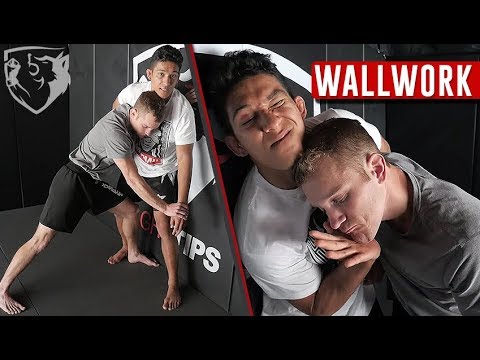
Fighting off the wall or cage is an art in itself, with very specific techniques that utilize leverage and control. 'The…
Translation: standard wall walk clinch position
The Standard Wall Walk Clinch Position represents the active wall walking stance where the attacker maintains cage pressure while systematically improving grip and position. [1] The attacker keeps a wide base with feet staggered, hips driving into the opponent, and actively works to advance grips from the current tie to a more dominant configuration. [1],[2] The position requires constant adjustment and sensitivity to the opponent's counter-movements, as each pummelling attempt creates a brief moment of vulnerability that the opponent can exploit to escape or counter. [2],[3]
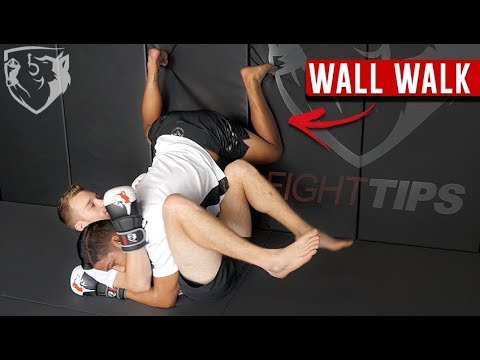
The wall walk clinch position allows a downed fighter to use the cage wall as a brace to stand up while maintaining defensive clinch control. [1] Couture describes the wall walk as 'the most important cage-specific skill in MMA' because it allows a fighter who has been taken down against the cage to return to their feet without conceding position. [1]
A cage-specific MMA technique. [1]
The standard wall walk clinch position is a transitional position in MMA cage fighting used to escape wall pins and return to striking range. [1]
No images yet for this technique.
Sign in to suggest an image.
Fighting off the wall or cage is an art in itself, with very specific techniques that utilize leverage and control. 'The…
In MMA, you have the ability to crawl up the cage or "wall walk" to elevate your hips either defensively (to buck someon…
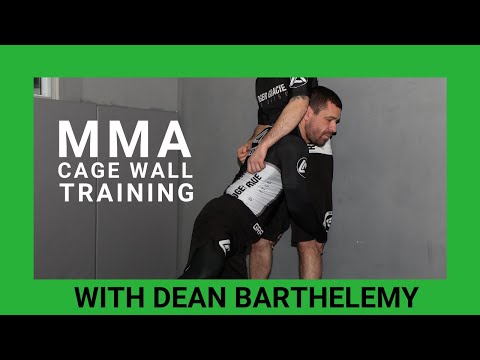
| MMA Cage Wall Training - Wall Control & Takedowns | In the 3rd video of a series, Roger Gracie Academy MMA Coach Dean…
The standard wall-walk clinch position is a fundamental control configuration used when fighters are pressed against the cage in MMA. According to fightTIPS instructors Shane and Vince, the position prioritizes three critical control points: the head, the hands, and the hips. The dominant fighter maintains head control by lifting and pressuring upward, which pins the opponent on their toes and restricts movement. Hand control is typically achieved through underhooks—ideally bilateral underhooks creating a butterfly or S-grip—or by controlling the opponent's wrist to limit their offensive options. Hip control is established by keeping one's own hips lower and tighter than the opponent's, often with a knee pressed against the cage. Stuart Tomlinson (RGA) emphasizes that this position facilitates takedown opportunities, particularly when the defending fighter attempts to square up and transition between split stances to escape—creating openings for double-leg takedowns. Both fightTIPS and Tomlinson agree on the defensive principles: the pressed fighter must battle all three control points simultaneously, using head pressure to create space, breaking hand grips through hip centering and knee lifts, and widening the stance to regain hip leverage beneath the opponent. fightTIPS additionally notes that the cage itself becomes a tool for elevation and leverage—fighters can walk their feet up the wall to raise their hips, enabling sweeps or guard passes. The position is physically demanding and serves as a core drilling format in training.
Synthesized from 3 instructors
No instructional courses yet for this technique.
Sign in to suggest a course.
Risk of injury to the person this technique is applied to
Cage clinch work involves grinding pressure; rib/facial abrasion risk
Skill level needed to execute this technique reliably
Whether this technique is allowed under major competition rule sets
Mastering Jujitsu (Renzo Gracie & John Danaher, 2003)
Alias sources — [1] Clinch Fighting for MMA (Couture, 2011) [2] Wrestling for Fighting (Velasquez, 2012) [3] MMA Instruction Manual (UFC, 2008)
Effectiveness sources — [1] Clinch Fighting for MMA (Couture, 2011)
Standard katakana transliteration of Western martial arts terminology (外来語) — used in Japanese MMA, boxing, and BJJ communities
Alias sources — [1] Clinch Fighting for MMA (Couture, 2011) [2] Wrestling for Fighting (Velasquez, 2012) [3] MMA Instruction Manual (UFC, 2008)
Effectiveness sources — [1] Clinch Fighting for MMA (Couture, 2011)
sustained grinding pressure, positional endurance, cage awareness
strong legs and hips for sustained cage pressure
quadriceps, glutes, shoulders, core, forearms
You need to focus on controlling your opponent's head, hands, and hips while also changing levels. FightTIPS emphasizes that controlling the head is critical—good head pressure allows you to clear space and maintain control even if your opponent has underhooks.
FightTIPS recommends keeping your hips centered underneath you, then lifting your knee up to break the grip. Once you break it, you can either swim an underhook or create enough space to work off the cage immediately.
Keep your hips low and wide rather than standing tall. FightTIPS notes that spreading your legs wide is a defensive key you'll often see in fights, and sometimes you need to force and create space by scooping your hips out to escape.
Yes—by getting your head in and controlling your opponent's chin while pushing off, you can clear space and move around even if they have double underhooks, as the head pressure allows you to reposition.
The Standard Wall Walk Clinch Position represents the active wall walking stance where the attacker maintains cage pressure while systematically improving grip and position. The attacker keeps a wide base with feet staggered, hips driving into the opponent, and actively works to advance grips from the current tie to a more dominant configuration.
The standard wall walk clinch position was codified as a distinct technical position in MMA coaching methodology, representing the active phase of cage clinch advancement. It is now a standard component of MMA wrestling curricula taught at major training camps worldwide.
Unified MMA: legal — Legal — clinching is integral to MMA; IJF: legal — Legal — kumi-kata (grip fighting) is fundamental to judo; IBJJF: legal — Legal — standing grip fighting and clinch work permitted; IFMA: legal — Legal — the clinch is a core element of Muay Thai, clinch dominance is highly…; WBC/Boxing: restricted — Holding is technically a foul — referee breaks clinch, excessive holding resu…; K: restricted — 1/GLORY — One attack from clinch allowed, then referee breaks; WAKO: restricted — Clinch generally broken by referee — limited or no clinch fighting in most fo…; UWW: legal — Legal — clinch is fundamental to wrestling, the primary position in Greco-Roman
Danger rating 4/10. Moderate — cage clinch work involves grinding pressure; rib/facial abrasion risk
The standard setup chain: Close Distance → Establish Primary Grip → Position the Hips → Apply Pressure.
Standard counters include: Pummeling — fight for inside position by swimming arms under opponent's grips / Frame and Push — create distance using forearm frames against the chest or neck / Grip Break — systematically strip the opponent's controlling grips / Posture Up — straighten the spine and drive the hips forward to break clinch control.
Common variants: Cage pin with underhooks (pinning the opponent against the fence with inside position); Cage pin with body lock (locking the body against the cage for control); Cage clinch with head control (using the collar tie against the fence).
The standard wall walk clinch position is a transitional position in MMA cage fighting used to escape wall pins and return to striking range.
Top errors to watch for: Accepting the low position against the cage passively — you must always be working to rise / Not bracing the core during the ascent — a loose midsection collapses under the opponent's pressure / Letting the opponent control both your arms — at least one hand must be actively fighting their grips / Pushing off the cage with the head instead of the shoulders/back — head pushes strain the neck.
The Standard Wall Walk Clinch Position is also known as Wōru Wōku Kurinchi Pojishon (Kihon-gata), Basic Wall Walk Position, Standard Cage Walk-Up Stance, Fence Walk Position.