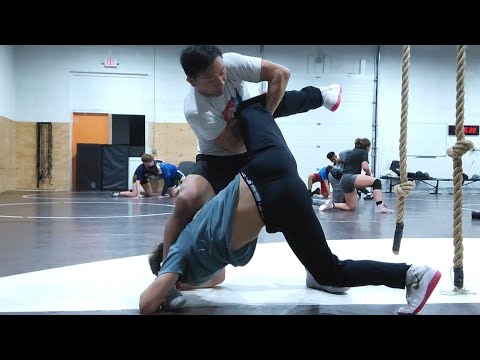
Shin Whizzer Offense When Opponent Circles Wrong Way to Finish
0
Offensive Whizzer·JO Wrestling·Added by Admin
Translation: offensive whizzer
The Offensive Whizzer uses the overhook with hip pressure as an attacking tool rather than purely defensive, leveraging the whizzer position to initiate throws, trips, and go-behind transitions. [1] The offensive whizzer drives the hip aggressively through the opponent while using the overhook to control their posture, creating off-balancing forces that set up hip throws (like harai-goshi), inside trips, or snap-and-spin-behind transitions. [1],[2] The offensive whizzer transforms a traditionally defensive position into an attack platform by increasing the aggression and directional commitment of the hip drive. [2],[3]
The offensive whizzer evolved as wrestlers discovered that the defensive overhook with hip pressure could be weaponised for attacks. [1] Judo's koshi-guruma (hip wheel) and similar hip throws share mechanical similarities with the offensive whizzer, suggesting convergent development across grappling arts. [2],[3]
The offensive whizzer uses the overhook position to initiate attacks rather than defend, setting up throws, turnovers, and cradles. [1] Petrov describes the offensive whizzer as underutilised in many programmes, noting that the arm-spin throw from the overhook is among the highest-amplitude throws available from the clinch. [1]
The offensive whizzer converts the defensive overhook into attack entries for throws and go-behinds. [1]
No images yet for this technique.
Sign in to suggest an image.
No instructional courses yet for this technique.
Sign in to suggest a course.
Risk of injury to the person this technique is applied to
Upper body clinch positions for control and transitions
Skill level needed to execute this technique reliably
Whether this technique is allowed under major competition rule sets
Freestyle Wrestling: A Complete Guide for Coaches and Wrestlers (Petrov, 1977)
Alias sources — [1] Wrestling Physical Conditioning Encyclopedia (Welker, 2010) [2] Freestyle Wrestling: A Complete Guide (Petrov, 2005) [3] Clinch Fighting for MMA (Couture, 2011)
Effectiveness sources — [1] Freestyle Wrestling: A Complete Guide (Petrov, 2005)
Official Kodokan ground technique classification system
Standard katakana transliteration of Western martial arts terminology (外来語) — used in Japanese MMA, boxing, and BJJ communities
Alias sources — [1] Wrestling Physical Conditioning Encyclopedia (Welker, 2010) [2] Freestyle Wrestling: A Complete Guide (Petrov, 2005) [3] Clinch Fighting for MMA (Couture, 2011)
Effectiveness sources — [1] Freestyle Wrestling: A Complete Guide (Petrov, 2005)
grip strength, hip positioning, shoulder clamping endurance
strong upper body and heavy hips for whizzer pressure
deltoids, biceps, hip flexors, core
You should feel comfortable with your positioning and weight distribution before committing to the technique. The whizzer is most effective when you can shift your weight and establish control over your opponent's arm.
The Offensive Whizzer uses the overhook with hip pressure as an attacking tool rather than purely defensive, leveraging the whizzer position to initiate throws, trips, and go-behind transitions. The offensive whizzer drives the hip aggressively through the opponent while using the overhook to control their posture, creating off-balancing forces that set up hip throws (like harai-goshi), inside trips, or snap-and-spin-behind transitions.
The offensive whizzer evolved as wrestlers discovered that the defensive overhook with hip pressure could be weaponised for attacks. Judo's koshi-guruma (hip wheel) and similar hip throws share mechanical similarities with the offensive whizzer, suggesting convergent development across grappling arts.
Unified MMA: legal — Legal — clinching is integral to MMA; IJF: legal — Legal — kumi-kata (grip fighting) is fundamental to judo; IBJJF: legal — Legal — standing grip fighting and clinch work permitted; IFMA: legal — Legal — the clinch is a core element of Muay Thai, clinch dominance is highly…; WBC/Boxing: restricted — Holding is technically a foul — referee breaks clinch, excessive holding resu…; K: restricted — 1/GLORY — One attack from clinch allowed, then referee breaks; WAKO: restricted — Clinch generally broken by referee — limited or no clinch fighting in most fo…; UWW: legal — Legal — clinch is fundamental to wrestling, the primary position in Greco-Roman
Danger rating 4/10. Moderate — upper body clinch positions for control and transitions
The standard setup chain: Close Distance → Establish Primary Grip → Position the Hips → Apply Pressure.
Standard counters include: Pummeling — fight for inside position by swimming arms under opponent's grips / Frame and Push — create distance using forearm frames against the chest or neck / Grip Break — systematically strip the opponent's controlling grips / Posture Up — straighten the spine and drive the hips forward to break clinch control.
Common variants: Standard overhook (wrapping over the opponent's arm and clamping tight); Whizzer with hip (combining the overhook with strong hip pressure to preven…); Overhook to throw (using the overhook to execute a throw or trip).
The offensive whizzer transitions from a defensive overhook to attack, setting up hip throws (koshi-guruma) and lateral drops in both wrestling and judo. In MMA, Fabricio Werdum used the offensive whizzer to set up throws in UFC competition.
Top errors to watch for: Trying to attack from the whizzer without first establishing hip position — the hip must be engaged / Attempting whizzer offence when you don't have a secure overhook — the arm must be firmly trapped / Not redirecting the opponent's energy — offensive whizzer works by using their push or drive against them / Standing square when attacking from the whizzer — angle off to the side for better throwing leverage.
The Offensive Whizzer is also known as Ofenshibu Wizā, Offensive Wizzer, Attack Whizzer, Throwing Whizzer.