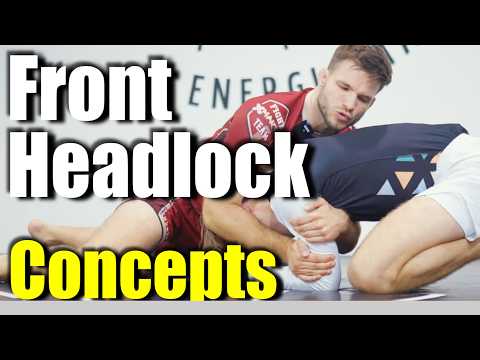
Front headlock CONCEPTS | Pins & control
0
Headlock Control·Energia Martial Arts
Front headlock CONCEPTS | Pins & control Side mount, knee on belly mount and north south; so many pins you cover so ofte…
Translation: headlock control
The Headlock Control subfamily covers clinch positions where the attacker wraps one arm around the opponent's head while controlling the arm on the same side, creating a secured head-and-arm clamp. [1] The headlock control provides a strong lateral control where the attacker can squeeze the head against their body, limiting the opponent's posture and movement in the clinch. [1],[2] Standing headlock control is used as a transition point for hip throws, snapdowns, and head-and-arm choke entries in both wrestling and MMA. [2],[3]
The headlock is one of the oldest and most recognised wrestling techniques, used in folk wrestling traditions worldwide. [1] In professional wrestling and catch-as-catch-can, the headlock was both a control position and a finishing hold. [2] Modern combat sports use the standing headlock primarily as a transitional clinch position for throws and submissions. [2],[3]
The standing headlock provides powerful head control but carries significant risk in grappling — if the attacker does not maintain hip position, the defender can take the back or execute a throw counter. [1] Welker notes it is more commonly used as a transitional position in modern wrestling rather than a static hold. [1] In judo, kubi-gatame (headlock control) is recognised as a legitimate control position for setting up throws. [2]
The headlock is one of the oldest grappling controls, documented in ancient wrestling traditions and used across judo, wrestling, and folk wrestling. [1]
No images yet for this technique.
Sign in to suggest an image.
Front headlock CONCEPTS | Pins & control Side mount, knee on belly mount and north south; so many pins you cover so ofte…
No instructional courses yet for this technique.
Sign in to suggest a course.
Risk of injury to the person this technique is applied to
Head/neck control positions create cervical strain; Muay Thai plum is primary striking platform
Skill level needed to execute this technique reliably
Whether this technique is allowed under major competition rule sets
Freestyle Wrestling: A Complete Guide for Coaches and Wrestlers (Petrov, 1977)
Alias sources — [1] Wrestling Physical Conditioning Encyclopedia (Welker, 2010) [2] Clinch Fighting for MMA (Couture, 2011) [3] Kodokan Judo (Kano, 1986) [4] Kodokan Judo (Kano, 1986)
Effectiveness sources — [1] Wrestling Physical Conditioning Encyclopedia (Welker, 2010) [2] Kodokan Judo (Kano, 1986)
Standard katakana transliteration of Western martial arts terminology (外来語) — used in Japanese MMA, boxing, and BJJ communities
Alias sources — [1] Wrestling Physical Conditioning Encyclopedia (Welker, 2010) [2] Clinch Fighting for MMA (Couture, 2011) [3] Kodokan Judo (Kano, 1986) [4] Kodokan Judo (Kano, 1986)
Effectiveness sources — [1] Wrestling Physical Conditioning Encyclopedia (Welker, 2010) [2] Kodokan Judo (Kano, 1986)
grip strength, upper body endurance, balance under pressure
strong arms and shoulders, stable base
forearms, deltoids, core, hip muscles
Every move, in any martial art, shares a few universal traits. Mix and match below to pinpoint the right tool — or compare equivalents across styles.
The standing headlock (kubi-nage entry in judo) wraps one arm around the opponent's head — a common position in street fights and self-defense. In wrestling, the headlock is taught early as both a throw entry and a control position, though experienced wrestlers can counter it by taking the back. (Wrestling coaching manuals; self-defense texts)
Position yourself on the back side of your partner with your shoulder pushing into the gap between their shoulder blades and neck—not too low. This weight distribution, combined with proper grip control, prevents your partner from escaping via sit-out (Energia Martial Arts).
Before diving for submissions like darces or guillotines, you need to establish and maintain control of the position first, similar to how you would control mount or side mount. Engaging the pin and controlling your partner's posture comes before attempting chokes (Energia Martial Arts).
If you're too high up on your partner's back, their head can pop out easily, making it simple for them to escape via sit-out, after which they may take your back (Energia Martial Arts).
You can set up the front headlock by faking a level change to shoot, or through other methods like defending against takedowns and using snap downs or other techniques while standing (Energia Martial Arts).
The Headlock Control subfamily covers clinch positions where the attacker wraps one arm around the opponent's head while controlling the arm on the same side, creating a secured head-and-arm clamp. The headlock control provides a strong lateral control where the attacker can squeeze the head against their body, limiting the opponent's posture and movement in the clinch.
The headlock is one of the oldest and most recognised wrestling techniques, used in folk wrestling traditions worldwide. In professional wrestling and catch-as-catch-can, the headlock was both a control position and a finishing hold.
Unified MMA: legal — Legal — clinching is integral to MMA; IJF: legal — Legal — kumi-kata (grip fighting) is fundamental to judo; IBJJF: legal — Legal — standing grip fighting and clinch work permitted; IFMA: legal — Legal — the clinch is a core element of Muay Thai, clinch dominance is highly…; WBC/Boxing: restricted — Holding is technically a foul — referee breaks clinch, excessive holding resu…; K: restricted — 1/GLORY — One attack from clinch allowed, then referee breaks; WAKO: restricted — Clinch generally broken by referee — limited or no clinch fighting in most fo…; UWW: legal — Legal — clinch is fundamental to wrestling, the primary position in Greco-Roman
Danger rating 5/10. High — head/neck control positions create cervical strain; Muay Thai plum is primary striking platform
The standard setup chain: Close Distance → Establish Primary Grip → Position the Hips → Apply Pressure.
Standard counters include: Pummeling — fight for inside position by swimming arms under opponent's grips / Frame and Push — create distance using forearm frames against the chest or neck / Hand Fight — strip grips by peeling fingers or pushing the wrist away / Level Change — change levels to break the collar tie angle and attack the legs.
Common variants: Standard variation (primary clinch configuration from the most common entry); Gi variation (adapted with collar and sleeve grips for gi-based grappling); No-gi / MMA variation (modified for no-gi or cage fighting conditions); Offensive variation (configured to set up strikes, takedowns, or submissions f…).
The headlock is used in wrestling and MMA, though in freestyle wrestling a headlock without an arm inclusion is penalised. In MMA, the standing headlock transitions to guillotine choke attempts, seen frequently in UFC competition.
Top errors to watch for: Applying a headlock without hip contact — the throw requires the hip as a fulcrum; without it you just crank the neck / Squeezing only the head without controlling the body — the headlock needs to be paired with body positioning / Turning your back to the opponent during the headlock without a throw plan — this gives up back exposure / Cranking the neck for pain compliance — headlock control is about position, not a neck crank.
The Headlock Control is also known as Heddo Rokku Kontorōru, Standing Headlock, Side Headlock, Kubi-Gatame, Head Chancery.