Strike & defenceLocksClose rangeFighting multiple people
Distance
CloseMiddleLong
Body target
Upper bodyMiddle bodyLower body
Overview
The Striking Single Collar Tie is a variant optimised for striking from the clinch, where the collar tie hand controls the head while the free hand delivers short-range punches, elbows, or positions for knee strikes. [1] Unlike the wrestling single collar tie where the free hand typically controls the opponent's arm, the striking variant keeps the free hand chambered for strikes. [1],[2] This position is fundamental in Muay Thai and MMA dirty boxing, where the ability to strike while maintaining clinch control creates a dangerous offensive combination. [2],[3]
The striking single collar tie evolved from Muay Thai clinch fighting and was further developed in MMA by fighters who combined wrestling clinch control with striking from close range. [1] The position became a signature tool of dirty boxing specialists in MMA. [2],[3]
Country of origin· shown in random order
🇧🇷BrazilMMA
🇺🇸USAMMA
🇹🇭ThailandMuay Thai
🇬🇧EnglandBoxing
🇬🇷GreeceBoxing
🇲🇲MyanmarLethwei
Effectiveness
The striking single collar tie is specifically adapted for MMA dirty boxing, allowing the fighter to control the opponent's head while delivering short punches, elbows, and knees with the free hand. [1] Couture describes this as one of the most effective clinch positions in MMA because it enables both striking and grappling threats simultaneously. [1]
Lineage
The striking variation of the single collar tie integrates punch and elbow setups, developed primarily in MMA. [1]
Competition Record
Randy Couture popularised the striking collar tie in MMA, using it extensively in his UFC title fights to control opponents against the cage and deliver short strikes. [1] His victories over Tim Sylvia (UFC 68, March 2007) and Gabriel Gonzaga (UFC 74, August 2007) showcased systematic dirty boxing from this position. [2]
Images
No images yet for this technique.
Sign in to suggest an image.
Biomechanical Mechanism
Primary Action — Controlling the opponent's head and posture using double collar tie or plum position
Joints Involved — Opponent's cervical spine (controlled via collar tie), attacker's elbows (clamped for control), hips (pulling base)
Force Vector — Downward — pulling the opponent's head below their centre of gravity breaks their posture and balance
Control Mechanic — Elbow frames create a cage around the opponent's head — inside position dominance is the key to clinch control
Position & Entry
From striking range — Close distance with a jab or level change, cup the hand behind the opponent's head (nape of the neck), pull their posture down
From hand fighting — During grip exchanges, swim inside and secure the collar tie by cupping the back of the head
Variants
Single collar tie — one hand on the nape controlling the head
Double collar tie (plum) — both hands behind the head for maximum control
Collar tie with wrist control — one hand on the nape, other controlling the wrist
5CitationMuay Thai: The Art of Fighting (Kraitus, 2002)
Effectiveness sources — [1] Clinch Fighting for MMA (Couture, 2011)
Community
Athletics
Requires
neck and bicep strength for head control, endurance for sustained clinch
Favours
longer forearms for deeper collar tie, strong neck
Key muscles
biceps, forearms, neck muscles, core
Frequently Asked Questions
Why is it so hard to escape a single collar tie if it's just fingers gripping my neck?
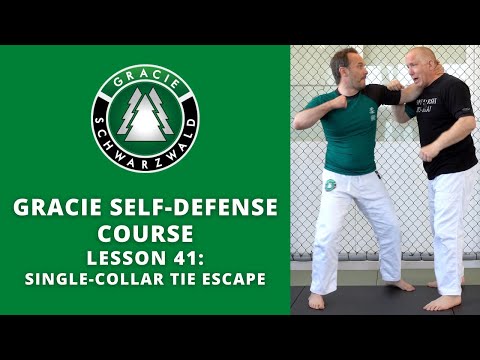
According to Gracie Schwarzwald Jiu-Jitsu, the problem is that your instinct when grabbed is to pull away or knock the arm off, which doesn't work. Instead, you need to establish a strong defensive position first by making the space between the bottom of your skull and top of your back as small as possible.
What's the correct body movement to escape a single collar tie?
Rather than just turning your head, you need to turn your whole body. Imagine your opponent is looking over your shoulder and you want to see what they're looking at—turn all the way through instead of just ducking or stepping to the side, and turn almost into your opponent to apply pressure on their elbow.
What's the most common mistake people make when escaping a single collar tie?
Gracie Schwarzwald Jiu-Jitsu emphasizes that the biggest mistake is going halfway with the escape, because if you fail partway through, your opponent now knows what you're attempting. You should commit fully to the technique or not attempt it at all.
When should I use a C-clamp variation on the single collar tie escape?
If your opponent is very strong, as you block their grip you can slide up and C-clamp their elbow while driving it inward as you turn your body, which provides additional control.
How does the Striking Single Collar Tie work?
The Striking Single Collar Tie is a variant optimised for striking from the clinch, where the collar tie hand controls the head while the free hand delivers short-range punches, elbows, or positions for knee strikes. Unlike the wrestling single collar tie where the free hand typically controls the opponent's arm, the striking variant keeps the free hand chambered for strikes.
Where does the Striking Single Collar Tie come from?
The striking single collar tie evolved from Muay Thai clinch fighting and was further developed in MMA by fighters who combined wrestling clinch control with striking from close range. The position became a signature tool of dirty boxing specialists in MMA.
Is the Striking Single Collar Tie legal in competition?
Unified MMA: legal — Legal — clinching is integral to MMA; IJF: legal — Legal — kumi-kata (grip fighting) is fundamental to judo; IBJJF: legal — Legal — standing grip fighting and clinch work permitted; IFMA: legal — Legal — the clinch is a core element of Muay Thai, clinch dominance is highly…; WBC/Boxing: restricted — Holding is technically a foul — referee breaks clinch, excessive holding resu…; K: restricted — 1/GLORY — One attack from clinch allowed, then referee breaks; WAKO: restricted — Clinch generally broken by referee — limited or no clinch fighting in most fo…; UWW: legal — Legal — clinch is fundamental to wrestling, the primary position in Greco-Roman
How dangerous is the Striking Single Collar Tie?
Danger rating 5/10. High — head/neck control positions create cervical strain; Muay Thai plum is primary striking platform
How do I set up the Striking Single Collar Tie?
The standard setup chain: Close Distance → Cup the Neck → Pull Down → Off-Balance.
How do I defend against the Striking Single Collar Tie?
Standard counters include: Pummeling — fight for inside position by swimming arms under opponent's grips / Frame and Push — create distance using forearm frames against the chest or neck / Hand Fight — strip grips by peeling fingers or pushing the wrist away / Level Change — change levels to break the collar tie angle and attack the legs.
What are the variants of the Striking Single Collar Tie?
Common variants: Single collar tie (one hand on the nape controlling the head); Double collar tie (plum) (both hands behind the head for maximum control); Collar tie with wrist control (one hand on the nape, other controlling the wrist).
How effective is the Striking Single Collar Tie in competition?
Randy Couture popularised the striking collar tie in MMA, using it extensively in his UFC title fights to control opponents against the cage and deliver short strikes. His victories over Tim Sylvia (UFC 68, March 2007) and Gabriel Gonzaga (UFC 74, August 2007) showcased systematic dirty boxing from this position.
What are common mistakes when doing the Striking Single Collar Tie?
Top errors to watch for: Holding the collar tie and forgetting to strike — the point is to land damage, not just control / Striking without pulling the head — the pull creates the opening and increases the collision force / Using only one type of strike — mix uppercuts, hooks, elbows, and knees for unpredictability / Striking from too far away — the collar tie must keep the opponent close for short-range strikes to land.
What are other names for the Striking Single Collar Tie?
The Striking Single Collar Tie is also known as Dageki Shinguru Karā Tai, Dirty Boxing Collar Tie, Striking Neck Tie, Clinch-And-Strike Collar Tie.