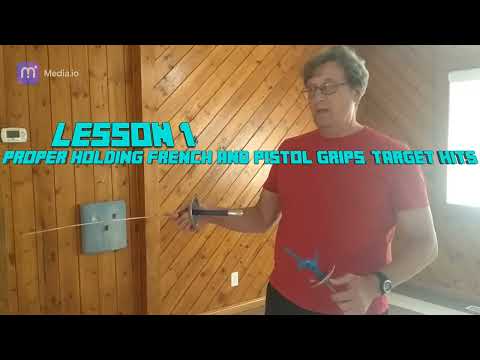
Basic Skills - Lesson 1: Proper holding french and pistol grips, target hit
0
Standard Pistol Grip Position·Fencing Academy of Calgary·Added by Admin
Translation: standard pistol grip position
The Standard Pistol Grip Position executes the fundamental pistol grip with fingers inserted into the sleeve opening at the wrist, hand closed into a fist with thumb pressing against the index finger. [1] The grip is applied by sliding the four fingers into the sleeve end, curling them to catch the fabric, and closing the hand firmly. [1],[2] This grip position provides maximum control over the opponent's arm — the wrist can be elevated, depressed, pulled, or pushed with precision, and the grip is extremely resistant to strip attempts. [2],[3]
The standard pistol grip inserts four fingers inside the opponent's sleeve cuff, providing powerful sleeve control for kuzushi. [1]
A modern judo grip that has been subject to IJF rule changes. [1]
The standard pistol grip position is used extensively in IJF judo competition at all levels, particularly effective for setting up ippon-seoi-nage and drop attacks. [1]
No images yet for this technique.
Sign in to suggest an image.
No instructional courses yet for this technique.
Sign in to suggest a course.
Risk of injury to the person this technique is applied to
Grip fighting is primarily positional; finger/wrist strain risk
Skill level needed to execute this technique reliably
Whether this technique is allowed under major competition rule sets
Freestyle Wrestling: A Complete Guide for Coaches and Wrestlers (Petrov, 1977)
Alias sources — [1] Kodokan Judo (Kano, 1986) [2] Best Judo (Inokuma & Sato, 1979) [3] IJF Competition Rules Commentary (IJF, 2018)
Effectiveness sources — [1] Kodokan Judo (Kano, 1986)
Standard katakana transliteration of Western martial arts terminology (外来語) — used in Japanese MMA, boxing, and BJJ communities
Alias sources — [1] Kodokan Judo (Kano, 1986) [2] Best Judo (Inokuma & Sato, 1979) [3] IJF Competition Rules Commentary (IJF, 2018)
Effectiveness sources — [1] Kodokan Judo (Kano, 1986)
grip strength, upper body endurance, balance under pressure
strong arms and shoulders, stable base
forearms, deltoids, core, hip muscles
The index finger and thumb are the most important parts of holding a pistol grip properly. The thumb goes underneath while the index finger is on top, with this shape extending to the middle of your palm while the other fingers rest on the side.
Hold the grip close to your arm at about a palm's width distance from your torso, keeping it touching your arm rather than pushing it away. This positioning allows you to properly extend and recover with control.
Extend your arm forward in a see-saw motion—straight ahead, not up or down—while keeping your shoulder relaxed and down. Your elbow stays positioned at a palm's width from your torso, and you extend fully toward the target before recovering with your forearm and blade parallel to the floor.
The Standard Pistol Grip Position executes the fundamental pistol grip with fingers inserted into the sleeve opening at the wrist, hand closed into a fist with thumb pressing against the index finger. The grip is applied by sliding the four fingers into the sleeve end, curling them to catch the fabric, and closing the hand firmly.
The pistol grip position is a product of competitive judo's grip fighting evolution, refined through decades of international competition where grip quality directly determines throwing success. It has become a universally taught gripping method in gi-based martial arts.
Unified MMA: legal — Legal — clinching is integral to MMA; IJF: legal — Legal — kumi-kata (grip fighting) is fundamental to judo; IBJJF: legal — Legal — standing grip fighting and clinch work permitted; IFMA: legal — Legal — the clinch is a core element of Muay Thai, clinch dominance is highly…; WBC/Boxing: restricted — Holding is technically a foul — referee breaks clinch, excessive holding resu…; K: restricted — 1/GLORY — One attack from clinch allowed, then referee breaks; WAKO: restricted — Clinch generally broken by referee — limited or no clinch fighting in most fo…; UWW: legal — Legal — clinch is fundamental to wrestling, the primary position in Greco-Roman
Danger rating 2/10. Low — grip fighting is primarily positional; finger/wrist strain risk
The standard setup chain: Close Distance → Establish Primary Grip → Position the Hips → Apply Pressure.
Standard counters include: Pummeling — fight for inside position by swimming arms under opponent's grips / Frame and Push — create distance using forearm frames against the chest or neck / Grip Break — systematically strip the opponent's controlling grips / Posture Up — straighten the spine and drive the hips forward to break clinch control.
Common variants: Standard variation (primary clinch configuration from the most common entry); Gi variation (adapted with collar and sleeve grips for gi-based grappling); No-gi / MMA variation (modified for no-gi or cage fighting conditions); Offensive variation (configured to set up strikes, takedowns, or submissions f…).
The standard pistol grip position is used extensively in IJF judo competition at all levels, particularly effective for setting up ippon-seoi-nage and drop attacks.
Top errors to watch for: Maintaining the pistol grip position without creating movement — static positions get penalised in competition / Pulling only with the sleeve hand — the collar hand must push simultaneously for effective kuzushi / Keeping both arms at the same height — stagger the grip heights for varied pulling angles / Standing square — angle your body to protect your weak side and enhance the pulling line.
The Standard Pistol Grip Position is also known as Pisutoru Gurippu Pojishon (Kihon-gata), Basic Pistol Grip Hold, Pocket Grip Position, Sleeve-End Grip Position.