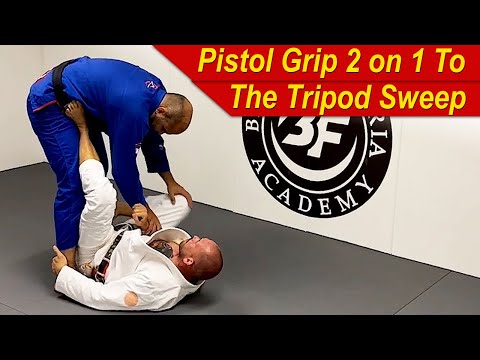
From The Pistol Grip 2 on 1 To The Tripod Sweep by Paul Schreiner
0
Pistol Grip·Bernardo Faria BJJ Fanatics
From The Pistol Grip 2 on 1 To The Tripod Sweep by Paul Schreiner. - Click Here To Check Out Paul Schreiner's Instructio…
Translation: pistol grip
The Pistol Grip family covers the specific gripping method where the attacker grips the opponent's sleeve or gi material by inserting the four fingers inside the sleeve end and closing the fist, creating a grip that resembles holding a pistol. [1] The pistol grip is one of the strongest gi grips because the finger-inside configuration allows the attacker to maintain hold even under significant pulling force, and the grip provides precise directional control of the opponent's arm. [1],[2] Pistol grips are fundamental in both judo and BJJ, used on sleeves and pants to control the opponent's limbs with maximum security. [2],[3]
The pistol grip developed as judo and BJJ practitioners optimised their gripping techniques for competition, finding that the finger-inside sleeve grip provided superior holding power compared to external fabric grips. [1] The term 'pistol grip' became standard martial arts terminology during the late 20th century as grip fighting methodology became more formalised. [2],[3]
The pistol grip (gripping the end of the sleeve by bunching the fabric) provides exceptionally strong sleeve control that is difficult for the opponent to break. [1] It has become increasingly common in international judo because it allows the gripping fighter to steer the opponent's arm with precision. [1] However, IJF rules have placed time restrictions on certain pistol grip configurations to prevent excessive grip fighting without attack. [2]
The pistol grip (grabbing the gi sleeve cuff with four fingers inside) developed as a dominant grip in modern judo competition. [1]
The pistol grip was restricted under 2014 IJF rule modifications that banned certain sleeve grips. [1]
No images yet for this technique.
Sign in to suggest an image.
From The Pistol Grip 2 on 1 To The Tripod Sweep by Paul Schreiner. - Click Here To Check Out Paul Schreiner's Instructio…
No instructional courses yet for this technique.
Sign in to suggest a course.
Risk of injury to the person this technique is applied to
Grip fighting is primarily positional; finger/wrist strain risk
Skill level needed to execute this technique reliably
Whether this technique is allowed under major competition rule sets
Kodokan Judo (Jigoro Kano, 1986)
Alias sources — [1] Kodokan Judo (Kano, 1986) [2] Kodokan Judo (Kano, 1986) [3] Kodokan Judo (Kano, 1986)
Effectiveness sources — [1] Kodokan Judo (Kano, 1986) [2] IJF Sport and Organisation Rules (IJF, 2022)
Standard katakana transliteration of Western martial arts terminology (外来語) — used in Japanese MMA, boxing, and BJJ communities
Alias sources — [1] Kodokan Judo (Kano, 1986) [2] Kodokan Judo (Kano, 1986) [3] Kodokan Judo (Kano, 1986)
Effectiveness sources — [1] Kodokan Judo (Kano, 1986) [2] IJF Sport and Organisation Rules (IJF, 2022)
grip strength, upper body endurance, balance under pressure
strong arms and shoulders, stable base
forearms, deltoids, core, hip muscles
Every move, in any martial art, shares a few universal traits. Mix and match below to pinpoint the right tool — or compare equivalents across styles.
A pistol grip 2-on-1, where you pass one arm over and grip behind the tricep, is preferred because it provides strong control that prevents your opponent from escaping even if they don't actively try to break it.
Yes, the pistol grip 2-on-1 is versatile and can be used for various transitions, including side control escapes and other techniques beyond sweeps.
The Pistol Grip family covers the specific gripping method where the attacker grips the opponent's sleeve or gi material by inserting the four fingers inside the sleeve end and closing the fist, creating a grip that resembles holding a pistol. The pistol grip is one of the strongest gi grips because the finger-inside configuration allows the attacker to maintain hold even under significant pulling force, and the grip provides precise directional control of the opponent's arm.
The pistol grip developed as judo and BJJ practitioners optimised their gripping techniques for competition, finding that the finger-inside sleeve grip provided superior holding power compared to external fabric grips. The term 'pistol grip' became standard martial arts terminology during the late 20th century as grip fighting methodology became more formalised.
Unified MMA: legal — Legal — clinching is integral to MMA; IJF: legal — Legal — kumi-kata (grip fighting) is fundamental to judo; IBJJF: legal — Legal — standing grip fighting and clinch work permitted; IFMA: legal — Legal — the clinch is a core element of Muay Thai, clinch dominance is highly…; WBC/Boxing: restricted — Holding is technically a foul — referee breaks clinch, excessive holding resu…; K: restricted — 1/GLORY — One attack from clinch allowed, then referee breaks; WAKO: restricted — Clinch generally broken by referee — limited or no clinch fighting in most fo…; UWW: legal — Legal — clinch is fundamental to wrestling, the primary position in Greco-Roman
Danger rating 2/10. Low — grip fighting is primarily positional; finger/wrist strain risk
The standard setup chain: Close Distance → Establish Primary Grip → Position the Hips → Apply Pressure.
Standard counters include: Pummeling — fight for inside position by swimming arms under opponent's grips / Frame and Push — create distance using forearm frames against the chest or neck / Grip Break — systematically strip the opponent's controlling grips / Posture Up — straighten the spine and drive the hips forward to break clinch control.
Common variants: Standard variation (primary clinch configuration from the most common entry); Gi variation (adapted with collar and sleeve grips for gi-based grappling); No-gi / MMA variation (modified for no-gi or cage fighting conditions); Offensive variation (configured to set up strikes, takedowns, or submissions f…).
The pistol grip was restricted under 2014 IJF rule modifications that banned certain sleeve grips.
Top errors to watch for: Gripping too much fabric, creating a bulky bunch that's hard to hold — grip just enough fabric for a firm closed fist / Not fully closing the fist — a half-open pistol grip is easily stripped / Using the pistol grip on the collar — it's a sleeve-specific grip; collar grips use different hand positions / Holding the pistol grip with the wrist bent — keep the wrist straight and aligned with the forearm for structural str….
The Pistol Grip is also known as Pisutoru Gurippu, Pocket Grip, Sleeve End Grip, Competition Grip.