Cross Sleeve Grip Sacrifice Take Down into Mount - BJJ
0
Standard Cross-Sleeve Grip·Jon Foster
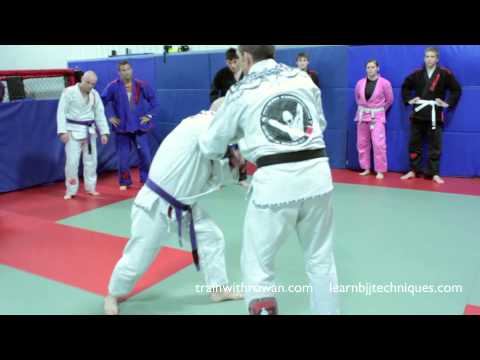
BJJ black belt Rowan Cunningham shows you how to do a take down into mount position starting with a cross sleeve grip on…
Translation: standard cross-sleeve grip
The Standard Cross-Sleeve Grip reaches across to grip the opponent's far sleeve at the wrist or forearm level, securing the fabric with a firm pull to control the distant arm. [1] The diagonal angle of the grip creates a pulling line that rotates the opponent's body, opening the near side for entries and disrupting their defensive structure. [1],[2] The standard cross-sleeve grip is often used as a setup for sacrifice throws, sweeps, and guard pulls in BJJ competition. [2],[3]
The standard cross-sleeve grip uses the opposite hand to control the far sleeve, creating kuzushi opportunities. [1]
A judo competition grip variation. [1]
The standard cross-sleeve grip is a common kumi-kata pattern in IJF judo competition, providing cross-body control for techniques like kosoto-gari and kouchi-gari. [1]
No images yet for this technique.
Sign in to suggest an image.
BJJ black belt Rowan Cunningham shows you how to do a take down into mount position starting with a cross sleeve grip on…
No instructional courses yet for this technique.
Sign in to suggest a course.
Risk of injury to the person this technique is applied to
Grip fighting is primarily positional; finger/wrist strain risk
Skill level needed to execute this technique reliably
Whether this technique is allowed under major competition rule sets
Freestyle Wrestling: A Complete Guide for Coaches and Wrestlers (Petrov, 1977)
Alias sources — [1] Kodokan Judo (Kano, 1986) [2] Kodokan New Japanese-English Dictionary of Judo (IJF, 2000) [3] Best Judo (Inokuma & Sato, 1979)
Effectiveness sources — [1] Kodokan Judo (Kano, 1986)
Standard katakana transliteration of Western martial arts terminology (外来語) — used in Japanese MMA, boxing, and BJJ communities
Alias sources — [1] Kodokan Judo (Kano, 1986) [2] Kodokan New Japanese-English Dictionary of Judo (IJF, 2000) [3] Best Judo (Inokuma & Sato, 1979)
Effectiveness sources — [1] Kodokan Judo (Kano, 1986)
grip strength, upper body endurance, balance under pressure
strong arms and shoulders, stable base
forearms, deltoids, core, hip muscles
The Standard Cross-Sleeve Grip reaches across to grip the opponent's far sleeve at the wrist or forearm level, securing the fabric with a firm pull to control the distant arm. The diagonal angle of the grip creates a pulling line that rotates the opponent's body, opening the near side for entries and disrupting their defensive structure.
The standard cross-sleeve grip has been part of judo and BJJ grip fighting for decades, used as both an offensive and transitional grip. It gained prominence in sport BJJ where cross-sleeve control from standing feeds directly into guard-based attack systems.
Unified MMA: legal — Legal — clinching is integral to MMA; IJF: legal — Legal — kumi-kata (grip fighting) is fundamental to judo; IBJJF: legal — Legal — standing grip fighting and clinch work permitted; IFMA: legal — Legal — the clinch is a core element of Muay Thai, clinch dominance is highly…; WBC/Boxing: restricted — Holding is technically a foul — referee breaks clinch, excessive holding resu…; K: restricted — 1/GLORY — One attack from clinch allowed, then referee breaks; WAKO: restricted — Clinch generally broken by referee — limited or no clinch fighting in most fo…; UWW: legal — Legal — clinch is fundamental to wrestling, the primary position in Greco-Roman
Danger rating 2/10. Low — grip fighting is primarily positional; finger/wrist strain risk
The standard setup chain: Close Distance → Establish Primary Grip → Position the Hips → Apply Pressure.
Standard counters include: Pummeling — fight for inside position by swimming arms under opponent's grips / Frame and Push — create distance using forearm frames against the chest or neck / Grip Break — systematically strip the opponent's controlling grips / Posture Up — straighten the spine and drive the hips forward to break clinch control.
Common variants: Standard variation (primary clinch configuration from the most common entry); Gi variation (adapted with collar and sleeve grips for gi-based grappling); No-gi / MMA variation (modified for no-gi or cage fighting conditions); Offensive variation (configured to set up strikes, takedowns, or submissions f…).
The standard cross-sleeve grip is a common kumi-kata pattern in IJF judo competition, providing cross-body control for techniques like kosoto-gari and kouchi-gari.
Top errors to watch for: Gripping at mid-forearm instead of the cuff — the cuff gives maximum leverage over the arm / Pulling straight back instead of diagonally across — the diagonal pull creates the rotational kuzushi / Over-reaching and leaving your body exposed on the near side — be aware of your own open side / Using the grip statically — the cross-sleeve must generate active kuzushi through constant pulling and adjusting.
The Standard Cross-Sleeve Grip is also known as Sutandādo Kurosu Surību Gurippu, Basic Cross Sleeve Grab, Standard Gyaku-Sode-Kumi, Fundamental Cross Sleeve.