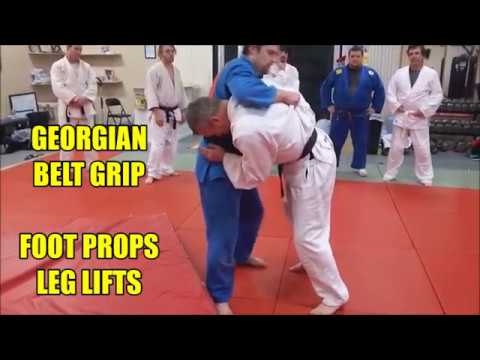
GEORGIAN BELT GRIP FOOT SWEEPS LEG LIFT THROWS
0
Georgian Rear Belt Grip·welcomematstevescott·Added by Admin
In this video, the Georgian Belt grip is used for several Foot Sweeps and Props and for Leg or Thigh Lift throws. coachi…
Translation: Georgian rear belt grip
The Georgian Rear Belt Grip is a signature gripping configuration from Georgian judo and wrestling where the attacker reaches deep behind the opponent to grip the back of the belt with one hand while controlling the collar or lapel with the other. [1] This grip creates an extremely powerful asymmetric control where the belt hand can lift and rotate the opponent's hips while the collar hand controls posture and direction. [1],[2] The Georgian grip is renowned for its effectiveness in setting up powerful throws such as harai goshi, uchi mata, and various suplex variations. [2],[3]
The Georgian grip is named for the country of Georgia, whose judoka developed this gripping style from their native wrestling art, chidaoba. [1] Georgian wrestlers traditionally grip a short jacket (chokha) at the waist, and when these athletes transitioned to judo, they brought their belt-gripping preferences with them. [2] Georgian judoka like Shota Khabareli, David Khakhaleishvili, and more recently Lasha Bekauri have demonstrated the devastating effectiveness of this grip system at the Olympic level. [2],[3]
The Georgian rear belt grip provides exceptional throwing power by securing the opponent's belt from behind with one or both hands, enabling explosive hip and suplex-style throws. [1] The grip is particularly effective in judo and freestyle wrestling where Georgian athletes have used it to execute devastating lateral and rotational throws. [1]
This grip originates from Georgian traditional wrestling (chidaoba), where all matches begin with a mandatory belt grip. [1] The Georgian wrestling tradition has produced a disproportionate number of Olympic and World Championship medallists in judo and wrestling, largely attributed to the belt-grip skills developed through chidaoba training. [1] Notable lineage figures include the coaches and wrestlers of the Georgian national wrestling and judo teams who have systematically adapted chidaoba belt techniques to international competition rules. [2]
Georgian judoka have dominated with belt grip techniques on the international stage. Shota Chochishvili won Georgia's first Olympic judo gold (1972 Munich) using Georgian grip techniques. [1] More recently, Lasha Bekauri (Olympic gold, Tokyo 2021, -90kg) and Lasha Shavdatuashvili (Olympic gold, London 2012, -66kg) continued the tradition of Georgian belt-grip dominance in Olympic judo. [2]
No images yet for this technique.
Sign in to suggest an image.
In this video, the Georgian Belt grip is used for several Foot Sweeps and Props and for Leg or Thigh Lift throws. coachi…
No instructional courses yet for this technique.
Sign in to suggest a course.
Risk of injury to the person this technique is applied to
Grip fighting is primarily positional; finger/wrist strain risk
Skill level needed to execute this technique reliably
Whether this technique is allowed under major competition rule sets
Kodokan Judo (Jigoro Kano, 1986)
Alias sources — [1] UWW Technical Terminology (UWW, 2018) [2] Georgian Wrestling: Chidaoba (Berdzenishvili, 2008) [3] Freestyle Wrestling: A Complete Guide (Petrov, 2005)
Effectiveness sources — [1] Georgian Wrestling: Chidaoba (Berdzenishvili, 2008)
Official Kodokan ground technique classification system
Mixed Japanese-Western terminology — combines traditional Japanese terms with katakana loanwords
Alias sources — [1] UWW Technical Terminology (UWW, 2018) [2] Georgian Wrestling: Chidaoba (Berdzenishvili, 2008) [3] Freestyle Wrestling: A Complete Guide (Petrov, 2005)
Effectiveness sources — [1] Georgian Wrestling: Chidaoba (Berdzenishvili, 2008)
grip strength, upper body endurance, balance under pressure
strong arms and shoulders, stable base
forearms, deltoids, core, hip muscles
The Georgian grip is a rear belt control technique used in Sambo that originates from Georgian grappling style. According to Steve Scott, it involves catching over the opponent's back from the side after they attempt to escape your initial grip.
The critical element is a quick turn with the hips—this explosive hip rotation combined with stepping out wide allows you to drop your opponent effectively with the grip.
From the Georgian grip, you can execute either a lifting thigh sweep action or a more traditional foot sweep to complete the throw.
The Georgian Rear Belt Grip is a signature gripping configuration from Georgian judo and wrestling where the attacker reaches deep behind the opponent to grip the back of the belt with one hand while controlling the collar or lapel with the other. This grip creates an extremely powerful asymmetric control where the belt hand can lift and rotate the opponent's hips while the collar hand controls posture and direction.
The Georgian grip is named for the country of Georgia, whose judoka developed this gripping style from their native wrestling art, chidaoba. Georgian wrestlers traditionally grip a short jacket (chokha) at the waist, and when these athletes transitioned to judo, they brought their belt-gripping preferences with them.
Unified MMA: legal — Legal — clinching is integral to MMA; IJF: legal — Legal — kumi-kata (grip fighting) is fundamental to judo; IBJJF: legal — Legal — standing grip fighting and clinch work permitted; IFMA: legal — Legal — the clinch is a core element of Muay Thai, clinch dominance is highly…; WBC/Boxing: restricted — Holding is technically a foul — referee breaks clinch, excessive holding resu…; K: restricted — 1/GLORY — One attack from clinch allowed, then referee breaks; WAKO: restricted — Clinch generally broken by referee — limited or no clinch fighting in most fo…; UWW: legal — Legal — clinch is fundamental to wrestling, the primary position in Greco-Roman
Danger rating 2/10. Low — grip fighting is primarily positional; finger/wrist strain risk
The standard setup chain: Close Distance → Establish Primary Grip → Position the Hips → Apply Pressure.
Standard counters include: Pummeling — fight for inside position by swimming arms under opponent's grips / Frame and Push — create distance using forearm frames against the chest or neck / Grip Break — systematically strip the opponent's controlling grips / Posture Up — straighten the spine and drive the hips forward to break clinch control.
Common variants: Standard variation (primary clinch configuration from the most common entry); Gi variation (adapted with collar and sleeve grips for gi-based grappling); No-gi / MMA variation (modified for no-gi or cage fighting conditions); Offensive variation (configured to set up strikes, takedowns, or submissions f…).
Georgian judoka have dominated with belt grip techniques on the international stage. Shota Chochishvili won Georgia's first Olympic judo gold (1972 Munich) using Georgian grip techniques.
Top errors to watch for: Reaching for the Georgian grip without first controlling the opponent's near arm — they block your reach / Wrapping behind the back but not reaching the far-side belt — the depth of the grip is what makes it powerful / Using the Georgian grip without immediately attacking — it's a throwing grip, not a holding grip / Standing too upright while gripping — bend the knees and get your hips below the opponent for throwing power.
The Georgian Rear Belt Grip is also known as Jōjian Ushiro Obi-dori, Georgian Grip, Chidaoba Belt Grip, Georgian Back Belt Clinch.