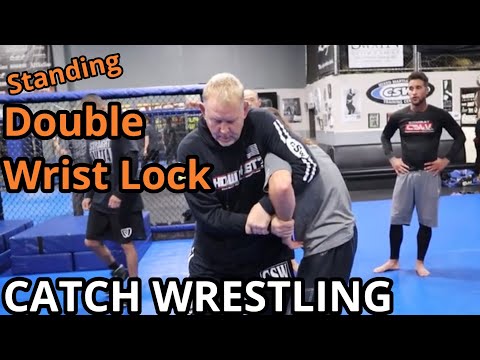
Standing Double Wrist Lock Sakuraba Style Part 1- CACC 4
0
Standard Double Wrist Control·CSW Fullerton·Added by Admin
Coach Erik Paulson shows how to enter and counter with the Standing Double Wrist Lock, Sakuraba Style. August 27, 2000 R…
Translation: standard double wrist control
The Standard Double Wrist Control positions the attacker's hands on both of the opponent's wrists, gripping firmly to control hand placement and prevent the opponent from establishing offensive grips or defensive frames. [1] The attacker can use push-pull dynamics on the wrists to off-balance the opponent, create openings for level changes, or release one grip to transition into collar ties, underhooks, or arm drags. [1],[2] Standard double wrist control is a common starting position in clinch exchanges, particularly in MMA where preventing the opponent from grabbing is essential for maintaining striking options. [2],[3]
Standard double wrist control grips both of the opponent's wrists simultaneously, providing maximum arm control at the expense of requiring both hands. [1]
A fundamental control position taught in BJJ, MMA, and self-defence systems. [1]
Double wrist control is used in striking-based martial arts competition (Muay Thai, kickboxing) to neutralise an opponent's offence, and in MMA to prevent punches in the clinch. [1]
No images yet for this technique.
Sign in to suggest an image.
Coach Erik Paulson shows how to enter and counter with the Standing Double Wrist Lock, Sakuraba Style. August 27, 2000 R…
No instructional courses yet for this technique.
Sign in to suggest a course.
Risk of injury to the person this technique is applied to
Arm control positions limit opponent's offense; low direct injury risk
Skill level needed to execute this technique reliably
Whether this technique is allowed under major competition rule sets
Freestyle Wrestling: A Complete Guide for Coaches and Wrestlers (Petrov, 1977)
Alias sources — [1] Wrestling Physical Conditioning Encyclopedia (Welker, 2010) [2] Clinch Fighting for MMA (Couture, 2011) [3] MMA Instruction Manual (UFC, 2008)
Effectiveness sources — [1] Mastering Jujitsu (Gracie & Danaher, 2003)
Aikido technique naming conventions
Mixed Japanese-Western terminology — combines traditional Japanese terms with katakana loanwords
Alias sources — [1] Wrestling Physical Conditioning Encyclopedia (Welker, 2010) [2] Clinch Fighting for MMA (Couture, 2011) [3] MMA Instruction Manual (UFC, 2008)
Effectiveness sources — [1] Mastering Jujitsu (Gracie & Danaher, 2003)
swimming speed for inside position, shoulder drive, hip pressure
strong shoulders and low centre of gravity
deltoids, pectorals, core, quadriceps
Grab the forward wrist first, then immediately collar tie your opponent, then scoop or shuck their head, and come over the top to establish the figure-four lock.
No—once you lock it, you never let it go. You keep that figure-four on there until you finish it, as this was the bread and butter hold of catch wrestling.
If they try to defend their arm, grab both their hands, drive your hip in, and rip to counter their defense, then reapply the lock and continue walking them down.
The Standard Double Wrist Control positions the attacker's hands on both of the opponent's wrists, gripping firmly to control hand placement and prevent the opponent from establishing offensive grips or defensive frames. The attacker can use push-pull dynamics on the wrists to off-balance the opponent, create openings for level changes, or release one grip to transition into collar ties, underhooks, or arm drags.
Standard double wrist control is a universal clinch technique found across all grappling arts, from traditional Japanese jujutsu to modern MMA hand fighting. Its fundamental nature means it has been independently developed in virtually every combat system.
Unified MMA: legal — Legal — clinching is integral to MMA; IJF: legal — Legal — kumi-kata (grip fighting) is fundamental to judo; IBJJF: legal — Legal — standing grip fighting and clinch work permitted; IFMA: legal — Legal — the clinch is a core element of Muay Thai, clinch dominance is highly…; WBC/Boxing: restricted — Holding is technically a foul — referee breaks clinch, excessive holding resu…; K: restricted — 1/GLORY — One attack from clinch allowed, then referee breaks; WAKO: restricted — Clinch generally broken by referee — limited or no clinch fighting in most fo…; UWW: legal — Legal — clinch is fundamental to wrestling, the primary position in Greco-Roman
Danger rating 3/10. Moderate — arm control positions limit opponent's offense; low direct injury risk
The standard setup chain: Close Distance → Establish Primary Grip → Position the Hips → Apply Pressure.
Standard counters include: Pummeling — fight for inside position by swimming arms under opponent's grips / Frame and Push — create distance using forearm frames against the chest or neck / Grip Break — systematically strip the opponent's controlling grips / Posture Up — straighten the spine and drive the hips forward to break clinch control.
Common variants: Single collar tie (one hand on the nape controlling the head); Double collar tie (plum) (both hands behind the head for maximum control); Collar tie with wrist control (one hand on the nape, other controlling the wrist).
Double wrist control is used in striking-based martial arts competition (Muay Thai, kickboxing) to neutralise an opponent's offence, and in MMA to prevent punches in the clinch.
Top errors to watch for: Holding both wrists at the same height — stagger them (one high, one low) for better rotational control / Gripping with fingers only — wrap the wrist fully with each hand / Standing square-on while holding both wrists — maintain a staggered stance for balance / Not releasing quickly enough to chain the next action — double wrist is a beat, not a position.
The Standard Double Wrist Control is also known as Sutandādo Ryō-tekubi Seigyo, Basic Double Wrist Grip, Fundamental Double Wrist Tie, Two-Wrist Hand Fight.