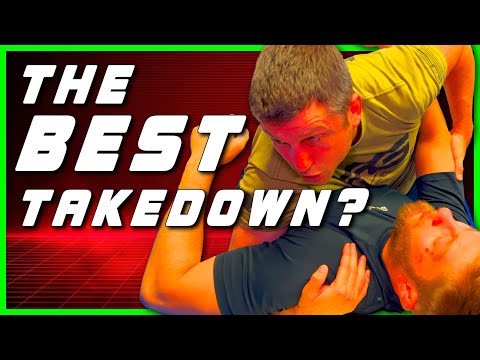
Arm Drag INSIDE Trip is SICK!
0
Inside Arm Drag·TeachMeGrappling Coach Brian
This video I teach an arm drag inside trip that I believe is one of the best takedowns in the game whether you do wrestl…
Translation: inside arm drag
The Inside Arm Drag subfamily executes arm drags where the attacker pulls the opponent's arm across their centreline toward the inside, creating access to the far side of the opponent's body. [1] The inside arm drag typically involves gripping the opponent's wrist or tricep with the lead hand and pulling it diagonally across while the attacker steps to the outside, ending up on the opponent's flank or behind them. [1],[2] This drag direction is effective because it compromises the opponent's structure by pulling their arm across their own body, disrupting their balance and exposing the back. [2],[3]
Inside arm drags have been a fundamental wrestling technique for over a century, taught as a basic offensive tool for creating angles and back exposure in both freestyle and folkstyle wrestling. [1] The technique was adapted for no-gi grappling and MMA where it serves as a primary clinch entry and back-take setup. [2],[3]
Marcelo Garcia used the seated arm drag extensively in ADCC competition, winning gold medals in 2003, 2005, 2007, and 2009 with arm drag entries to back control. [1]
No images yet for this technique.
Sign in to suggest an image.
This video I teach an arm drag inside trip that I believe is one of the best takedowns in the game whether you do wrestl…
This video I teach a few students to arm drag to an inside trip . Check out the details of this takedown and you are su…
The inside arm drag subfamily comprises techniques that combine arm-drag mechanics with inside-trip takedowns, creating a multi-layered attack chain. The unifying principle is the sequential application of arm displacement followed by leg-hook mechanics: the practitioner drags the opponent's arm across their centerline to create an opening, then immediately executes an inside trip (kouchi gari variation) by hooking the leg with the same-side foot while maintaining forward pressure. TeachMeGrappling Coach Brian emphasizes that this combination is effective because if any single component fails—the trip doesn't land, the leg is stepped out—the practitioner retains backup options: a double-leg takedown, a single-leg takedown, or even a pure arm-drag repositioning. Key technical distinctions the videos highlight include foot placement (the hooking foot's instep contacts the mat, toes never touching), the critical need to lower the level and drive off the back leg rather than standing upright on one's own leg, timing the arm-drag release before re-drag vulnerability occurs, and maintaining chest-to-chest contact during the transition. Coach Brian stresses that practitioners should master one side thoroughly before attempting bilateral proficiency, noting that elite competitors like Mark Schultz often excel on a single-side preference. The inside trip variant delivers a whiplash-like effect that rapidly concludes the takedown with minimal guard development by the opponent.
Synthesized from 2 instructors
No instructional courses yet for this technique.
Sign in to suggest a course.
Risk of injury to the person this technique is applied to
Arm control positions limit opponent's offense; low direct injury risk
Skill level needed to execute this technique reliably
Whether this technique is allowed under major competition rule sets
Freestyle Wrestling: A Complete Guide for Coaches and Wrestlers (Petrov, 1977)
Alias sources — [1] Wrestling Physical Conditioning Encyclopedia (Welker, 2010) [2] Freestyle Wrestling: A Complete Guide (Petrov, 2005) [3] No-Gi Grappling Fundamentals (Danaher, 2010)
Effectiveness sources — [1] Wrestling Physical Conditioning Encyclopedia (Petrov, 1977) [2] Mastering Jujitsu (Gracie & Danaher, 2003)
Standard katakana transliteration of Western martial arts terminology (外来語) — used in Japanese MMA, boxing, and BJJ communities
Alias sources — [1] Wrestling Physical Conditioning Encyclopedia (Welker, 2010) [2] Freestyle Wrestling: A Complete Guide (Petrov, 2005) [3] No-Gi Grappling Fundamentals (Danaher, 2010)
Effectiveness sources — [1] Wrestling Physical Conditioning Encyclopedia (Petrov, 1977) [2] Mastering Jujitsu (Gracie & Danaher, 2003)
grip strength, upper body endurance, balance under pressure
strong arms and shoulders, stable base
forearms, deltoids, core, hip muscles
Every move, in any martial art, shares a few universal traits. Mix and match below to pinpoint the right tool — or compare equivalents across styles.
The arm drag is one of the oldest wrestling techniques — documented in the 1943 US Navy Hand-to-Hand Combat manual as a fundamental grappling entry. In BJJ, it is the primary back-take setup from guard and standing. (1943 US Navy H2H Combat manual; Mastering Jujitsu, Gracie & Danaher)
Coach Brian emphasizes that it's very important not to stay with the arm drag too long—you need to transition quickly to your next move to be effective.
Cut between the bodies after the arm drag so your opponent can't re-drag you and take your back. Keep your positioning tight and maintain control of the space.
Lower your level and bend your knee slightly so it can touch the ground without hyperextension. Position your foot upright and get your knee to the mat for proper pressure into your opponent.
Coach Brian recommends mastering one side first rather than becoming mediocre on both sides—focus 100% on drilling one side to develop real effectiveness before working the other.
The Inside Arm Drag subfamily executes arm drags where the attacker pulls the opponent's arm across their centreline toward the inside, creating access to the far side of the opponent's body. The inside arm drag typically involves gripping the opponent's wrist or tricep with the lead hand and pulling it diagonally across while the attacker steps to the outside, ending up on the opponent's flank or behind them.
Inside arm drags have been a fundamental wrestling technique for over a century, taught as a basic offensive tool for creating angles and back exposure in both freestyle and folkstyle wrestling. The technique was adapted for no-gi grappling and MMA where it serves as a primary clinch entry and back-take setup.
Unified MMA: legal — Legal — clinching is integral to MMA; IJF: legal — Legal — kumi-kata (grip fighting) is fundamental to judo; IBJJF: legal — Legal — standing grip fighting and clinch work permitted; IFMA: legal — Legal — the clinch is a core element of Muay Thai, clinch dominance is highly…; WBC/Boxing: restricted — Holding is technically a foul — referee breaks clinch, excessive holding resu…; K: restricted — 1/GLORY — One attack from clinch allowed, then referee breaks; WAKO: restricted — Clinch generally broken by referee — limited or no clinch fighting in most fo…; UWW: legal — Legal — clinch is fundamental to wrestling, the primary position in Greco-Roman
Danger rating 3/10. Moderate — arm control positions limit opponent's offense; low direct injury risk
The standard setup chain: Close Distance → Establish Primary Grip → Position the Hips → Apply Pressure.
Standard counters include: Pummeling — fight for inside position by swimming arms under opponent's grips / Frame and Push — create distance using forearm frames against the chest or neck / Grip Break — systematically strip the opponent's controlling grips / Posture Up — straighten the spine and drive the hips forward to break clinch control.
Common variants: Standard variation (primary clinch configuration from the most common entry); Gi variation (adapted with collar and sleeve grips for gi-based grappling); No-gi / MMA variation (modified for no-gi or cage fighting conditions); Offensive variation (configured to set up strikes, takedowns, or submissions f…).
Marcelo Garcia used the seated arm drag extensively in ADCC competition, winning gold medals in 2003, 2005, 2007, and 2009 with arm drag entries to back control.
Top errors to watch for: Pulling the arm without stepping outside — you must move your body past the opponent / Dragging toward your chest instead of past your hip — the arm goes behind you, not into you / Gripping only one point (wrist or tricep) — both grips are needed for the two-on-one / Moving too slowly and allowing the opponent to re-establish their base.
The Inside Arm Drag is also known as Insaido Āmu Doraggu, Inside Arm Pull, Cross-Body Drag, Inside Bicep Drag.