Renaissance Fencing Tutorial 2 Stoccata Thrust
0
Counter Thrust·Edinburgh Renaissance Fencing Academy
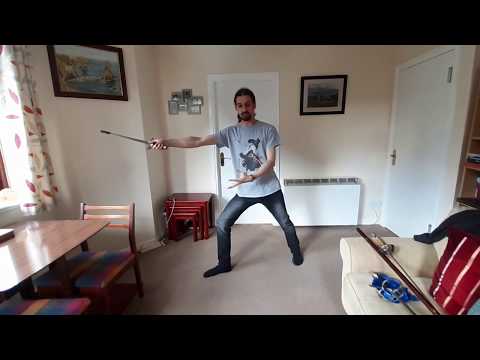
The second ERFA online tutorial video - now with better resolution! This time we look at how to practise the stoccata th…
Перевод: counter thrust
The Counter Thrust is a defensive-offensive action in rapier fencing where the fencer parries or evades an incoming attack and delivers an immediate thrust in response, embodying the principle of a single-tempo defence and attack. [1] The most effective counter-thrusts combine a blade displacement (parry) with a simultaneous extension of the point toward the opponent's exposed target, achieving both defence and offence in one motion. [1],[2] Italian masters term this the contratempo (counter-time), considered the highest expression of rapier skill. [2],[3]
Counter-attacking developed as a core fencing principle, with the Italian term controtempo and French arrêt describing the concept of hitting into the opponent's attack. [1]
Counter-attacks are a primary scoring method in Olympic épée competition and are also used in foil and sabre when timing is precise. [1]
Изображений для этой техники пока нет.
Войдите, чтобы предложить изображение.
The second ERFA online tutorial video - now with better resolution! This time we look at how to practise the stoccata th…
Get the NEW Kali Apex training course here: https://www.kalicenter.training/ And Join the APEX Members for continued tra…
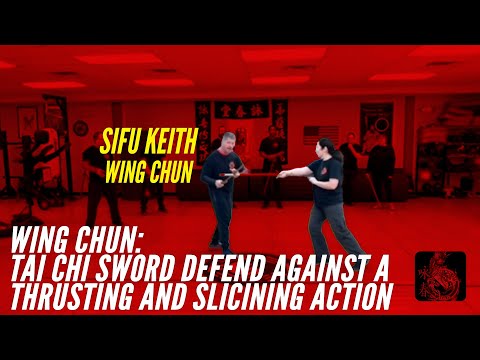
Welcome to today's Tai Chi sword training with Sifu Keith! In this lesson, we delve into essential techniques for defend…
Counter thrust techniques vary significantly across martial traditions but share core principles of defensive redirection and immediate offensive response. Sifu Keith (Wing Chun) emphasizes the 'carry' method against incoming thrusts, where the defender steps offline while guiding the opponent's blade across their body before executing a counter-cut. This approach applies equally to straight thrusts, horizontal slices, and vertical slices, using gentle guidance rather than forceful blocking—a principle articulated through the Cantonese term 'jerk' (to guide). The technique incorporates footwork to create distance and angle while maintaining blade contact. Kali Center's Paul Ingram addresses thrust fundamentals as foundational to counter-work, categorizing three basic thrust angles (center line, backhand, forehand) that inform defensive positioning and response selection. While Ingram focuses on initial thrust mechanics rather than explicit counters, his emphasis on coordination and weapon path awareness directly supports counter-thrust execution. Edinburgh Renaissance Fencing Academy's Greg demonstrates the stoccata thrust recovery and body mechanics central to Degrassi's system: elastic expansion of the torso, a short forward step, and controlled retraction back to guard. This recovery mechanism is inversely applicable to countering—the defender must recognize the opponent's expansion phase to time their deflection and counter-attack effectively. All three traditions emphasize economy of motion, footwork integration, and maintaining defensive readiness after the counter action.
Сформировано на основе 3 инструкторов
Учебных курсов по этой технике пока нет.
Войдите, чтобы предложить курс.
Риск травмы для человека, к которому применяется техника
Edged weapons cause fatal lacerations; historical battlefield mortality rates >30% (Amberger 1999)
Уровень мастерства, необходимый для надёжного выполнения техники
Разрешена ли техника по основным соревновательным правилам
The Art of Fencing (Luigi Barbasetti, 1932)
Alias sources — [1] The Sword and the Centuries (Castle, 1901) [2] Classical Fencing (Rogers, 2014) [3] Classical Fencing (Rogers, 2014)
Effectiveness sources — [1] The Art and Science of Fencing (Evangelista, 1996) [2] FIE technical guidelines
Mixed Japanese-Western terminology — combines traditional Japanese terms with katakana loanwords
Alias sources — [1] The Sword and the Centuries (Castle, 1901) [2] Classical Fencing (Rogers, 2014) [3] Classical Fencing (Rogers, 2014)
Effectiveness sources — [1] The Art and Science of Fencing (Evangelista, 1996) [2] FIE technical guidelines
wrist control for edge alignment, grip endurance, footwork precision
quick wrists, strong forearms, good posture
forearm extensors/flexors, deltoids, core, calves
At Kali Center, thrusting is viewed as the primary knife tactic, with slashing following as the secondary tactic.
Practice about 10-20 repetitions per side with your dominant hand first, then switch to your non-dominant hand, and then alternate between both sides to help your brain develop the coordination.
Make sure your weapon never intersects with any part of your own body during the technique—keep the blade path clear and go very slowly at first to prevent accidental cuts to yourself.
Yes—even experienced practitioners should regularly return to basic fundamentals and look for ways to refine and improve them over time.
The Counter Thrust is a defensive-offensive action in rapier fencing where the fencer parries or evades an incoming attack and delivers an immediate thrust in response, embodying the principle of a single-tempo defence and attack. The most effective counter-thrusts combine a blade displacement (parry) with a simultaneous extension of the point toward the opponent's exposed target, achieving both defence and offence in one motion.
Counter-thrust technique is described extensively in Italian rapier manuals, with Fabris devoting significant attention to the concept of contratempo as the ideal fencing action. The ability to defend and attack simultaneously was considered the mark of a master swordsman.
FIE: разрешён — Legal fencing technique — governed by FIE rules for foil, épée, and sabre; HEMA: разрешён — Legal in historical fencing competition
Оценка опасности 9/10. Extreme — edged weapons cause fatal lacerations; historical battlefield mortality rates >30% (Amberger 1999)
Стандартная цепочка подготовки: En Garde → Advance/Lunge Preparation → Attack → Recovery.
Стандартные контрприёмы: Beat Parry — deflect the blade with a sharp lateral beat before it reaches target / Displacement — move the body off the line while threatening with the point / Counter-Thrust — extend into the attacker's line during their advance.
Распространённые варианты: Standard cut (primary cutting angle from the ready stance); Thrust (tsuki) (straight thrust targeting the throat, chest, or face); Rising cut (kiri-age) (upward diagonal cut from low to high); Diagonal cut (kesa-giri) (downward diagonal cut following the kimono line).
Counter-attacks are a primary scoring method in Olympic épée competition and are also used in foil and sabre when timing is precise.
Основные ошибки, на которые стоит обратить внимание: Attempting the counter thrust without reading the opponent's attack — the specific attack must be identified to corre… / Timing the counter too late — the counter must arrive before or simultaneously with the attack / Not displacing the opponent's blade — the counter thrust must include a defensive element; simply thrusting forward i… / Using the counter thrust against feints — the counter thrust only works against committed attacks; feints draw it out….
Counter Thrust также известен как Kauntā Tsuki, Controcavazione, Counter-Disengage, Ricavazione.