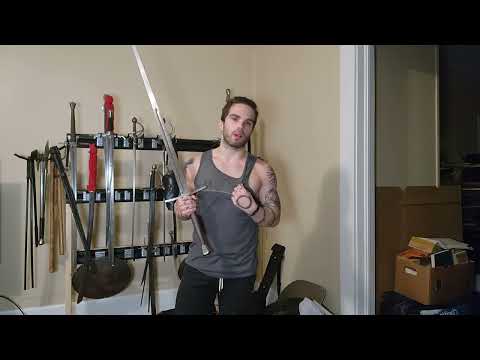
Rapier vs Longsword: mechanics
0
Rapier·Sellsword Arts
Help support us on Patreon! https://www.patreon.com/sellswordarts This Video is Powered by GFUEL Follow this link: http…
Перевод: rapier
The Rapier family covers the combat techniques of the rapier, the long, slender, thrusting-oriented sword that dominated European civilian swordsmanship from the mid-sixteenth through seventeenth centuries. [1] Rapier fencing developed into three major schools: the Italian school (Salvator Fabris, Ridolfo Capoferro, Francesco Alfieri), the Spanish school of Destreza (Jerónimo Sánchez de Carranza, Luis Pacheco de Narváez), and the various German, English, and French interpretations. [1],[2] Rapier technique emphasises thrusting over cutting, precise distance management (misura), the use of the off-hand or companion weapon (dagger, cloak, buckler) for defence, and a vocabulary of guards, invitations, and counter-attacks that directly prefigured modern sport fencing. [2],[3] HEMA rapier tournaments are among the most popular competitive events in the HEMA community. [3],[4]
The rapier evolved from the civilian side-sword (spada da lato) in the early sixteenth century as urban self-defence requirements favoured a lighter, thrust-oriented weapon. [1] Salvator Fabris published Lo Schermo (1606), one of the most influential rapier manuals, while Ridolfo Capoferro's Gran Simulacro (1610) provided a geometric and biomechanical analysis of rapier fencing. [2],[3] The Spanish school of Destreza, founded by Carranza in 1569, developed an independent system based on geometry and philosophy. [3],[4]
The rapier was the dominant civilian sidearm in Europe from the late 16th to early 18th centuries, optimised for thrusting in unarmoured combat. [1] Its longer blade and complex hilt provided superior reach and hand protection compared to earlier swords, making it the weapon of choice for duelling. [2] Italian masters demonstrated that the rapier's thrust was biomechanically faster and more lethal than cutting actions, establishing the primacy of the point in European swordsmanship. [3]
The rapier tradition was developed primarily by Italian masters, beginning with Camillo Agrippa's Trattato di Scienza d'Arme (1553), which introduced the four guards (prima through quarta) still used in modern fencing. [1] Ridolfo Capo Ferro's Gran Simulacro dell'Arte e dell'Uso della Scherma (1610) refined the lunge and measure system. [2] The Spanish school of Destreza, founded by Jerónimo Sánchez de Carranza (De la Filosofía de las Armas, 1569) and systematised by Luis Pacheco de Narváez, developed a geometrically-based approach to rapier combat. [3] Salvator Fabris's De lo Schermo (1606) served as the basis for the Scandinavian and German rapier traditions. [4]
Rapier combat is featured in HEMA tournaments worldwide, with dedicated rapier divisions at events like Swordfish (Sweden) and Longpoint (USA). [1]
Изображений для этой техники пока нет.
Войдите, чтобы предложить изображение.
Help support us on Patreon! https://www.patreon.com/sellswordarts This Video is Powered by GFUEL Follow this link: http…
Учебных курсов по этой технике пока нет.
Войдите, чтобы предложить курс.
Риск травмы для человека, к которому применяется техника
Edged weapons cause fatal lacerations; historical battlefield mortality rates >30% (Amberger 1999)
Уровень мастерства, необходимый для надёжного выполнения техники
Разрешена ли техника по основным соревновательным правилам
The Art of Fencing (Luigi Barbasetti, 1932)
Alias sources — [1] FIE Fencing Rules [2] MMA Instruction Manual (UFC, 2008) [3] MMA Instruction Manual (UFC, 2008)
Effectiveness sources — [1] Mondschein, K., The Knightly Art of Battle (Getty Publications, 2011) [2] Anglo, S., The Martial Arts of Renaissance Europe (Yale University Press, 2000) [3] Anglo, S., The Martial Arts of Renaissance Europe (Yale University Press, 2000)
Standard katakana transliteration of Western martial arts terminology (外来語) — used in Japanese MMA, boxing, and BJJ communities
Alias sources — [1] FIE Fencing Rules [2] MMA Instruction Manual (UFC, 2008) [3] MMA Instruction Manual (UFC, 2008)
Effectiveness sources — [1] Mondschein, K., The Knightly Art of Battle (Getty Publications, 2011) [2] Anglo, S., The Martial Arts of Renaissance Europe (Yale University Press, 2000) [3] Anglo, S., The Martial Arts of Renaissance Europe (Yale University Press, 2000)
wrist control for edge alignment, grip endurance, footwork precision
quick wrists, strong forearms, good posture
forearm extensors/flexors, deltoids, core, calves
Каждое движение в любом боевом искусстве обладает рядом универсальных свойств. Комбинируйте параметры ниже, чтобы найти нужный инструмент или сравнить аналоги из разных стилей.
The Rapier Cut subfamily covers the cutting actions of rapier fencing, which, though secondary to thrusting, were an important component of the rapier's tactical repertoire. [1] Rapier cuts are delivered with the edge in slashing or drawing motions, typically targeting the opponent's hand, wrist, or face — areas where a lighter cut can still be effective. [1,2] Italian masters such as Fabris described cuts as supplementary actions used to disrupt the opponent's guard or to create openings for thrusts. [2,3]
The Rapier Guard subfamily covers the four primary guard positions of Italian rapier fencing — Prima, Seconda, Terza, and Quarta — each named for the hand position (first through fourth) and corresponding to the four classical fencing invitations. [1] Each guard protects specific lines while threatening thrusts to others, and the system of four guards creates a comprehensive framework for controlling the engagement. [1,2] Salvator Fabris and Capoferro both describe these four guards as the foundation of rapier defence, with the choice of guard dictating available offensive and defensive options. [2,3]
The Rapier Thrust subfamily covers the thrusting techniques that form the core offensive repertoire of rapier fencing, the rapier being designed primarily as a thrusting weapon. [1] Italian rapier masters identified the straight thrust (stoccata), the disengage thrust (cavazione), and the counter-thrust as the primary offensive actions, supplemented by body-evasion techniques such as the lunge and the passata sotto. [1,2] The lunge — extending the front foot while pushing off the rear — was developed as the primary delivery system for rapier thrusts and remains the foundational offensive movement in all modern fencing. [2,3]
The rapier is the primary thrusting sword of the Italian and Spanish fencing traditions (16th–17th century). Documented in the treatises of Salvator Fabris, Ridolfo Capoferro, and Girard Thibault. Modern sport fencing descended from rapier traditions. (Clements, Medieval Swordsmanship; fencing history)
Rapier swordplay is primarily a dexterity-based discipline rather than strength-dependent, according to Sellsword Arts.
The Rapier family covers the combat techniques of the rapier, the long, slender, thrusting-oriented sword that dominated European civilian swordsmanship from the mid-sixteenth through seventeenth centuries. Rapier fencing developed into three major schools: the Italian school (Salvator Fabris, Ridolfo Capoferro, Francesco Alfieri), the Spanish school of Destreza (Jerónimo Sánchez de Carranza, Luis Pacheco de Narváez), and the various German, English, and French interpretations.
The rapier evolved from the civilian side-sword (spada da lato) in the early sixteenth century as urban self-defence requirements favoured a lighter, thrust-oriented weapon. Salvator Fabris published Lo Schermo (1606), one of the most influential rapier manuals, while Ridolfo Capoferro's Gran Simulacro (1610) provided a geometric and biomechanical analysis of rapier fencing.
FIE: разрешён — Legal fencing technique — governed by FIE rules for foil, épée, and sabre; HEMA: разрешён — Legal in historical fencing competition
Оценка опасности 9/10. Extreme — edged weapons cause fatal lacerations; historical battlefield mortality rates >30% (Amberger 1999)
Стандартная цепочка подготовки: Assume Guard (Kamae/Hut) → Measure Distance (Ma-ai) → Initiate Cut/Thrust → Follow Through (Zanshin).
Стандартные контрприёмы: Parry (Absetzen) — deflect the incoming blade with a counter-displacement / Void (Step Back) — withdraw from measure to avoid the cutting arc / Counter-Cut (Nachreisen) — strike into the opponent's opening during their attack.
Распространённые варианты: Standard cut (primary cutting angle from the ready stance); Thrust (tsuki) (straight thrust targeting the throat, chest, or face); Rising cut (kiri-age) (upward diagonal cut from low to high); Diagonal cut (kesa-giri) (downward diagonal cut following the kimono line).
Rapier combat is featured in HEMA tournaments worldwide, with dedicated rapier divisions at events like Swordfish (Sweden) and Longpoint (USA).
Основные ошибки, на которые стоит обратить внимание: Using wide, sweeping cuts with the rapier — the rapier is primarily a thrusting weapon; cuts are secondary and should… / Fighting at close range with the rapier — the rapier's advantage is reach; maintain distance / Not using the off-hand — many rapier traditions include a dagger, buckler, or cloak in the off-hand / Holding the rapier with a death grip — the grip must allow fine point control for accurate thrusting.
Rapier также известен как Reipia, Rapier Fencing, Renaissance Swordsmanship, Destreza.