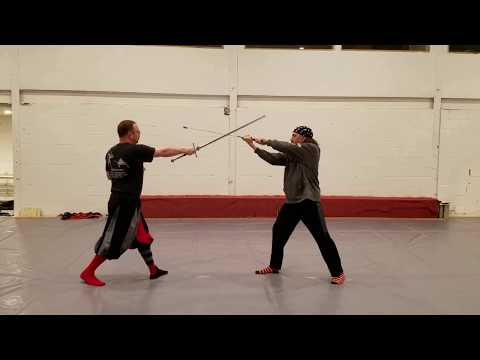
Layers of Liechtenauer's Fight: Zwerchau
0
Liechtenauer Cut·The Historical Fencing Channel
In this video, we discuss our interpretation of the Zwerchau, it's functions and the plays which its sets up. e ave no g…
Перевод: Liechtenauer cut
The Liechtenauer Cut subfamily covers the primary cutting techniques of HEMA longsword fencing, anchored in the German tradition's five master cuts (Fünf Meisterhäue) — Zornhau, Krumphau, Zwerchhau, Schielhau, and Scheitelhau — along with the fundamental Oberhau (descending cut) and Unterhau (rising cut). [1] Each master cut is not merely a strike but a complete tactical concept that simultaneously attacks and defends by displacing the opponent's blade while cutting to an opening. [1],[2] The principle of Indes (meanwhile) teaches that cuts must flow without pause from one action to the next, maintaining constant pressure. [2],[3]
The five master cuts are attributed to Johannes Liechtenauer and were extensively glossed by his students in the fifteenth century, forming the technical core of the German longsword tradition. [1] The master cuts were considered 'secret' techniques transmitted only to worthy students, as recorded in Ringeck's and von Danzig's glosses. [2],[3]
The Liechtenauer cutting system uses five master cuts (Meisterhäue)—Zwerchau, Krumphau, Schielhau, Scheitelhau, and Zornhau—each designed to counter specific guards while simultaneously attacking. [1]
Liechtenauer cuts are the primary offensive techniques in HEMA longsword competition, with the Zornhau and Zwerchau being the most commonly used. [1]
Изображений для этой техники пока нет.
Войдите, чтобы предложить изображение.
In this video, we discuss our interpretation of the Zwerchau, it's functions and the plays which its sets up. e ave no g…
Учебных курсов по этой технике пока нет.
Войдите, чтобы предложить курс.
Риск травмы для человека, к которому применяется техника
Edged weapons cause fatal lacerations; historical battlefield mortality rates >30% (Amberger 1999)
Уровень мастерства, необходимый для надёжного выполнения техники
Разрешена ли техника по основным соревновательным правилам
The Art of Combat (Joachim Meyer, 1570)
Alias sources — [1] Sigmund Ringeck's Knightly Arts of Combat [2] Sigmund Ringeck's Knightly Arts of Combat [3] Sigmund Ringeck's Knightly Arts of Combat
Effectiveness sources — [1] Fighting with the German Longsword (Tobler, 2004)
Mixed Japanese-Western terminology — combines traditional Japanese terms with katakana loanwords
Alias sources — [1] Sigmund Ringeck's Knightly Arts of Combat [2] Sigmund Ringeck's Knightly Arts of Combat [3] Sigmund Ringeck's Knightly Arts of Combat
Effectiveness sources — [1] Fighting with the German Longsword (Tobler, 2004)
wrist control for edge alignment, grip endurance, footwork precision
quick wrists, strong forearms, good posture
forearm extensors/flexors, deltoids, core, calves
Каждое движение в любом боевом искусстве обладает рядом универсальных свойств. Комбинируйте параметры ниже, чтобы найти нужный инструмент или сравнить аналоги из разных стилей.
The Crooked Cut, delivered with crossed wrists to strike with the short edge, used to break the opponent's Ochs guard.
The Oberhau (descending cut) is the fundamental overhead cut of German longsword fencing, delivered from a high guard (Vom Tag or similar) downward to the opponent's head, shoulder, or arm. [1] The Oberhau is the most natural and powerful longsword cut, using gravity and the full range of shoulder rotation to generate force. [1,2] Liechtenauer's system uses the Oberhau as the basis of the Zornhau (wrath cut), the first and most important of the five master cuts. [2,3]
The Unterhau (rising cut) travels from below upward, targeting the opponent's arms, chin, or torso from a low guard (Alber or similar). [1] The Unterhau is the natural complement to the Oberhau, and alternating between descending and rising cuts creates the continuous cutting flow that characterises German longsword fencing. [1,2] Though less powerful than the Oberhau, the Unterhau attacks from an unexpected angle and is effective against opponents in high guards. [2,3]
The Zornhau (wrath cut) is the first and most important of Liechtenauer's five master cuts — a powerful diagonal descending cut from the dominant shoulder to the opponent's opposite side, delivered with an aggressive step forward. [1] The Zornhau is not simply a strong cut; it is designed to simultaneously attack the opponent and displace their incoming cut by crossing their blade en route to the target. [1,2] From the Zornhau bind (where the swords cross), the fencer transitions into winding, thrusting, or further cutting based on the opponent's reaction. [2,3]
The Zwerchhau (cross cut or thwart cut) is a horizontal cut delivered with the short edge (false edge) by rotating the hands so the hilt rises and the blade travels horizontally across the opponent's head or body. [1] The Zwerchhau is the master cut that specifically counters attacks from Vom Tag (high guard) and overhead positions, as the horizontal trajectory naturally passes beneath a descending blade while simultaneously striking the opponent's temple. [1,2] The Zwerchhau also serves as a powerful entry into grappling range because of its body rotation and forward step. [2,3]
According to The Historical Fencing Channel, if your opponent gains a strong angle on your sword in response to your cut, striking a second cut to the other side isn't optimal. Instead, you should change your line of attack to the other side to draw that strong parry away, then immediately change your line again on the opposite side.
The Historical Fencing Channel explains that weak parries aren't necessarily bad—there's just a different set of techniques to use. If your opponent parries weakly and begins to lift your sword, you can rush in and throw your sword behind his neck with the short edge, using your strong position at the cross guard to control his sword.
According to The Historical Fencing Channel, if your opponent tries to throw you with the short edge along your neck after you parry weakly, lift your pommel up and thrust down along the sword, then strike with the short edge along his neck to neutralize both the throw and any hand control he's gained.
The Liechtenauer Cut subfamily covers the primary cutting techniques of HEMA longsword fencing, anchored in the German tradition's five master cuts (Fünf Meisterhäue) — Zornhau, Krumphau, Zwerchhau, Schielhau, and Scheitelhau — along with the fundamental Oberhau (descending cut) and Unterhau (rising cut). Each master cut is not merely a strike but a complete tactical concept that simultaneously attacks and defends by displacing the opponent's blade while cutting to an opening.
The five master cuts are attributed to Johannes Liechtenauer and were extensively glossed by his students in the fifteenth century, forming the technical core of the German longsword tradition. The master cuts were considered 'secret' techniques transmitted only to worthy students, as recorded in Ringeck's and von Danzig's glosses.
FIE: разрешён — Legal fencing technique — governed by FIE rules for foil, épée, and sabre; HEMA: разрешён — Legal in historical fencing competition
Оценка опасности 9/10. Extreme — edged weapons cause fatal lacerations; historical battlefield mortality rates >30% (Amberger 1999)
Стандартная цепочка подготовки: Assume Guard (Kamae/Hut) → Measure Distance (Ma-ai) → Initiate Cut/Thrust → Follow Through (Zanshin).
Стандартные контрприёмы: Parry (Absetzen) — deflect the incoming blade with a counter-displacement / Void (Step Back) — withdraw from measure to avoid the cutting arc / Counter-Cut (Nachreisen) — strike into the opponent's opening during their attack.
Распространённые варианты: Standard cut (primary cutting angle from the ready stance); Thrust (tsuki) (straight thrust targeting the throat, chest, or face); Rising cut (kiri-age) (upward diagonal cut from low to high); Diagonal cut (kesa-giri) (downward diagonal cut following the kimono line).
Liechtenauer cuts are the primary offensive techniques in HEMA longsword competition, with the Zornhau and Zwerchau being the most commonly used.
Основные ошибки, на которые стоит обратить внимание: Treating the master cuts as simple swings — each cut is a complex technique with specific mechanics, targets, and tac… / Not understanding which guard each cut counters — the cuts exist to solve specific problems; know the problems / Using only one or two cuts — the full system requires all five master cuts plus the basic cuts / Cutting without understanding the simultaneous defence — each cut should displace the opponent's sword while attacking.
Liechtenauer Cut также известен как Rihitenauā Kiri, Meisterhau, Master Cut, Liechtenauer's Five Cuts.