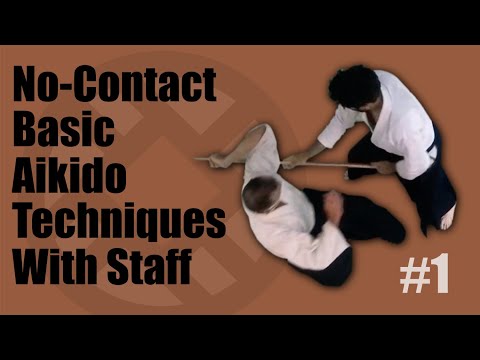
No-contact Basic Aikido Techniques #1 - With Jo
0
Standard Jo Block·Tampa Aikido
Many Aikido schools are planning for phased options during the progress of the COVID19 pandemic, and are looking for tra…
Перевод: Basic Short Staff Block
The standard jo block represents the foundational defensive technique in jojutsu, appearing in the first Seitei Jodo kata (Tsuki-zue) and in numerous Shinto Muso-ryu techniques. [1] The block is executed by holding the jo in a two-handed grip and positioning it to intercept the descending sword cut, absorbing force along the staff's axis. [2] This fundamental receiving action embodies the core principle of jojutsu: using the jo's speed and versatility to neutralise the sword's cutting power before immediately transitioning to a counter-attack. [2]
The standard jō block is the fundamental defensive technique in jōjutsu/jōdō, intercepting sword attacks with the short staff. [1]
Standard jō blocking technique was systematised within the Shintō Musō-ryū and incorporated into modern AJKF jōdō. [1]
Standard jō blocks are performed in AJKF jōdō kata competition. [1]
Изображений для этой техники пока нет.
Войдите, чтобы предложить изображение.
Many Aikido schools are planning for phased options during the progress of the COVID19 pandemic, and are looking for tra…
📥 ACCESS THE CLASSIFIED ARCHIVES: 📂 VOL. I // STRUCTURAL NEGATION (Bone & Joint) Break the hardware. Learn how to dis…
Get your Quantum Cane Masters Staffs here: https://canemasters.com/collections/walking-sticks-and-walking-staffs?ref=GpL…
The standard jo block is a defensive technique using the Japanese short staff (jo) to intercept and deflect incoming attacks. According to Matt Pasquinilli, the foundational blocking mechanics involve positioning the staff between defender and opponent, with hand placement controlling both the angle and power of the deflection. The technique emphasizes pushing attacks off the center line rather than meeting force directly, particularly important when defending against bladed weapons that could damage the staff if struck edge-on. Pasquinilli details specific hand positioning: the back hand turns palm-up while the front hand turns palm-down, creating a pushing motion behind the body before transitioning into counterattacks. The block can be executed at various angles—straight down the middle, to the temple, clavicle, ribs, or knee—with the top hand controlling trajectory and the bottom hand generating primary power. Pasquinilli stresses continuous hand contact with the weapon to prevent disarming and demonstrates fluid transitions from blocking into spearing strikes and overhead strikes. The Tampa Aikido video provides no usable transcript content for analysis. The Master Yourself video on pressure points, while addressing general self-defense principles, does not specifically address jo blocking mechanics or staff-weapon defensive techniques, making it not directly applicable to this technique's synthesis.
Сформировано на основе 3 инструкторов
Учебных курсов по этой технике пока нет.
Войдите, чтобы предложить курс.
Риск травмы для человека, к которому применяется техника
Staff/bo/jo weapons generate significant blunt force; fracture risk
Уровень мастерства, необходимый для надёжного выполнения техники
Разрешена ли техника по основным соревновательным правилам
The Essence of Okinawan Karate-Do (Shoshin Nagamine, 1976)
Alias sources — [1] Kobudo: Okinawan Weapons (Demura, 1976) [2] Comprehensive Asian Fighting Arts (Draeger & Smith, 1969) [3] Comprehensive Asian Fighting Arts (Draeger & Smith, 1969)
History sources — [1] Krieger, P., The Jo: Art of the Japanese Short Staff (Koryu Books, 1989) [2] Draeger, D., Classical Bujutsu (Weatherhill, 1973)
Established Japanese martial arts naming convention — native Japanese term (和語/漢語)
Alias sources — [1] Kobudo: Okinawan Weapons (Demura, 1976) [2] Comprehensive Asian Fighting Arts (Draeger & Smith, 1969) [3] Comprehensive Asian Fighting Arts (Draeger & Smith, 1969)
History sources — [1] Krieger, P., The Jo: Art of the Japanese Short Staff (Koryu Books, 1989) [2] Draeger, D., Classical Bujutsu (Weatherhill, 1973)
wrist control for edge alignment, grip endurance, footwork precision
quick wrists, strong forearms, good posture
forearm extensors/flexors, deltoids, core, calves
According to Matt Pasquinilli, you should practice changing hand positions without ever taking your hands off the weapon by sliding one hand over the other. This continuous contact with the staff makes it much harder for an opponent to knock it away or disarm you.
Matt Pasquinilli teaches positioning your hand at the end of the staff with your palm up or down, keeping your back leg back, then stepping forward to block while maintaining hand contact along the length of the staff throughout the motion.
Matt Pasquinilli emphasizes controlling the angle of attack with your top hand while applying forward pressure with your bottom hand, allowing you to strike targets straight down the middle or at angles to the temple, clavicle, ribs, or knee.
Matt Pasquinilli notes that hitting the side of the blade is critical because blades are typically only sharp on one or two sides—not the edge you're targeting—so strike the flat side of the blade rather than attempting to block the sharp edge directly.
Fundamental blocking technique using the jo shaft to receive and redirect an incoming sword or staff attack.
The standard jo block represents the foundational defensive technique in jojutsu, appearing in the first Seitei Jodo kata (Tsuki-zue) and in numerous Shinto Muso-ryu techniques. The block is executed by holding the jo in a two-handed grip and positioning it to intercept the descending sword cut, absorbing force along the staff's axis.
Traditional martial arts: разрешён — Practiced in traditional kata/forms and weapon-specific competition under var…; IWUF: разрешён — Legal in wushu taolu if applicable; HEMA: разрешён — Legal in applicable historical weapon categories
Оценка опасности 7/10. Very High — staff/bo/jo weapons generate significant blunt force; fracture risk
Стандартная цепочка подготовки: Assume Guard (Kamae/Hut) → Measure Distance (Ma-ai) → Initiate Cut/Thrust → Follow Through (Zanshin).
Стандартные контрприёмы: Parry (Absetzen) — deflect the incoming blade with a counter-displacement / Void (Step Back) — withdraw from measure to avoid the cutting arc / Counter-Cut (Nachreisen) — strike into the opponent's opening during their attack.
Распространённые варианты: Standard cut (primary cutting angle from the ready stance); Thrust (tsuki) (straight thrust targeting the throat, chest, or face); Rising cut (kiri-age) (upward diagonal cut from low to high); Diagonal cut (kesa-giri) (downward diagonal cut following the kimono line).
Standard jō blocks are performed in AJKF jōdō kata competition.
Основные ошибки, на которые стоит обратить внимание: Receiving the strike at 90 degrees — a perpendicular block absorbs maximum impact; angle the jo to deflect / Not stepping offline — the body must move off the attack line; relying on the block alone risks being overpowered / Keeping the rear hand passive — the rear hand drives the counter-thrust; it must be active and ready / Gripping too tightly — the hands need to slide and adjust during and after the block; a rigid grip prevents this.
Standard Jo Block также известен как Jodan Jo Uke, Basic Jo Block, Standard Jodo Block.