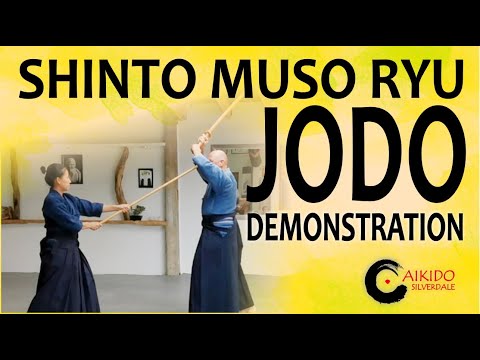
SHINTO MUSO RYU JODO DEMONSTRATION | JODO AUCKLAND
0
Jo Block·AIKIDO SILVERDALE
A demonstration of Shinto Muso Ryu Jodo, a purely kata based art, from the team at Jodo Auckland. PLEASE SUBSCRIBE! htt…
Перевод: Short Staff Blocks
Jo blocking techniques derive from the Shinto Muso-ryu tradition, where the jo was specifically designed to counter sword attacks. [1] Krieger describes how the jo's defensive methods exploit its manoeuvrability — the shorter length allows rapid repositioning to intercept cuts from any angle, while the rounded cross-section prevents the blade from biting into the wood as deeply as it would a flat surface. [2] Blocking forms are preserved in the twelve Seitei Jodo kata adopted by the All Japan Kendo Federation. [1]
Jō blocks intercept incoming sword attacks, using the staff's durability and the practitioner's positioning to neutralise cuts and thrusts. [1]
Jō blocking techniques were designed specifically to counter the Japanese sword, forming the defensive foundation of Shintō Musō-ryū jōjutsu. [1]
Jō blocking is demonstrated in AJKF jōdō competition (kata format) and koryū jōjutsu embu. [1]
Изображений для этой техники пока нет.
Войдите, чтобы предложить изображение.
A demonstration of Shinto Muso Ryu Jodo, a purely kata based art, from the team at Jodo Auckland. PLEASE SUBSCRIBE! htt…
Учебных курсов по этой технике пока нет.
Войдите, чтобы предложить курс.
Риск травмы для человека, к которому применяется техника
Staff/bo/jo weapons generate significant blunt force; fracture risk
Уровень мастерства, необходимый для надёжного выполнения техники
Разрешена ли техника по основным соревновательным правилам
The Essence of Okinawan Karate-Do (Shoshin Nagamine, 1976)
Alias sources — [1] Kobudo: Okinawan Weapons (Demura, 1976) [2] Comprehensive Asian Fighting Arts (Draeger & Smith, 1969) [3] Comprehensive Asian Fighting Arts (Draeger & Smith, 1969)
History sources — [1] Draeger, D., Classical Bujutsu (Weatherhill, 1973) [2] Krieger, P., The Jo: Art of the Japanese Short Staff (Koryu Books, 1989)
Established Japanese martial arts naming convention — native Japanese term (和語/漢語)
Alias sources — [1] Kobudo: Okinawan Weapons (Demura, 1976) [2] Comprehensive Asian Fighting Arts (Draeger & Smith, 1969) [3] Comprehensive Asian Fighting Arts (Draeger & Smith, 1969)
History sources — [1] Draeger, D., Classical Bujutsu (Weatherhill, 1973) [2] Krieger, P., The Jo: Art of the Japanese Short Staff (Koryu Books, 1989)
wrist control for edge alignment, grip endurance, footwork precision
quick wrists, strong forearms, good posture
forearm extensors/flexors, deltoids, core, calves
Каждое движение в любом боевом искусстве обладает рядом универсальных свойств. Комбинируйте параметры ниже, чтобы найти нужный инструмент или сравнить аналоги из разных стилей.
Defensive techniques using the jo to intercept sword strikes, a core element of jo-versus-sword kata.
Jo blocking techniques derive from the Shinto Muso-ryu tradition, where the jo was specifically designed to counter sword attacks. Krieger describes how the jo's defensive methods exploit its manoeuvrability — the shorter length allows rapid repositioning to intercept cuts from any angle, while the rounded cross-section prevents the blade from biting into the wood as deeply as it would a flat surface.
Traditional martial arts: разрешён — Practiced in traditional kata/forms and weapon-specific competition under var…; IWUF: разрешён — Legal in wushu taolu if applicable; HEMA: разрешён — Legal in applicable historical weapon categories
Оценка опасности 7/10. Very High — staff/bo/jo weapons generate significant blunt force; fracture risk
Стандартная цепочка подготовки: Assume Guard (Kamae/Hut) → Measure Distance (Ma-ai) → Initiate Cut/Thrust → Follow Through (Zanshin).
Стандартные контрприёмы: Parry (Absetzen) — deflect the incoming blade with a counter-displacement / Void (Step Back) — withdraw from measure to avoid the cutting arc / Counter-Cut (Nachreisen) — strike into the opponent's opening during their attack.
Распространённые варианты: Standard cut (primary cutting angle from the ready stance); Thrust (tsuki) (straight thrust targeting the throat, chest, or face); Rising cut (kiri-age) (upward diagonal cut from low to high); Diagonal cut (kesa-giri) (downward diagonal cut following the kimono line).
Jō blocking is demonstrated in AJKF jōdō competition (kata format) and koryū jōjutsu embu.
Основные ошибки, на которые стоит обратить внимание: Blocking too far from the body — keep the jo close enough that the block has structural support from the body / Using only two-handed blocks — the jo's one-handed blocking capability is a major advantage; train both / Not shifting the grip after blocking — the jo grip must adjust for the counter-technique that follows the block / Meeting sword cuts directly — the jo should deflect sword attacks at an angle, not absorb the full cutting force.
Jo Block также известен как Jo Uke, Short Staff Block, Jodo Uke.