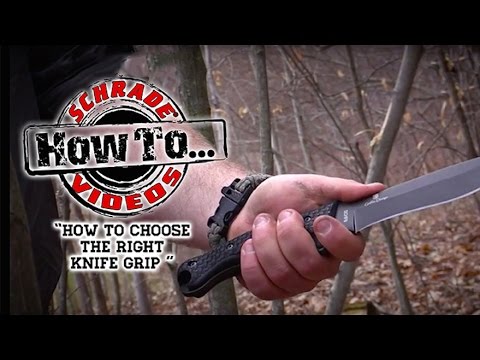
How To Choose the Right Knife Grip
0
Knife Grip·Schrade Knives
In this Schrade Quick Tip video we’re going to take a look at a few different knife grips that can be used to save time …
Перевод: knife grip
The Knife Grip subfamily covers the fundamental ways a combatant holds a knife, each grip offering distinct advantages for cutting, thrusting, retention, and transitional actions. [1] The two primary knife grips are the forward (saber/hammer) grip and the reverse (icepick) grip, with each grip favouring different angles of attack and defensive capabilities. [1],[2] Filipino martial arts and modern tactical knife systems also train grip transitions — switching between forward and reverse grip mid-combat to adapt to changing distances and angles. [2],[3]
Knife grip methodology has been studied wherever blades are used in combat, with Filipino martial arts developing the most detailed grip-transition training. [1] Modern tactical knife instructors such as Michael Janich and Kelly McCann have systematised grip selection based on threat assessment and intended application. [2],[3]
Knife grip selection (forward/hammer, reverse/ice-pick, and variations) directly determines the available techniques and range of the knife fighter. [1]
Different knife-fighting traditions emphasise different grips: FMA uses both forward and reverse, silat favours reverse grip with the kerambit, and Western combatives typically use the forward grip. [1]
Knife grip techniques are demonstrated and applied in FMA competition and training events. [1]
Изображений для этой техники пока нет.
Войдите, чтобы предложить изображение.
In this Schrade Quick Tip video we’re going to take a look at a few different knife grips that can be used to save time …
Учебных курсов по этой технике пока нет.
Войдите, чтобы предложить курс.
Риск травмы для человека, к которому применяется техника
Knives and short blades are the most common weapon in real-world assaults; high lethality
Уровень мастерства, необходимый для надёжного выполнения техники
Разрешена ли техника по основным соревновательным правилам
Bubishi: The Classic Manual of Combat (Patrick McCarthy, 2008)
Alias sources — [1] Filipino Martial Arts (Wiley, 1994) [2] Hoplology (Burton, 1884) [3] Comprehensive Asian Fighting Arts (Draeger & Smith, 1969)
Effectiveness sources — [1] Filipino Martial Arts (Wiley, 1997)
Standard katakana transliteration of Western martial arts terminology (外来語) — used in Japanese MMA, boxing, and BJJ communities
Alias sources — [1] Filipino Martial Arts (Wiley, 1994) [2] Hoplology (Burton, 1884) [3] Comprehensive Asian Fighting Arts (Draeger & Smith, 1969)
Effectiveness sources — [1] Filipino Martial Arts (Wiley, 1997)
wrist control for edge alignment, grip endurance, footwork precision
quick wrists, strong forearms, good posture
forearm extensors/flexors, deltoids, core, calves
Каждое движение в любом боевом искусстве обладает рядом универсальных свойств. Комбинируйте параметры ниже, чтобы найти нужный инструмент или сравнить аналоги из разных стилей.
The Forward Grip (also called saber grip or hammer grip) holds the knife with the blade extending from the thumb side of the fist, as one would hold a hammer. [1] This grip provides the greatest reach, strong thrusting capability, and intuitive cutting motions along all standard angles of attack. [1,2] The forward grip is the most commonly taught knife grip in both military combatives and Filipino martial arts because of its versatility and natural biomechanics. [2,3]
The Reverse Grip (also called icepick grip) holds the knife with the blade extending from the little-finger side of the fist, point downward. [1] This grip excels at close-range downward stabs, hooking cuts, and weapon retention, as the blade is difficult to strip when held this way. [1,2] Filipino martial arts systems like Pekiti-Tirsia Kali use the reverse grip extensively for close-quarters combat and for pakal (reverse-grip) drills that develop fluid slashing and trapping combinations. [2,3]
Always be aware of others within arm's reach, never cut towards yourself, and avoid carving in the triangle area formed between your knees and crotch, as a knife wound there could prove fatal. If you find yourself cutting toward yourself, stop and switch to a safer grip.
Stop immediately and think of another grip to accomplish the task in a safer way rather than continuing with an unsafe cutting angle.
The Knife Grip subfamily covers the fundamental ways a combatant holds a knife, each grip offering distinct advantages for cutting, thrusting, retention, and transitional actions. The two primary knife grips are the forward (saber/hammer) grip and the reverse (icepick) grip, with each grip favouring different angles of attack and defensive capabilities.
Knife grip methodology has been studied wherever blades are used in combat, with Filipino martial arts developing the most detailed grip-transition training. Modern tactical knife instructors such as Michael Janich and Kelly McCann have systematised grip selection based on threat assessment and intended application.
WEKAF: разрешён — Legal in padded stick competition; HEMA: разрешён — Legal in applicable weapon categories
Оценка опасности 9/10. Extreme — knives and short blades are the most common weapon in real-world assaults; high lethality
Стандартная цепочка подготовки: Ready Position → Distance Control → Execute Technique → Return to Guard.
Стандартные контрприёмы: Parry (Absetzen) — deflect the incoming blade with a counter-displacement / Void (Step Back) — withdraw from measure to avoid the cutting arc / Counter-Cut (Nachreisen) — strike into the opponent's opening during their attack.
Распространённые варианты: Standard cut (primary cutting angle from the ready stance); Thrust (tsuki) (straight thrust targeting the throat, chest, or face); Rising cut (kiri-age) (upward diagonal cut from low to high); Diagonal cut (kesa-giri) (downward diagonal cut following the kimono line).
Knife grip techniques are demonstrated and applied in FMA competition and training events.
Основные ошибки, на которые стоит обратить внимание: Gripping too tightly — a rigid hand fatigues quickly and prevents smooth technique execution / Using only one grip exclusively — both grips have applications; limiting to one reduces the tactical toolkit / Holding the blade with fingers extended beyond the guard — exposed fingers are vulnerable to being cut / Not aligning the edge properly — the cutting edge must be oriented correctly for the intended technique.
Knife Grip также известен как Naifu Gurippu, Hawakan, Knife Hold, Blade Grip.