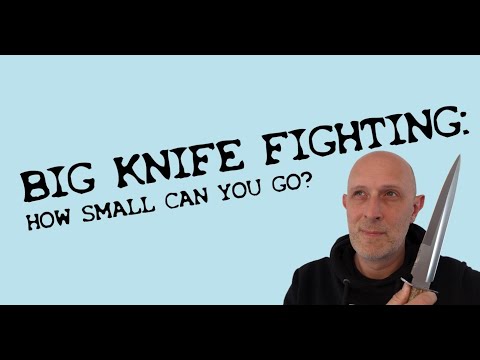
Big Knife Fighting VS Small Knife Fighting
0
Knife Fighting·scholagladiatoria
I strongly believe that the size of a knife has a large effect on the best ways of using it, and large knives, such as B…
Перевод: knife fighting
The Knife Fighting family covers combat systems that employ a single-edged knife as the primary weapon, spanning traditions from Filipino martial arts to Russian military knife combat and modern self-defence curricula. [1] Unlike dagger techniques that are primarily thrust-oriented, knife fighting encompasses a full range of cuts (slashes, backhand cuts, upward cuts), thrusts, grip changes, and defensive disarm techniques. [1],[2] Filipino martial arts — particularly Pekiti-Tirsia Kali, Sayoc Kali, and Balintawak — have produced the most technically elaborate knife-fighting curricula, organising techniques around angles of attack and fluid grip transitions. [2],[3] Knife fighting is also studied within Krav Maga, the Russian Systema, and various military combatives programs as a practical close-quarters combat skill. [3],[4]
Knife combat is as old as edged weapons themselves, but systematic training methods were first documented in the Filipino martial arts, where the knife (baraw or daga) is a foundational weapon. [1] In the twentieth century, William Fairbairn and Eric Sykes developed the Fairbairn–Sykes fighting knife and an accompanying combatives method for British commandos during World War II. [2],[3] Russian Spetsnaz knife work, Israeli Krav Maga knife defence, and Filipino martial arts knife curricula form the three major modern lineages of systematic knife-fighting training. [3],[4]
Knife fighting systems are among the most practical close-quarters weapon arts because the knife is ubiquitous, easily concealed, and requires minimal training for basic lethality. [1] Filipino, Indonesian (silat), and Russian (Systema/military sambo) knife systems are the most systematically developed. [2] Modern military and law enforcement combatives universally incorporate knife defence training, reflecting the knife's prevalence as a weapon in real-world violent encounters. [2]
Knife-fighting competition exists in FMA tournaments (dagger divisions) and some reality-based self-defence events using training knives. [1]
Изображений для этой техники пока нет.
Войдите, чтобы предложить изображение.
I strongly believe that the size of a knife has a large effect on the best ways of using it, and large knives, such as B…
Учебных курсов по этой технике пока нет.
Войдите, чтобы предложить курс.
Риск травмы для человека, к которому применяется техника
Knives and short blades are the most common weapon in real-world assaults; high lethality
Уровень мастерства, необходимый для надёжного выполнения техники
Разрешена ли техника по основным соревновательным правилам
Bubishi: The Classic Manual of Combat (Patrick McCarthy, 2008)
Alias sources — [1] MMA Instruction Manual (UFC, 2008) [2] MMA Instruction Manual (UFC, 2008) [3] MMA Instruction Manual (UFC, 2008)
Effectiveness sources — [1] Draeger, D. & Smith, R., Comprehensive Asian Fighting Arts (Kodansha, 1969) [2] Wiley, M., Filipino Martial Arts (Charles E. Tuttle, 1994)
Standard katakana transliteration of Western martial arts terminology (外来語) — used in Japanese MMA, boxing, and BJJ communities
Alias sources — [1] MMA Instruction Manual (UFC, 2008) [2] MMA Instruction Manual (UFC, 2008) [3] MMA Instruction Manual (UFC, 2008)
Effectiveness sources — [1] Draeger, D. & Smith, R., Comprehensive Asian Fighting Arts (Kodansha, 1969) [2] Wiley, M., Filipino Martial Arts (Charles E. Tuttle, 1994)
wrist control for edge alignment, grip endurance, footwork precision
quick wrists, strong forearms, good posture
forearm extensors/flexors, deltoids, core, calves
Каждое движение в любом боевом искусстве обладает рядом универсальных свойств. Комбинируйте параметры ниже, чтобы найти нужный инструмент или сравнить аналоги из разных стилей.
The Knife Cut subfamily covers all cutting and slashing actions performed with a knife, as distinct from thrusting techniques. [1] Knife cuts employ the edge of the blade in sweeping, arcing, or hooking motions to target the opponent's limbs, neck, and torso. [1,2] Filipino martial arts organise knife cuts around numbered angles of attack (typically five or twelve angles), ensuring that all lines of cutting are systematically trained. [2,3]
The Knife Defence-Disarm subfamily covers techniques for defending against a knife attack and stripping the weapon from the attacker's hand. [1] Disarm techniques typically combine a parry or redirect of the attacking arm with a joint lock, wrist manipulation, or leveraged strip that forces the knife free. [1,2] Filipino martial arts, Krav Maga, and Hapkido all include extensive knife-disarm curricula, though the tactical philosophies differ significantly between systems. [2,3]
The Knife Grip subfamily covers the fundamental ways a combatant holds a knife, each grip offering distinct advantages for cutting, thrusting, retention, and transitional actions. [1] The two primary knife grips are the forward (saber/hammer) grip and the reverse (icepick) grip, with each grip favouring different angles of attack and defensive capabilities. [1,2] Filipino martial arts and modern tactical knife systems also train grip transitions — switching between forward and reverse grip mid-combat to adapt to changing distances and angles. [2,3]
The Knife Thrust subfamily covers all stabbing and piercing actions performed with a knife, where the point of the blade is driven directly into the target. [1] Thrusting is biomechanically the most efficient knife action for penetrating force, requiring less space and travel distance than a cut. [1,2] Military combatives systems emphasise the thrust as the primary lethal knife technique due to its speed, directness, and difficulty to detect and parry. [2,3]
Knife fighting appears in 261 passages across 39 books. One of the most extensively documented weapon categories due to its self-defense relevance. Filipino martial arts (Kali/Eskrima) have the most developed knife fighting systems. (39 books; FMA manuals; military combatives texts)
According to Schola Gladiatoria, blade length is critical for defensive maneuvers where you cut into incoming attacks. Around six inches is roughly the minimum, but nine to nine-and-a-half inches is preferred because it gives you enough blade and leverage to reliably interpose and defend against attacks.
Schola Gladiatoria explains that blade length directly relates to margins of error—when the blade is too short, it becomes too risky to perform defensive cuts against incoming attacks because you lack sufficient blade to reliably execute them.
According to Schola Gladiatoria, a K-Bar (approximately six inches) is technically usable for knife fighting, but with a shorter blade you need to engage the opponent's attacks in different ways rather than relying on blade-to-blade interceptions.
The Knife Fighting family covers combat systems that employ a single-edged knife as the primary weapon, spanning traditions from Filipino martial arts to Russian military knife combat and modern self-defence curricula. Unlike dagger techniques that are primarily thrust-oriented, knife fighting encompasses a full range of cuts (slashes, backhand cuts, upward cuts), thrusts, grip changes, and defensive disarm techniques.
Knife combat is as old as edged weapons themselves, but systematic training methods were first documented in the Filipino martial arts, where the knife (baraw or daga) is a foundational weapon. In the twentieth century, William Fairbairn and Eric Sykes developed the Fairbairn–Sykes fighting knife and an accompanying combatives method for British commandos during World War II.
WEKAF: разрешён — Legal in padded stick competition; HEMA: разрешён — Legal in applicable weapon categories
Оценка опасности 9/10. Extreme — knives and short blades are the most common weapon in real-world assaults; high lethality
Стандартная цепочка подготовки: En Garde → Advance/Lunge Preparation → Attack → Recovery.
Стандартные контрприёмы: Parry (Absetzen) — deflect the incoming blade with a counter-displacement / Void (Step Back) — withdraw from measure to avoid the cutting arc / Counter-Cut (Nachreisen) — strike into the opponent's opening during their attack.
Распространённые варианты: Standard cut (primary cutting angle from the ready stance); Thrust (tsuki) (straight thrust targeting the throat, chest, or face); Rising cut (kiri-age) (upward diagonal cut from low to high); Diagonal cut (kesa-giri) (downward diagonal cut following the kimono line).
Knife-fighting competition exists in FMA tournaments (dagger divisions) and some reality-based self-defence events using training knives.
Основные ошибки, на которые стоит обратить внимание: Underestimating the lethality of knife encounters — knife fighting training must include awareness of the real conseq… / Neglecting the empty hand — the non-weapon hand is critical for checking, trapping, and controlling the opponent / Training only offence — defensive skills (evasion, redirection, disarming) are equally important in edged weapon combat / Fighting at the wrong range — knife fighting occurs at very close range; staying too far away wastes the weapon's uti….
Knife Fighting также известен как Naifu Faitingu, Knife Combat, Blade Fighting, Baraw.