Wushu - Code 21 Deduction - IWUF Rules
0
Standard Spear Sweep·Brandon Sugiyama (invibe)
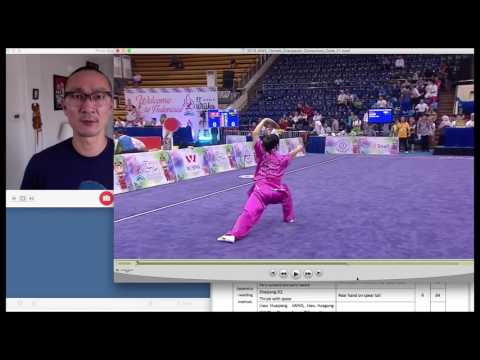
For this first video, I'm talking about the code 21. Code 21 is a very common A judge deduction for a backsweep/huosaotu…
Перевод: Basic Spear Sweep
The Standard Spear Sweep executes the fundamental shaft strike by sliding the grip position and swinging the butt end or mid-shaft in a horizontal or diagonal arc to strike the opponent's legs, midsection, or weapon, or to sweep their weapon aside to create an opening for a follow-up thrust. [1] The standard sweep uses the same body mechanics as a staff strike — hip rotation driving the shaft through the target — and can be directed at the opponent's lower legs to trip, at the hands to disarm, or at the weapon shaft to deflect. [1],[2] Following the sweep, the practitioner typically recovers to a thrusting position, using the sweep as a set-up for the spear's primary weapon: the straight thrust. [2],[3]
Standard spear sweep techniques are part of the comprehensive sojutsu curriculum found in koryu schools, representing the shaft-based component of Japanese spear fighting that complements the dominant thrusting method. [1] The sweep-to-thrust combination is one of the most effective tactical sequences in sojutsu. [2],[3]
The standard spear sweep is the basic leg-sweeping technique using the spear's shaft at low level. [1]
Standard spear sweeps are part of Chinese gun-shu and Japanese sōjutsu training curricula. [1]
Standard spear sweeps appear in wushu gun-shu competition forms. [1]
Изображений для этой техники пока нет.
Войдите, чтобы предложить изображение.
For this first video, I'm talking about the code 21. Code 21 is a very common A judge deduction for a backsweep/huosaotu…
Edited with English headings for educational purpose. Acknowledgement to IWUF as the producer of original videos in Chi…
The standard spear sweep, known in wushu competition as the ho-sau-twe or back sweep, is a fundamental technique evaluated under Code 21 deductions in international wushu judging. According to Brandon Sugiyama (invibe), judges assess this technique using two strict criteria: the sole of the sweeping foot must maintain contact with the ground throughout the entire movement, and the sweeping leg must remain straight from initiation through completion. A bent leg is defined as any visually perceptible deviation from straightness, regardless of degree. The foot leaving the ground—even intermittently—constitutes an infraction. Sugiyama emphasizes that Code 21 deductions are preventable through focused technique practice rather than dynamic enhancement, distinguishing them from other deductions rooted in execution errors. The technique is common in compulsory forms across multiple wushu styles and schools. Judges do not evaluate the sweep based on rotation completeness, body height, or speed; only ground contact and leg straightness matter. The first instructor (taichikungfu99) provides no intelligible technical instruction in the available transcript.
Сформировано на основе 2 инструкторов
Учебных курсов по этой технике пока нет.
Войдите, чтобы предложить курс.
Риск травмы для человека, к которому применяется техника
Spears, halberds, and naginata; maximum reach with lethal cutting/thrusting capability
Уровень мастерства, необходимый для надёжного выполнения техники
Разрешена ли техника по основным соревновательным правилам
Chinese Martial Arts Training Manuals (Brian Kennedy & Elizabeth Guo, 2005)
Alias sources — [1] Japanese Swordsmanship (Warner & Draeger, 1982) [2] Secrets of the Samurai (Ratti & Westbrook, 1973) [3] Secrets of the Samurai (Ratti & Westbrook, 1973)
Effectiveness sources — [1] Comprehensive Asian Fighting Arts (Draeger & Smith, 1969)
Established Japanese martial arts naming convention — native Japanese term (和語/漢語)
Alias sources — [1] Japanese Swordsmanship (Warner & Draeger, 1982) [2] Secrets of the Samurai (Ratti & Westbrook, 1973) [3] Secrets of the Samurai (Ratti & Westbrook, 1973)
Effectiveness sources — [1] Comprehensive Asian Fighting Arts (Draeger & Smith, 1969)
wrist snap speed, sliding grip coordination, hip rotation
long reach and strong wrists for staff manipulation
forearms, wrist rotators, core rotators, shoulders
A Code 21 deduction (ho-sau-twe) is a judging penalty applied when a spear sweep is performed with technical errors. Brandon Sugiyama (invibe) explains that the two main errors judges look for during a spear sweep are improper foot positioning—specifically when the sole of the foot is not parallel to the ground but instead faces laterally toward the judges.
According to Brandon Sugiyama (invibe), Code 21 deductions are typically caused by habit and bad technique rather than random errors, and can be fixed through focused practice and proper form.
The Standard Spear Sweep executes the fundamental shaft strike by sliding the grip position and swinging the butt end or mid-shaft in a horizontal or diagonal arc to strike the opponent's legs, midsection, or weapon, or to sweep their weapon aside to create an opening for a follow-up thrust. The standard sweep uses the same body mechanics as a staff strike — hip rotation driving the shaft through the target — and can be directed at the opponent's lower legs to trip, at the hands to disarm, or at the weapon shaft to deflect.
Standard spear sweep techniques are part of the comprehensive sojutsu curriculum found in koryu schools, representing the shaft-based component of Japanese spear fighting that complements the dominant thrusting method. The sweep-to-thrust combination is one of the most effective tactical sequences in sojutsu.
Traditional martial arts: разрешён — Practiced in traditional kata/forms and weapon-specific competition under var…; IWUF: разрешён — Legal in wushu taolu if applicable; HEMA: разрешён — Legal in applicable historical weapon categories
Оценка опасности 9/10. Extreme — spears, halberds, and naginata; maximum reach with lethal cutting/thrusting capability
Стандартная цепочка подготовки: Grip and Stance → Chamber → Strike → Recovery.
Стандартные контрприёмы: Parry (Absetzen) — deflect the incoming blade with a counter-displacement / Void (Step Back) — withdraw from measure to avoid the cutting arc / Counter-Cut (Nachreisen) — strike into the opponent's opening during their attack.
Распространённые варианты: Overhead strike (bringing the staff down from above in a vertical arc); Lateral strike (horizontal sweep targeting the ribs or head); Thrust (straight thrust with the end of the staff); Butt-end strike (striking with the rear end of the staff at close range).
Standard spear sweeps appear in wushu gun-shu competition forms.
Основные ошибки, на которые стоит обратить внимание: Sweeping with too much force — excessive force makes it difficult to transition quickly to the thrust / Pausing between sweep and thrust — the sweep-thrust must be continuous; any pause allows the opponent to recover guard / Not contacting the opponent's weapon at the optimal point — contact near the centre of their weapon provides maximum … / Sweeping in the wrong direction — sweep the opponent's weapon to the outside (away from their centre) for maximum effect.
Standard Spear Sweep также известен как Basic Yari Sweep, Nagi Waza, Lateral Spear Sweep.