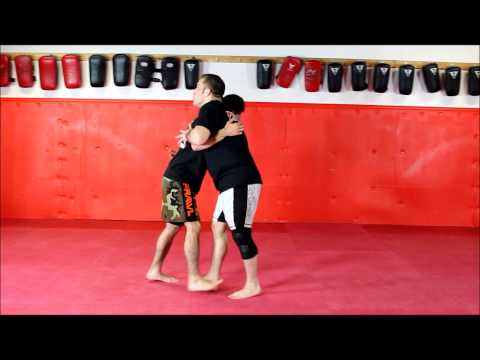
Poughkeepsie BJJ Lateral Drop - Precision MMA LaGrange, NY
0
Lateral Drop·Precision Boxing & MMA
http://www.learntograpple.com BJJ Black Belt Brian McLaughlin shows the lateral drop Train BJJ in Poughkeepsie, NY FRE…
Перевод: Side Drop
Lateral Drop is a family of wrestling throws in which the attacker secures an upper-body clinch — typically a body lock or over-under position — and falls laterally to one side while arching to lift and rotate the opponent, slamming them to the mat in a high-amplitude sideways arc. [1],[2] The lateral drop is one of the most spectacular throws in Greco-Roman wrestling, requiring explosive hip extension, back strength, and precise timing to execute correctly. [2],[3] The throw is particularly effective from the over-under clinch (one overhook, one underhook) and is a high-scoring technique due to the back-exposure it creates on the opponent during the fall. [3],[4] In MMA, the lateral drop has been adopted as a devastating clinch throw that can end fights through the impact of the slam. [4]
The lateral drop has been a cornerstone of Greco-Roman wrestling since the sport's codification in 19th-century Europe. [1] Soviet and Eastern European wrestlers refined the technique to devastating effect during the 20th century, and the lateral drop became a hallmark of the high-amplitude Greco-Roman throwing style. [1],[2] The technique was popularised in MMA by wrestlers such as Randy Couture and Matt Hughes. [2],[3]
Изображений для этой техники пока нет.
Войдите, чтобы предложить изображение.
http://www.learntograpple.com BJJ Black Belt Brian McLaughlin shows the lateral drop Train BJJ in Poughkeepsie, NY FRE…
Учебных курсов по этой технике пока нет.
Войдите, чтобы предложить курс.
Риск травмы для человека, к которому применяется техника
Lateral drop generates high rotational force; head/shoulder impact risk
Уровень мастерства, необходимый для надёжного выполнения техники
Разрешена ли техника по основным соревновательным правилам
Japanese amateur wrestling terminology
Japanese amateur wrestling terminology
Standard Japanese martial arts terminology (kanji/hiragana)
Established Japanese martial arts naming convention — native Japanese term (和語/漢語)
Standard katakana transliteration used in Japanese wrestling (レスリング)
hip rotation speed, core strength, lower back stability
strong hips and core, good flexibility for turning entry
hip rotators, core, quadriceps, latissimus dorsi
Каждое движение в любом боевом искусстве обладает рядом универсальных свойств. Комбинируйте параметры ниже, чтобы найти нужный инструмент или сравнить аналоги из разных стилей.
One of the highest-amplitude throws in wrestling. Extremely effective but carries significant neck injury risk for the thrower if executed incorrectly. (FILA/UWW wrestling coaching manuals)
You need one arm as an over-hook and the other arm as an under-hook. You'll fall towards your over-hook side while maintaining this grip structure.
Don't commit too much weight or lean heavily into your opponent, as this will get you thrown. Instead, apply light shoulder pressure to inch them back and provoke their natural drive response.
Twisting too early is the most frequent error—many grapplers try to twist immediately like a foot sweep instead of letting themselves free fall first before rotating on the over-hook side.
Pop your hips and arch your back to generate amplitude on the throw. This creates a high-amplitude technique without requiring much strength because you're giving away rather than forcing the movement.
Lateral Drop is a family of wrestling throws in which the attacker secures an upper-body clinch — typically a body lock or over-under position — and falls laterally to one side while arching to lift and rotate the opponent, slamming them to the mat in a high-amplitude sideways arc. The lateral drop is one of the most spectacular throws in Greco-Roman wrestling, requiring explosive hip extension, back strength, and precise timing to execute correctly.
The lateral drop has been a cornerstone of Greco-Roman wrestling since the sport's codification in 19th-century Europe. Soviet and Eastern European wrestlers refined the technique to devastating effect during the 20th century, and the lateral drop became a hallmark of the high-amplitude Greco-Roman throwing style.
IJF: разрешён — Legal throwing technique; IBJJF: разрешён — Legal at all belt levels; UWW: разрешён — Legal in both freestyle and Greco-Roman; Unified MMA: разрешён — Legal throwing technique; ADCC: разрешён — Legal; FIAS Sport Sambo: разрешён — Legal; FIAS Combat Sambo: разрешён — Legal
Оценка опасности 7/10. Very High — lateral drop generates high rotational force; head/shoulder impact risk
Стандартная цепочка подготовки: Grip Setup (Kumi-kata) → Off-Balance (Kuzushi) → Entry (Tsukuri) → Execution (Kake).
Стандартные контрприёмы: Lower Centre of Gravity — bend knees and drop hips to make the throw harder to execute / Block the Hip — post hand on the thrower's hip to prevent loading / Step Around — circle away from the throw direction to avoid being loaded / Grip Break — deny the thrower their preferred gripping configuration.
Распространённые варианты: Standard hip throw (full turn-in with hip below the opponent's centre of gravity); No-gi hip throw (adapted without gi grips, using overhook and collar tie); Drop hip throw (dropping to one knee to lower the fulcrum point); Combination hip throw (chaining from a failed foot technique or hand technique).
The lateral drop scores 5 points in Greco-Roman competition as a grand amplitude throw. It is used in both wrestling and MMA.
Основные ошибки, на которые стоит обратить внимание: Attempting without hip contact — the hip pop is the throwing mechanism; no hip contact means no throw / Arching backward instead of laterally — the lateral drop goes sideways, not backward (that's a suplex) / Not popping the hip explosively enough — a slow hip movement lets the opponent adjust / Releasing the body lock during the throw — maintain it through the landing.
Lateral Drop также известен как Yoko Otoshi, Lat drop, Side body lock throw.