Legless Fireman’s Carry
0
Standard Modified Fireman Carry·Sambo Fusion
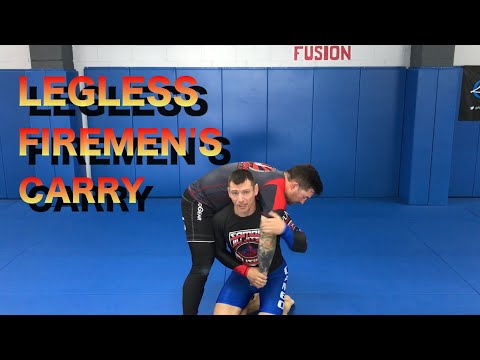
Have you ever gotten caught in a crucifix, trying to throw someone with fireman’s carry? This version will eliminate tha…
Перевод: standard modified fireman's carry
Standard Modified Fireman's Carry is the most common variation in which the attacker enters from a collar tie or arm drag, drops to one knee, threads the arm between the opponent's legs, and completes the throw with a lateral roll rather than standing up fully with the opponent on the shoulders. [1],[2] This modification reduces the energy required and minimises the exposure time during the lifting phase. [2],[3]
The standard modified fireman's carry is the baseline adapted version of the technique. [1]
Modified fireman's carry variations have been developed within freestyle and Greco-Roman wrestling programs to adapt the technique to different grip situations and defensive reactions. [1]
Used in freestyle competition as an alternative entry. [1]
Изображений для этой техники пока нет.
Войдите, чтобы предложить изображение.
Have you ever gotten caught in a crucifix, trying to throw someone with fireman’s carry? This version will eliminate tha…
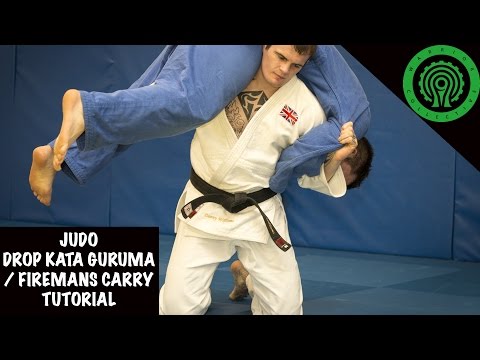
Danny Williams, Judo Olympian, Commonwealth Champion and Coach of Camberley Judo Club is here filmed by the Warrior Coll…
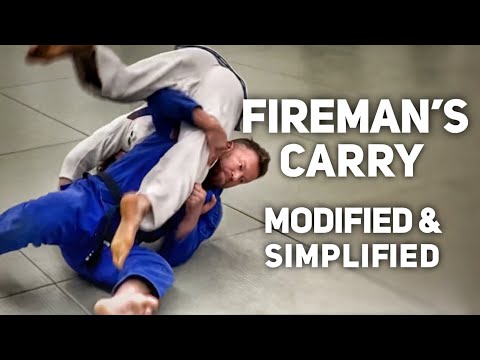
Much more at Patreon.com/KnightJiuJitsu The Fireman’s Carry, or kata garuma, is one of the coolest throws found across …
The Standard Modified Fireman Carry is a versatile throwing technique taught across judo, Brazilian jiu-jitsu, and sambo, with instructors offering complementary approaches to execution and adaptation. Stuart Tomlinson emphasizes the traditional judo method (Kata Garuma/shoulder wheel), detailing the arm-trapping mechanics and the forward roll finish over the shoulder, while noting how modern judo rules prohibiting below-belt grips have necessitated sleeve-based variations. Knight Jiu-Jitsu presents a BJJ-focused modification designed for practitioners struggling with conventional execution, particularly effective when opponents stiff-arm: the technique involves securing a sleeve grip, wrapping the opponent's arm while ducking through their legs with the head and bicep positioned in the crotch, then sliding the trailing leg outward rather than lifting vertically—reducing the strength requirement. Kolokov (Sambo Fusion) teaches a legless variation emphasizing 2-on-1 control from the collar-and-wrist grip, focusing on timing the rotation beneath the opponent as they move, landing perpendicular on the shins, maintaining strict body posture to create mechanical advantage, and rolling the opponent toward the trapped shoulder rather than backwards. All three instructors stress the importance of tight arm control, proper body positioning relative to the opponent, and timing over raw speed. Key differences include Tomlinson's emphasis on arm wrapping, Knight Jiu-Jitsu's sleeve-based entry and leg positioning, and Kolokov's detailed footwork and shoulder pressure mechanics.
Сформировано на основе 3 инструкторов
Учебных курсов по этой технике пока нет.
Войдите, чтобы предложить курс.
Риск травмы для человека, к которому применяется техника
Kata-Guruma; shoulder carry to throw; moderate landing impact
Уровень мастерства, необходимый для надёжного выполнения техники
Разрешена ли техника по основным соревновательным правилам
Japanese amateur wrestling terminology
Japanese amateur wrestling terminology
Mixed Japanese-Western terminology — combines traditional Japanese terms with katakana loanwords
Standard katakana transliteration used in Japanese wrestling (レスリング)
explosive turning speed, arm pulling power, deep level change
shorter stature for getting under the opponent, strong back
deltoids, trapezius, quadriceps, core
Get your first elbow above your opponent's elbow line and tuck it down and through, then drive your second arm up between their legs with your bicep toward their crotch while your knee hits the ground. Make sure your head ducks through while keeping your arm positioned to prevent a guillotine.
The legless version avoids putting your hand between the opponent's legs, which prevents getting caught in a leg lock grip that often occurs with the traditional hand position.
Not pulling enough on the opponent's arm during the dump—relying on speed alone won't work. You must create a position where they're parallel to the floor and fully commit to the pull before executing the throw.
You want to land perpendicular to your opponent, and make sure you're deep and directly beneath them—not too far away. Roll them toward their trapped shoulder as you dump them, similar to a jump roll.
Standard Modified Fireman's Carry is the most common variation in which the attacker enters from a collar tie or arm drag, drops to one knee, threads the arm between the opponent's legs, and completes the throw with a lateral roll rather than standing up fully with the opponent on the shoulders. This modification reduces the energy required and minimises the exposure time during the lifting phase.
The standard modified fireman's carry developed in competitive wrestling as athletes sought more efficient and less risky entries than the classical standing shoulder wheel.
IJF: запрещён — Banned since 2010 leg grab prohibition — direct hansoku-make; IBJJF: разрешён — Legal at all belt levels; UWW: разрешён — Legal in both freestyle and Greco-Roman; Unified MMA: разрешён — Legal throwing technique; ADCC: разрешён — Legal; FIAS Sport Sambo: разрешён — Legal; FIAS Combat Sambo: разрешён — Legal
Оценка опасности 5/10. High — Kata-Guruma; shoulder carry to throw; moderate landing impact
Стандартная цепочка подготовки: Grip Setup (Kumi-kata) → Off-Balance (Kuzushi) → Entry (Tsukuri) → Execution (Kake).
Стандартные контрприёмы: Lower Centre of Gravity — bend knees and drop hips to make the throw harder to execute / Grip Break — deny the thrower their preferred gripping configuration / Stiff-Arm — maintain distance with straight arms to prevent the entry.
Распространённые варианты: Morote seoi nage (two-handed shoulder throw with both hands gripping); Ippon seoi nage (one-arm shoulder throw loading the arm over the shoulder); Drop seoi nage (dropping to the knees for a lower entry point); Korean-style shoulder throw (modified entry with deeper level change).
Used in freestyle competition as an alternative entry.
Основные ошибки, на которые стоит обратить внимание: Losing the wrist grip during the roll — without gi, the grip is the weakest link / Not level-changing deep enough — the no-gi fireman's carry requires getting very low / Loading the opponent but not rolling because the arm control slips / Not protecting the head during entry — guillotine risk is higher in no-gi.
Standard Modified Fireman Carry также известен как Henkei Faiyāmanzu Kyarī, Standard Modified Fireman's, Classical Modified Fireman's Carry.