Dominate Your Opponent with Soto Makikomi: Pro-Level Tips Revealed
0
Standard Soto Makikomi·DadBod Judo ·Added by Admin
Soto Makikomi is a Judo throwing technique classified as one of the "sacrifice throws" or sutemi-waza. In Japanese, "sot…
Перевод: outer wraparound
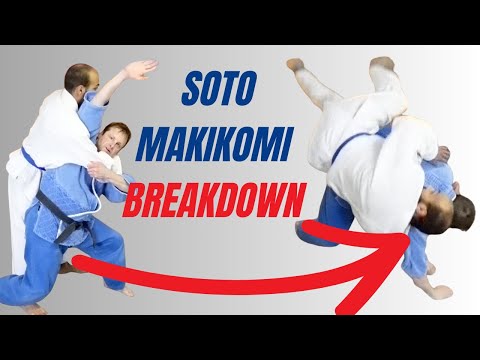
Standard Soto Makikomi is the conventional execution in which tori secures a deep over-the-top grip on uke's arm, turns their body while wrapping uke's arm tightly to their chest, and drops laterally into a roll that brings uke down under tori's body weight. [1],[2] The throw is characterised by the tight binding of uke's arm, which prevents defensive rotation during the fall. [2],[3]
Soto makikomi is classified in the Kodokan system as a yoko-sutemi-waza technique. [1]
Soto makikomi is regularly scored at IJF events, particularly by Georgian and other Eastern European competitors known for their physical, grip-dominant style. [1]
Изображений для этой техники пока нет.
Войдите, чтобы предложить изображение.
Soto Makikomi is a Judo throwing technique classified as one of the "sacrifice throws" or sutemi-waza. In Japanese, "sot…
Учебных курсов по этой технике пока нет.
Войдите, чтобы предложить курс.
Риск травмы для человека, к которому применяется техника
Rolling sacrifice adds rotational momentum; uncontrolled landing risk
Уровень мастерства, необходимый для надёжного выполнения техники
Разрешена ли техника по основным соревновательным правилам
Kodokan Judo — Official Nage-waza Classification
Traditional Judo throwing technique terminology (Kodokan Institute)
Official Kodokan ground technique classification system
Standard Japanese martial arts terminology (kanji/hiragana)
Established Japanese martial arts naming convention — native Japanese term (和語/漢語)
Traditional Judo throwing technique terminology (Kodokan Institute)
commitment, timing, body weight manipulation, falling skill
heavier build (body weight drives the throw), good ukemi
core rotators, hip flexors, abdominals
Start by taking your hand off the lapel, pull across their body, come across their face, then turn and wind them up as much as possible before executing the throw. DadBod Judo emphasizes this hand sequencing as key to controlling your opponent during the setup.
The key is to 'wind them up' by rotating your body and pulling your opponent tight to you before throwing—this creates maximum rotational force for the throw over your hip.
Standard Soto Makikomi is the conventional execution in which tori secures a deep over-the-top grip on uke's arm, turns their body while wrapping uke's arm tightly to their chest, and drops laterally into a roll that brings uke down under tori's body weight. The throw is characterised by the tight binding of uke's arm, which prevents defensive rotation during the fall.
Standard soto makikomi has been part of the Kodokan throwing curriculum and gained significant use in Olympic judo from the 1970s onward.
IJF: разрешён — Legal throwing technique; IBJJF: разрешён — Legal at all belt levels; UWW: разрешён — Legal in both freestyle and Greco-Roman; Unified MMA: разрешён — Legal throwing technique; ADCC: разрешён — Legal; FIAS Sport Sambo: разрешён — Legal; FIAS Combat Sambo: разрешён — Legal
Оценка опасности 6/10. High — rolling sacrifice adds rotational momentum; uncontrolled landing risk
Стандартная цепочка подготовки: Grip Setup (Kumi-kata) → Off-Balance (Kuzushi) → Entry (Tsukuri) → Execution (Kake).
Стандартные контрприёмы: Lower Centre of Gravity — bend knees and drop hips to make the throw harder to execute / Grip Break — deny the thrower their preferred gripping configuration / Stiff-Arm — maintain distance with straight arms to prevent the entry.
Распространённые варианты: Rear sacrifice (falling backward while pulling the opponent over); Side sacrifice (falling to the side to project the opponent laterally); Rolling sacrifice (combining a roll with the sacrifice throw for rotation); Counter sacrifice (using the opponent's forward pressure as the driving force).
Soto makikomi is regularly scored at IJF events, particularly by Georgian and other Eastern European competitors known for their physical, grip-dominant style.
Основные ошибки, на которые стоит обратить внимание: Not clamping the overhook tight enough — uke pulls free mid-roll / Rolling over the head instead of the shoulder — dangerous for your neck / Entering too far from uke — you need to be tight against them before rolling / Not pulling with the sleeve hand during the roll — both grips must work together.
Standard Soto Makikomi также известен как Soto Makikomi, Classical Outer Winding Throw, Standard Outside Wrap-Around.