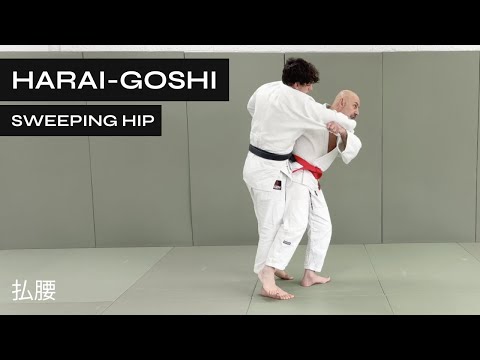
How to do Harai-Goshi | Sweeping Hip | 払腰
0
Standard Harai Goshi·Sampson Judo·Added by Admin
How to do Harai-Goshi, Sweeping Hip in Judo and BJJ Check out my online course 👇🏻 🔥https://sampsonjudo.thinkific.com…
Перевод: sweeping hip throw
Standard Harai Goshi executes the classical sweeping hip throw where the thrower turns in with the hip placed beneath the opponent's centre of gravity, then sweeps the back of the thigh against the opponent's front thigh in a large upward arc while pulling strongly with both hands to rotate the opponent over the hip. [1] The sweep drives the opponent's leg backward and upward while the hands wheel the upper body forward, creating a powerful rotational throw. [1],[2] The technique requires precise coordination between the hip placement, the sweeping leg action, and the hand pull to generate maximum throwing force. [2],[3]
Harai goshi is one of the most powerful throws in judo, combining the rotational force of a hip throw with the sweeping action of the leg to produce high-amplitude, ippon-scoring throws. [1] Daigo classifies it among the most effective competition techniques, noting that the dual-action mechanism (hip rotation plus leg sweep) makes it more difficult to defend than pure hip or pure leg techniques. [2] The throw is versatile, applicable from multiple grip configurations and effective against opponents of varying body types. [3]
Изображений для этой техники пока нет.
Войдите, чтобы предложить изображение.
How to do Harai-Goshi, Sweeping Hip in Judo and BJJ Check out my online course 👇🏻 🔥https://sampsonjudo.thinkific.com…
Учебных курсов по этой технике пока нет.
Войдите, чтобы предложить курс.
Риск травмы для человека, к которому применяется техника
Harai-Goshi sweeping hip action; requires good timing
Уровень мастерства, необходимый для надёжного выполнения техники
Разрешена ли техника по основным соревновательным правилам
Kodokan Judo — Official Nage-waza Classification
Traditional Judo throwing technique terminology (Kodokan Institute)
Official Kodokan ground technique classification system
Standard Japanese martial arts terminology (kanji/hiragana)
Established Japanese martial arts naming convention — native Japanese term (和語/漢語)
Traditional Judo throwing technique terminology (Kodokan Institute)
hip rotation speed, core strength, lower back stability
strong hips and core, good flexibility for turning entry
hip rotators, core, quadriceps, latissimus dorsi
Hold underneath the elbow across the body rather than over the top. According to Sampson Judo, holding underneath gives more control and is more subtle—when you twist the jacket, you have good control of the shoulder, whereas holding high doesn't give you as much control.
Bending forward before making body contact with your opponent. Sampson Judo emphasizes that if you lean forward before your opponent is connected to your hips, you lose about 60-70% of the throw's power—you need to step in and make contact first, then bend forward so your opponent comes with you.
Your opponent should land in front of you, not to your side. Sampson Judo explains that where uke lands is the key indicator of whether the throw has been done correctly or falsely—proper execution means they land directly in front of you as you throw in the direction they're pointing.
According to Sampson Judo: (1) keep your opponent's elbow controlled upward at all times, (2) get your elbow underneath their shoulder throughout, (3) position your entry between their legs—not to one side and close, not far forward, and (4) make sure your hips make contact with theirs before bending forward to throw.
Standard Harai Goshi executes the classical sweeping hip throw where the thrower turns in with the hip placed beneath the opponent's centre of gravity, then sweeps the back of the thigh against the opponent's front thigh in a large upward arc while pulling strongly with both hands to rotate the opponent over the hip. The sweep drives the opponent's leg backward and upward while the hands wheel the upper body forward, creating a powerful rotational throw.
The standard form of harai goshi has been a core Kodokan technique since the original gokyo, and it is demonstrated in the Nage no Kata as a representative koshi-waza technique. It remains one of the most commonly scored throws at international judo competitions.
IJF: разрешён — Legal throwing technique; IBJJF: разрешён — Legal at all belt levels; UWW: разрешён — Legal in both freestyle and Greco-Roman; Unified MMA: разрешён — Legal throwing technique; ADCC: разрешён — Legal; FIAS Sport Sambo: разрешён — Legal; FIAS Combat Sambo: разрешён — Legal
Оценка опасности 5/10. High — Harai-Goshi sweeping hip action; requires good timing
Стандартная цепочка подготовки: Grip Setup (Kumi-kata) → Off-Balance (Kuzushi) → Entry (Tsukuri) → Execution (Kake).
Стандартные контрприёмы: Lower Centre of Gravity — bend knees and drop hips to make the throw harder to execute / Block the Hip — post hand on the thrower's hip to prevent loading / Step Around — circle away from the throw direction to avoid being loaded / Grip Break — deny the thrower their preferred gripping configuration.
Распространённые варианты: Standard hip throw (full turn-in with hip below the opponent's centre of gravity); No-gi hip throw (adapted without gi grips, using overhook and collar tie); Drop hip throw (dropping to one knee to lower the fulcrum point); Combination hip throw (chaining from a failed foot technique or hand technique).
Harai goshi is consistently among the highest-scoring throws at IJF World Championships and Olympic Games. Isao Okano (JPN), who won the 1964 Tokyo Olympics gold at 80 kg, was renowned for his devastating harai goshi.
Основные ошибки, на которые стоит обратить внимание: Sweeping with a straight stiff leg instead of a fluid sweeping motion / Making contact too low on uke's leg (at the knee or below) — aim for mid-thigh / Not breaking uke's balance forward before the sweep — they simply step around it / Losing the sleeve grip during the sweep — hikite control is essential for directing uke's fall.
Standard Harai Goshi также известен как Harai Goshi, Classical Sweeping Hip Throw, Standard Hip Sweep, Kihon Harai Goshi.