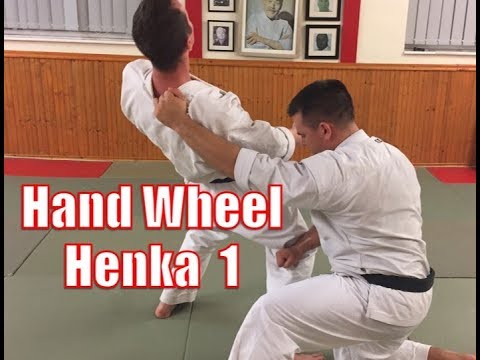
Hand Wheel Throws - Hiza Te Guruma - Karate Jutsu
0
Standard Te Guruma·Daniel Pyatt·Added by Admin
This technique is a variation on Ohyo 5 of Wado Ryu Karate (I say 3 in the video, that is the variation for next week, g…
Перевод: Hand Wheel
Te Guruma (hand wheel) is a judo throwing technique classified under te-waza (hand techniques) where the attacker scoops under the opponent's thigh with one arm while controlling the collar with the other, executing a circular wheel-like lifting throw. [1] Described in Kyuzo Mifune's 'The Canon of Judo' (1956) and demonstrated in his instructional film 'The Essence of Judo,' Te Guruma is officially classified by the Kodokan as equivalent to Sukui Nage (scooping throw). [2] The technique was a standard part of competitive judo until the 2010-2011 IJF rule changes that banned direct leg grabs, driven by statistical analysis showing that leg-grab techniques encouraged low-quality sloppy attempts.
Te Guruma is documented in Kyuzo Mifune's 'The Canon of Judo' (1956) and demonstrated in his instructional film 'The Essence of Judo.' [1] The Kodokan classifies it as equivalent to Sukui Nage within te-waza. The technique was part of standard competitive judo until the 2010-2011 IJF leg-grab ban. [2]
Te Guruma was an effective competitive judo throw before the 2011 leg-grab ban. Particularly devastating as a counter to forward-entry throws like seoi nage. The scooping mechanics generate high-amplitude throws that score ippon (full point) in judo. [1]
Kodokan judo te-waza tradition. Documented by Kyuzo Mifune (10th dan). Classified as equivalent to Sukui Nage by the Kodokan. Competition use restricted by IJF leg-grab ban (2010-2011).
Used at the highest levels of international judo competition before the 2011 ban. A Swedish competitor won Best Athlete at the Swedish World Cup in 2005, winning the final with a Te Guruma. The technique was particularly effective as a counter to seoi nage entries.
Изображений для этой техники пока нет.
Войдите, чтобы предложить изображение.
This technique is a variation on Ohyo 5 of Wado Ryu Karate (I say 3 in the video, that is the variation for next week, g…
Учебных курсов по этой технике пока нет.
Войдите, чтобы предложить курс.
Риск травмы для человека, к которому применяется техника
Amplitude throw where the opponent lands from significant height — risk of shoulder, back, and head injury if thrown forcefully onto hard surfaces; in judo competition on tatami, the risk is moderated by mats
Уровень мастерства, необходимый для надёжного выполнения техники
Разрешена ли техника по основным соревновательным правилам
The Canon of Judo (Mifune, 1956) — Te Guruma
Primary historical source — [1] The Canon of Judo (Mifune, 1956) — Te Guruma documented as reference technique
[2] IJF rule analysis — Thierry Loison statistical study leading to 2010-2011 leg-grab ban
Official Kodokan ground technique classification system
Standard Japanese martial arts terminology (kanji/hiragana)
Established Japanese martial arts naming convention — native Japanese term (和語/漢語)
Primary historical source — [1] The Canon of Judo (Mifune, 1956) — Te Guruma documented as reference technique
[2] IJF rule analysis — Thierry Loison statistical study leading to 2010-2011 leg-grab ban
upper body strength for scooping lift, good timing and tai-sabaki
strong legs and back for the lifting component
quadriceps, biceps, latissimus dorsi, core stabilizers
Start with a straight punch when first learning the technique, as it provides simplicity, though you can eventually apply it against kicks, grabs, and other attacks.
As your opponent attacks, absorb their energy by loading your kick, then drive forward with your whole body entering in one continuous motion to generate the power needed for the throw.
If the initial throw is absorbed, redirect by bringing their head forward and strike the back of the head while controlling the arm, then drop them to complete the technique.
Bring the opponent's shoulders over their head and heel line with a short, controlled movement rather than just pulling, while simultaneously dropping your body and pushing forward to rotate them around.
Te Guruma (hand wheel) is a judo throwing technique classified under te-waza (hand techniques) where the attacker scoops under the opponent's thigh with one arm while controlling the collar with the other, executing a circular wheel-like lifting throw. Described in Kyuzo Mifune's 'The Canon of Judo' (1956) and demonstrated in his instructional film 'The Essence of Judo,' Te Guruma is officially classified by the Kodokan as equivalent to Sukui Nage (scooping throw).
Te Guruma is documented in Kyuzo Mifune's 'The Canon of Judo' (1956) and demonstrated in his instructional film 'The Essence of Judo. ' The Kodokan classifies it as equivalent to Sukui Nage within te-waza.
IJF: запрещён — Banned since 2010 leg grab prohibition — direct hansoku-make; IBJJF: разрешён — Legal at all belt levels; UWW: разрешён — Legal in both freestyle and Greco-Roman; Unified MMA: разрешён — Legal throwing technique; ADCC: разрешён — Legal; FIAS Sport Sambo: разрешён — Legal; FIAS Combat Sambo: разрешён — Legal
Оценка опасности 7/10. High-amplitude throw where the opponent lands from significant height — risk of shoulder, back, and head injury if thrown forcefully onto hard surfaces; in judo competition on tatami, the risk is moderated by mats
Стандартная цепочка подготовки: Establish Gripping → Break Balance (Kuzushi) → Scoop Under Thigh → Guide with Collar → Execute Circular Lift → Complete the Throw.
Стандартные контрприёмы: Sprawl — drop hips back to deny the scooping arm access to the thigh / Crossface — use the free hand to push the attacker's face away / Underhook Defense — establish an underhook to prevent the scooping entry / Hip Drop — lower center of gravity to make the lift more difficult.
Распространённые варианты: Standard Te Guruma (classical one-arm scoop with collar control); Counter Te Guruma (specifically used as a counter to seoi nage or hip throws); Sukui Nage (scooping throw) (the Kodokan's official grouping, nearly identical mechanics); Modified Te Guruma (adapted versions for post-2025 IJF partial leg-grab allow…); No-gi Te Guruma (adapted for MMA and submission grappling without gi grips).
Used at the highest levels of international judo competition before the 2011 ban. A Swedish competitor won Best Athlete at the Swedish World Cup in 2005, winning the final with a Te Guruma.
Основные ошибки, на которые стоит обратить внимание: Not breaking balance before the lift — uchikomi (entry practice) must establish kuzushi first / Scooping too low — the hand should scoop the thigh near the hip, not the knee / Not committing to the lift — half-hearted attempts result in failed throws and vulnerable positions / Poor timing as a counter — waiting too long after opponent's attack entry makes the counter impossible.
Standard Te Guruma также известен как Te Guruma, Hand Wheel, Sukui Nage variant, Scooping Wheel Throw.