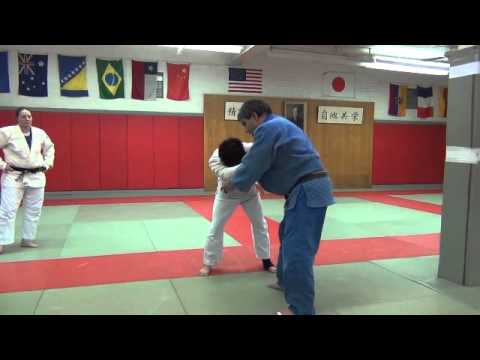
Tai Otoshi (Body Drop) Throw
0
Body Drop·WINNING
Tai Otoshi (Body Drop) Taiwaza (Hand Technique) Throw is taught by Sensei Felix Lanier during a fundamentals class at th…
Перевод: body drop
The Body Drop family centres on tai-otoshi, a fundamental te-waza technique in which the thrower turns in and extends the leg across the opponent's path as a trip while pulling the opponent forward and over the outstretched leg. [1] Body drop techniques are classified as hand techniques despite the use of the extended leg because the leg does not actively sweep or reap — it serves as a passive block or trip while the throwing force comes from the pulling and rotating action of the hands. [1],[2] Tai-otoshi is one of judo's most versatile and frequently scored throws, effective at all weight categories and adaptable to many grip configurations. [2],[3]
Tai-otoshi was included in the original Kodokan gokyo as a foundational te-waza technique and has been one of judo's most popular competition throws since the art's early days. [1] The technique's versatility and effectiveness have made it a staple of judo competition across all weight categories and eras. [2],[3]
Body drop techniques are classified under te-waza in the Kodokan judo syllabus. [1]
Tai otoshi is one of the most commonly scored throws in IJF competition. [1]
Изображений для этой техники пока нет.
Войдите, чтобы предложить изображение.
Tai Otoshi (Body Drop) Taiwaza (Hand Technique) Throw is taught by Sensei Felix Lanier during a fundamentals class at th…
Учебных курсов по этой технике пока нет.
Войдите, чтобы предложить курс.
Риск травмы для человека, к которому применяется техника
Tai-Otoshi uses body as fulcrum; controlled but high-velocity landing
Уровень мастерства, необходимый для надёжного выполнения техники
Разрешена ли техника по основным соревновательным правилам
Kodokan Judo — Official Nage-waza Classification
Traditional Judo throwing technique terminology (Kodokan Institute)
Official Kodokan ground technique classification system
Standard Japanese martial arts terminology (kanji/hiragana)
Established Japanese martial arts naming convention — native Japanese term (和語/漢語)
Traditional Judo throwing technique terminology (Kodokan Institute)
precise timing, ankle coordination, upper body kuzushi ability
excellent balance and quick reflexes
tibialis anterior, calves, hip rotators, forearms (grip)
Каждое движение в любом боевом искусстве обладает рядом универсальных свойств. Комбинируйте параметры ниже, чтобы найти нужный инструмент или сравнить аналоги из разных стилей.
Tai-otoshi is unique among judo throws — it is classified as a hand technique (te-waza) despite resembling a leg technique, because the leg acts as a block rather than a sweep. (Kano, Kodokan Judo)
You should execute the body drop when your opponent is standing straight up, driving your whole body to throw them down. If they're bent over, the technique becomes easier but you're relying on strength rather than proper positioning. According to WINNING's instruction, master the upright version first before exploring variations.
The correct technique involves setting your whole body and driving your opponent down the direction you're going, not reaching with your weight. WINNING emphasizes that reaching with weight is wrong because your real strength comes from driving through your back, not extending your arms.
If your opponent is positioned where you can't reach their foot for a foot technique, you should stand them up first before attempting the body drop. WINNING notes that positioning and reach matter—don't force a technique when the situation calls for adjustment.
The Body Drop family centres on tai-otoshi, a fundamental te-waza technique in which the thrower turns in and extends the leg across the opponent's path as a trip while pulling the opponent forward and over the outstretched leg. Body drop techniques are classified as hand techniques despite the use of the extended leg because the leg does not actively sweep or reap — it serves as a passive block or trip while the throwing force comes from the pulling and rotating action of the hands.
Tai-otoshi was included in the original Kodokan gokyo as a foundational te-waza technique and has been one of judo's most popular competition throws since the art's early days. The technique's versatility and effectiveness have made it a staple of judo competition across all weight categories and eras.
IJF: разрешён — Legal throwing technique; IBJJF: разрешён — Legal at all belt levels; UWW: разрешён — Legal in both freestyle and Greco-Roman; Unified MMA: разрешён — Legal throwing technique; ADCC: разрешён — Legal; FIAS Sport Sambo: разрешён — Legal; FIAS Combat Sambo: разрешён — Legal
Оценка опасности 5/10. High — Tai-Otoshi uses body as fulcrum; controlled but high-velocity landing
Стандартная цепочка подготовки: Grip Setup (Kumi-kata) → Off-Balance (Kuzushi) → Entry (Tsukuri) → Execution (Kake).
Стандартные контрприёмы: Lower Centre of Gravity — bend knees and drop hips to make the throw harder to execute / Lift the Targeted Leg — raise the foot being attacked above the sweeping action / Counter-Throw — exploit the attacker's committed weight to throw them instead / Grip Break — deny the thrower their preferred gripping configuration.
Распространённые варианты: Forward sweep (sweeping the foot in the direction the opponent is stepping); Rear sweep (sweeping the foot backward as the opponent retreats); Combination sweep (chaining sweeps to both feet); Counter sweep (timing the sweep as the opponent initiates their own attack).
Tai otoshi is one of the most commonly scored throws in IJF competition.
Основные ошибки, на которые стоит обратить внимание: Trying to trip the opponent with the leg instead of using it as a block — the hands throw, the leg blocks / Not turning far enough — your back should face the opponent with the leg extended across their path / Placing the blocking leg too high, which allows the opponent to step over it / Not pulling the opponent forward and over the block — without strong hand action, the block alone does nothing.
Body Drop также известен как Tai Otoshi, Body drop throws, Leg barrier throws.