05 Uki Otoshi
0
Uki Otoshi·PAT settore Judo Fijlkam
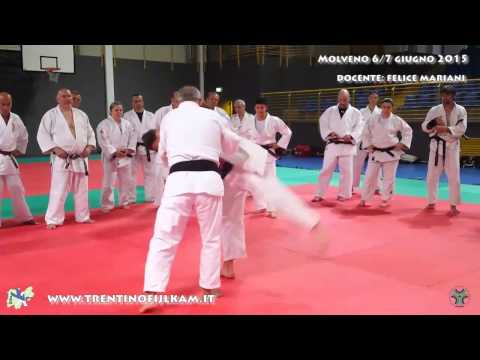
6/7 giugno 2015 Corso di aggiornamento tecnici judo 2015 Molveno - Centro Sportivo M° Felice Mariani
Перевод: floating drop
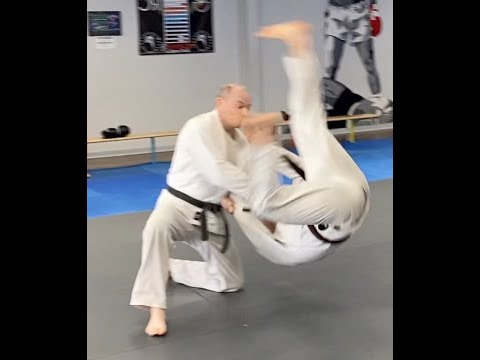
Uki Otoshi (floating drop) is a te-waza technique in which the thrower drops to one knee while pulling the opponent forward and downward, using the sudden level change and pulling action to project the opponent over and past the thrower's lowered body. [1] The throw is generated entirely by the hand action combined with the thrower's body drop — as the thrower drops, the pulling hands create a forward-and-downward force that floats the opponent over. [1],[2] Uki-otoshi is the first technique in the Nage no Kata (Forms of Throwing), representing the fundamental principle of using hand control and body movement to create a throw without relying on hip or leg contact. [2],[3]
Uki otoshi was included in the original 1895 Kodokan gokyo as a first-set technique and holds the honour of being the first throw demonstrated in the Nage no Kata. [1] Its placement at the beginning of the kata reflects Kano's belief that understanding the pure hand-throw principle is foundational to all other throwing techniques. [2],[3]
Uki otoshi is part of the Kodokan judo te-waza syllabus and is the first throw in Nage no Kata (the forms of throwing). [1]
Uki otoshi is seen more in kata competition than in randori-based competition, though it is occasionally scored in IJF events. [1]
Изображений для этой техники пока нет.
Войдите, чтобы предложить изображение.
6/7 giugno 2015 Corso di aggiornamento tecnici judo 2015 Molveno - Centro Sportivo M° Felice Mariani
Mark Gilston, 4th degree judo black belt, discusses and demonstrates uses of Uki Otoshi, the Floating Drop throw in judo…
Учебных курсов по этой технике пока нет.
Войдите, чтобы предложить курс.
Риск травмы для человека, к которому применяется техника
Arm throws use arm leverage; shoulder dislocation risk if arm trapped
Уровень мастерства, необходимый для надёжного выполнения техники
Разрешена ли техника по основным соревновательным правилам
Kodokan Judo — Official Nage-waza Classification
Traditional Judo throwing technique terminology (Kodokan Institute)
Official Kodokan ground technique classification system
Standard Japanese martial arts terminology (kanji/hiragana)
Established Japanese martial arts naming convention — native Japanese term (和語/漢語)
Traditional Judo throwing technique terminology (Kodokan Institute)
hip rotation speed, core strength, lower back stability
strong hips and core, good flexibility for turning entry
hip rotators, core, quadriceps, latissimus dorsi
Каждое движение в любом боевом искусстве обладает рядом универсальных свойств. Комбинируйте параметры ниже, чтобы найти нужный инструмент или сравнить аналоги из разных стилей.
Uki Otoshi works best when your opponent is committed and pushing into you. If they're moving cautiously and not committing their weight, Seiryoku Zenyo instructors recommend switching to Osu no Gake instead, since Uki Otoshi requires that forward momentum to be effective.
Step forward to block your opponent's movement, but rather than just blocking passively, bend your leg as you step and then straighten it—this extension of your leg throws them off balance.
Yes, Uki Otoshi can counter advancing techniques like foot sweeps. As soon as you feel your opponent start to attack or go off balance, respond with the pull-down motion, and they essentially throw themselves.
Uki Otoshi works when your opponent continues to push forward aggressively, while Sumiyotoshi (corner drop) is the opposite direction technique that works when they are withdrawing and hesitating.
Uki Otoshi (floating drop) is a te-waza technique in which the thrower drops to one knee while pulling the opponent forward and downward, using the sudden level change and pulling action to project the opponent over and past the thrower's lowered body. The throw is generated entirely by the hand action combined with the thrower's body drop — as the thrower drops, the pulling hands create a forward-and-downward force that floats the opponent over.
Uki otoshi was included in the original 1895 Kodokan gokyo as a first-set technique and holds the honour of being the first throw demonstrated in the Nage no Kata. Its placement at the beginning of the kata reflects Kano's belief that understanding the pure hand-throw principle is foundational to all other throwing techniques.
IJF: разрешён — Legal throwing technique; IBJJF: разрешён — Legal at all belt levels; UWW: разрешён — Legal in both freestyle and Greco-Roman; Unified MMA: разрешён — Legal throwing technique; ADCC: разрешён — Legal; FIAS Sport Sambo: разрешён — Legal; FIAS Combat Sambo: разрешён — Legal
Оценка опасности 5/10. High — arm throws use arm leverage; shoulder dislocation risk if arm trapped
Стандартная цепочка подготовки: Grip Setup (Kumi-kata) → Off-Balance (Kuzushi) → Entry (Tsukuri) → Execution (Kake).
Стандартные контрприёмы: Lower Centre of Gravity — bend knees and drop hips to make the throw harder to execute / Block the Hip — post hand on the thrower's hip to prevent loading / Step Around — circle away from the throw direction to avoid being loaded / Grip Break — deny the thrower their preferred gripping configuration.
Распространённые варианты: Standard hip throw (full turn-in with hip below the opponent's centre of gravity); No-gi hip throw (adapted without gi grips, using overhook and collar tie); Drop hip throw (dropping to one knee to lower the fulcrum point); Combination hip throw (chaining from a failed foot technique or hand technique).
Uki otoshi is seen more in kata competition than in randori-based competition, though it is occasionally scored in IJF events.
Основные ошибки, на которые стоит обратить внимание: Trying to use strength to pull the opponent down instead of timing the pull to their step / Not stepping to the side — uki otoshi requires a lateral step to create the angle for the spiral / Pulling straight down instead of forward-sideways-down in a spiral path / Attempting uki otoshi against a stationary opponent — they must be in motion for the timing to work.
Uki Otoshi также известен как Floating Drop, Floating Drop Throw, Uki Otoshi.