Standard Sumi Otoshi

Род

Перевод: corner drop

Дистанция и классификация

Категория
Удар и защитаЗамкиБлижний бойБой против нескольких
Дистанция
БлижняяСредняяДальняя
Целевая зона
Верхняя частьСредняя частьНижняя часть

Обзор

Standard Sumi Otoshi executes the classical corner drop where the thrower steps to the side, pulls the opponent diagonally to the rear corner with both hands, and drops the opponent to the mat through the spiralling hand action alone. [1] No hip, leg, or body contact is used — the throw is accomplished entirely by the directional force of the gripping hands pulling the opponent into a void where no support exists. [1],[2] The technique requires the thrower to move off-line and create the corner angle while maintaining powerful pulling action. [2],[3]

Также известна как
Classical Corner Drop[1]Standard Corner Drop Throw[2]
Используется в

История и происхождение

The standard form of sumi otoshi has been part of the Kodokan curriculum since the early gokyo, representing one of the purest expressions of hand-technique throwing. [1] It is widely studied in judo kata and remains an important competitive technique when executed with precise timing. [2],[3]

Страна происхождения· показано в случайном порядке

  • Япония隅落とし(Sumi Otoshi)Дзюдо, Айкидо
  • КитайШуайцзяо

Эффективность

Sumi otoshi (corner drop) is a pure hand technique that requires no leg or hip contact with the opponent, relying entirely on hand action to direct the opponent down to the corner. [1] Its effectiveness depends on precise timing and powerful kuzushi to the rear corner, making it challenging to execute but devastating when successful. [2]

Родословная

Sumi otoshi is classified in the Kodokan system as a te-waza technique and is demonstrated in the Nage no Kata. [1] It represents one of the purest expressions of hand-technique throwing in judo. [2]

Соревновательные результаты

The standard sumi otoshi is occasionally scored in IJF competition. [1]

Изображения

Изображений для этой техники пока нет.

Войдите, чтобы предложить изображение.

Биомеханический механизм

Primary ActionLoading the opponent onto the hip and rotating them over it — the hip acts as the fulcrum
Joints InvolvedAttacker's hip (fulcrum point), knees (deep bend for loading), core (rotation), opponent's centre of gravity (elevated)
Force VectorRotational — pulling and turning motion loads the opponent, then hip extension and rotation drives them over
Kuzushi (Off-balancing)Forward and upward — breaking opponent's posture forward lifts their centre of gravity onto the attacker's hip

Позиция и вход

From judo gripBreak the opponent's balance forward (kuzushi), turn in with hip below their centre of gravity, and rotate to throw
From clinch (overhook or underhook)Secure inside position, turn the hips across the opponent's body, load and throw

Варианты

Standard hip throwfull turn-in with hip below the opponent's centre of gravity
No-gi hip throwadapted without gi grips, using overhook and collar tie
Drop hip throwdropping to one knee to lower the fulcrum point
Combination hip throwchaining from a failed foot technique or hand technique

Видео

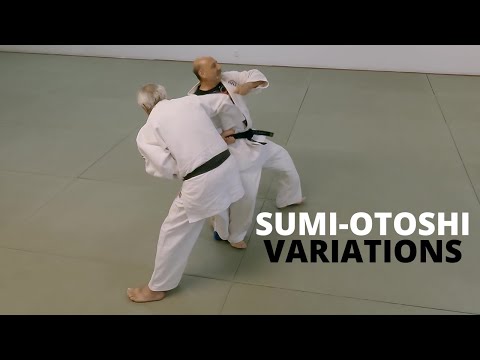
Sumi-Otoshi Variations | Riki Judo Dojo

0
Standard Sumi Otoshi·Riki Judo Dojo·Added by Admin

Riki sensei showed us many different grips and entries for sumi-otoshi (隅落 - corner drop) during judo class on 9-6-2021.

1 video

Изучить технику

Учебных курсов по этой технике пока нет.

Войдите, чтобы предложить курс.

Оценки

Уровень опасности

Риск травмы для человека, к которому применяется техника

5
Высокий5/10

Arm throws use arm leverage; shoulder dislocation risk if arm trapped

Сложность

Уровень мастерства, необходимый для надёжного выполнения техники

Средний
Допустимость на соревнованиях

Разрешена ли техника по основным соревновательным правилам

IJF — Legal throwing technique
IJF Sport and Organisation Rules 2025, Article 27PDF
IBJJF — Legal at all belt levels
IBJJF Rules Book v6.0, June 2024PDF
UWW — Legal in both freestyle and Greco-Roman
UWW International Wrestling Rules, January 2026PDF
Unified MMA — Legal throwing technique
Unified Rules of MMA, August 2025PDF
FIAS Sport Sambo — Legal
FIAS International Sambo Competition RulesPDF
FIAS Combat Sambo — Legal
FIAS Combat Sambo RulesPDF

Заметки по тренировке

From grips, move to one side of the opponent by stepping diagonally
Pull the opponent toward their rear diagonal corner — the corner behind and to one side of them
The pulling direction is approximately 45 degrees behind the opponent, to one side
Use both hands in coordination: the sleeve hand pulls sideways and back, the collar hand drives the opponent's shoulder toward the rear corner
Drop your own centre of gravity as you pull — step back and down to generate the direction
The opponent falls to their rear corner because their feet cannot reach back to support
Control the fall with the grips — guide them to the mat smoothly

Типичные ошибки

!Pulling in the wrong direction — the specific rear corner angle is what the throw depends on
!Not moving laterally before pulling — you must create the angle first
!Pulling upward instead of diagonally downward to the rear
!Using only one hand — sumi otoshi requires both hands working in coordination
!Standing upright during the pull — your centre must drop to generate the downward component
!Attempting from directly in front of the opponent — the corner angle requires a lateral position
!Not training the specific diagonal pulling pattern — the direction must be precise

Связанные техники

Контрприёмы

Цепочка подготовки

1Grip Setup (Kumi-kata)establish the controlling grips needed for the throw
2Off-Balance (Kuzushi)break the opponent's balance in the throwing direction
3Entry (Tsukuri)position the body for the throw by turning, stepping, or loading
4Execution (Kake)complete the throwing action with full commitment and follow-through

Источники и ссылки

Основной источник

Kodokan Judo — Official Nage-waza Classification

1КнигаKodokan Judo — Official Nage-waza Classification

Traditional Judo throwing technique terminology (Kodokan Institute)

Official Kodokan ground technique classification system

3Учебная программаKodokan Judo Institute — Official Waza Names

Standard Japanese martial arts terminology (kanji/hiragana)

4ДругоеJapanese Martial Arts Standard Terminology (武道用語)

Established Japanese martial arts naming convention — native Japanese term (和語/漢語)

5ЦитатаKodokan Judo — Official Nage-waza Classification

Traditional Judo throwing technique terminology (Kodokan Institute)

Сообщество

Атлетизм

Requires

hip rotation speed, core strength, lower back stability

Favours

strong hips and core, good flexibility for turning entry

Key muscles

hip rotators, core, quadriceps, latissimus dorsi

Часто задаваемые вопросы

Where exactly should my armpit make contact during Sumi Otoshi?

Your armpit should strike the opponent's shoulder, not their arm. This precise contact point is key to executing the technique effectively.

Should I back out or step forward when executing Sumi Otoshi?

Instead of backing out, step with your opponent as they move, then apply the shoulder strike to execute the technique smoothly.

How do I set up Sumi Otoshi with my hands?

Pull with your left hand while pushing with your right hand to set up the throw, similar to transitioning from a chimata grip.

Как работает Standard Sumi Otoshi?

Standard Sumi Otoshi executes the classical corner drop where the thrower steps to the side, pulls the opponent diagonally to the rear corner with both hands, and drops the opponent to the mat through the spiralling hand action alone. No hip, leg, or body contact is used — the throw is accomplished entirely by the directional force of the gripping hands pulling the opponent into a void where no support exists.

Откуда происходит Standard Sumi Otoshi?

The standard form of sumi otoshi has been part of the Kodokan curriculum since the early gokyo, representing one of the purest expressions of hand-technique throwing. It is widely studied in judo kata and remains an important competitive technique when executed with precise timing.

Разрешён ли Standard Sumi Otoshi на соревнованиях?

IJF: разрешён — Legal throwing technique; IBJJF: разрешён — Legal at all belt levels; UWW: разрешён — Legal in both freestyle and Greco-Roman; Unified MMA: разрешён — Legal throwing technique; ADCC: разрешён — Legal; FIAS Sport Sambo: разрешён — Legal; FIAS Combat Sambo: разрешён — Legal

Насколько опасен Standard Sumi Otoshi?

Оценка опасности 5/10. High — arm throws use arm leverage; shoulder dislocation risk if arm trapped

Как подготовить Standard Sumi Otoshi?

Стандартная цепочка подготовки: Grip Setup (Kumi-kata) → Off-Balance (Kuzushi) → Entry (Tsukuri) → Execution (Kake).

Как защититься от Standard Sumi Otoshi?

Стандартные контрприёмы: Lower Centre of Gravity — bend knees and drop hips to make the throw harder to execute / Block the Hip — post hand on the thrower's hip to prevent loading / Step Around — circle away from the throw direction to avoid being loaded / Grip Break — deny the thrower their preferred gripping configuration.

Какие есть варианты Standard Sumi Otoshi?

Распространённые варианты: Standard hip throw (full turn-in with hip below the opponent's centre of gravity); No-gi hip throw (adapted without gi grips, using overhook and collar tie); Drop hip throw (dropping to one knee to lower the fulcrum point); Combination hip throw (chaining from a failed foot technique or hand technique).

Насколько эффективен Standard Sumi Otoshi на соревнованиях?

The standard sumi otoshi is occasionally scored in IJF competition.

Какие типичные ошибки при выполнении Standard Sumi Otoshi?

Основные ошибки, на которые стоит обратить внимание: Pulling in the wrong direction — the specific rear corner angle is what the throw depends on / Not moving laterally before pulling — you must create the angle first / Pulling upward instead of diagonally downward to the rear / Using only one hand — sumi otoshi requires both hands working in coordination.

Какие ещё названия есть у Standard Sumi Otoshi?

Standard Sumi Otoshi также известен как Sumi Otoshi, Classical Corner Drop, Standard Corner Drop Throw.