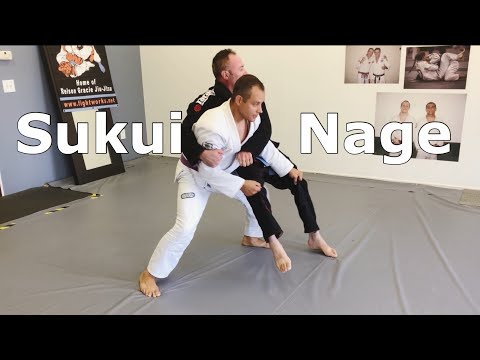
Sukui Nage Jiu-Jitsu Self Defense Throw Made Easy!
0
Standard Sukui Nage·Robert Silas (Aiki_and_Jiu)·Added by Admin
How to eliminate the need for muscle and easily lift your opponent’s legs in the classic throw known as Sukui Nage. This…
Перевод: scoop throw
Standard Sukui Nage executes the classical scoop throw where the thrower reaches between or around the opponent's legs, scoops the lower body upward with the arms, and drives the opponent over by rotating them around a horizontal axis. [1] The scooping arm gathers the opponent's thigh or leg area while the other hand controls the upper body, creating a rotating force that inverts or topples the opponent. [1],[2] The technique requires the thrower to lower their level significantly to reach the opponent's legs while maintaining enough base to execute the lifting scoop. [2],[3]
The standard form of sukui nage has been part of the Kodokan nage-waza catalogue and was widely used in competition before leg-grab restrictions were introduced. [1] The technique remains an important part of the judo technical syllabus and is actively used in sambo, freestyle wrestling, and no-gi grappling. [2],[3]
Sukui nage (scooping throw) is effective in close-range situations where the thrower can scoop the opponent's legs while driving the upper body, creating a high-amplitude throw. [1] Its effectiveness in modern judo competition has been reduced by the IJF leg-grab ban, though it remains a powerful technique in sambo, wrestling, and MMA. [2]
The standard sukui nage was common in IJF competition before the 2010 leg-grab ban. [1]
Изображений для этой техники пока нет.
Войдите, чтобы предложить изображение.
How to eliminate the need for muscle and easily lift your opponent’s legs in the classic throw known as Sukui Nage. This…
Учебных курсов по этой технике пока нет.
Войдите, чтобы предложить курс.
Риск травмы для человека, к которому применяется техника
Arm throws use arm leverage; shoulder dislocation risk if arm trapped
Уровень мастерства, необходимый для надёжного выполнения техники
Разрешена ли техника по основным соревновательным правилам
Kodokan Judo — Official Nage-waza Classification
Traditional Judo throwing technique terminology (Kodokan Institute)
Official Kodokan ground technique classification system
Standard Japanese martial arts terminology (kanji/hiragana)
Established Japanese martial arts naming convention — native Japanese term (和語/漢語)
Traditional Judo throwing technique terminology (Kodokan Institute)
coordination, grip strength, hip and core power, balance
athletic build with strong hips and good proprioception
core, hips, legs, grip/forearms
Robert Silas emphasizes using angle instead of muscle, and establishing a strong base immediately when an attack happens by making yourself heavy so the opponent cannot easily pick you up.
Rather than fighting force with force, turn your body to redirect their grip, pick their legs up, turn them in front of you, drop into base, step to the side, and drop behind to complete the throw.
Sukui nage is a judo technique that crosses multiple martial arts disciplines and can be applied in jiu-jitsu self-defense contexts.
Standard Sukui Nage executes the classical scoop throw where the thrower reaches between or around the opponent's legs, scoops the lower body upward with the arms, and drives the opponent over by rotating them around a horizontal axis. The scooping arm gathers the opponent's thigh or leg area while the other hand controls the upper body, creating a rotating force that inverts or topples the opponent.
The standard form of sukui nage has been part of the Kodokan nage-waza catalogue and was widely used in competition before leg-grab restrictions were introduced. The technique remains an important part of the judo technical syllabus and is actively used in sambo, freestyle wrestling, and no-gi grappling.
IJF: запрещён — Banned since 2010 leg grab prohibition — direct hansoku-make; IBJJF: разрешён — Legal at all belt levels; UWW: разрешён — Legal in both freestyle and Greco-Roman; Unified MMA: разрешён — Legal throwing technique; ADCC: разрешён — Legal; FIAS Sport Sambo: разрешён — Legal; FIAS Combat Sambo: разрешён — Legal
Оценка опасности 5/10. High — arm throws use arm leverage; shoulder dislocation risk if arm trapped
Стандартная цепочка подготовки: Grip Setup (Kumi-kata) → Off-Balance (Kuzushi) → Entry (Tsukuri) → Execution (Kake).
Стандартные контрприёмы: Lower Centre of Gravity — bend knees and drop hips to make the throw harder to execute / Grip Break — deny the thrower their preferred gripping configuration / Stiff-Arm — maintain distance with straight arms to prevent the entry.
Распространённые варианты: Standard technique (primary execution from standard grip and positioning); No-gi adaptation (modified without gi grips for submission grappling or MMA); Combination entry (entering from a failed attack or chain of techniques); Counter throw (applied as a direct counter to the opponent's throw or at…).
The standard sukui nage was common in IJF competition before the 2010 leg-grab ban.
Основные ошибки, на которые стоит обратить внимание: Not getting low enough to initiate the scoop — the entry requires a deep level change / Scooping too high on the body, missing the centre of gravity / Not driving forward during the lift — the opponent must be driven off balance, not just lifted / Using the back instead of the legs for the lifting action.
Standard Sukui Nage также известен как Sukui Nage, Classical Scooping Throw, Standard Scoop Throw.