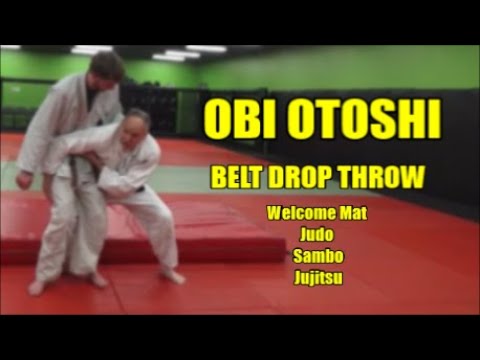
OBI OTOSHI The Belt Drop Throw
0
Obi Otoshi·welcomematstevescott
Obi Otoshi is the Belt Drop and it's not a commonly used throwing technique. It is part of the Kodokan Judo syllabus. G…
Перевод: belt drop
Obi Otoshi is a judo hand technique where the attacker grabs the opponent's belt, lifts them, and drops them to the ground. [1] The attacker secures a deep grip on the opponent's belt with both hands, pulls them close, lifts them off the mat, and drops or throws them to the side. [1] It requires significant upper body strength and is classified in the Gokyo no Waza under te-waza. [1]
Classified in the Kodokan Judo syllabus. [1]
A powerful lifting throw that works best against smaller or lighter opponents. [1] The belt grip provides exceptional control over the opponent's body. Less common in modern competition due to the difficulty of securing deep belt grips, but devastating in no-gi when a body lock replaces the belt grip. [1]
Kodokan judo lineage: Jigoro Kano (1860–1938) systematized this technique as part of the Kodokan judo curriculum. Transmitted through the Kodokan instructor system to judo federations worldwide. Adopted into BJJ through Mitsuyo Maeda → Carlos Gracie → the Gracie family lineage. [1]
Recognized Kodokan judo technique but rarely seen in modern IJF competition due to rule changes favoring forward-throwing techniques. Occasionally appears in kata demonstrations and regional tournaments. [1]
Изображений для этой техники пока нет.
Войдите, чтобы предложить изображение.
Obi Otoshi is the Belt Drop and it's not a commonly used throwing technique. It is part of the Kodokan Judo syllabus. G…
Учебных курсов по этой технике пока нет.
Войдите, чтобы предложить курс.
Риск травмы для человека, к которому применяется техника
Opponent is lifted and dropped.
Уровень мастерства, необходимый для надёжного выполнения техники
Разрешена ли техника по основным соревновательным правилам
Kano, J. Kodokan Judo. Kodansha International.
[1] Kano, J. Kodokan Judo. Kodansha International.
Official Kodokan ground technique classification system
Standard Japanese martial arts terminology (kanji/hiragana)
Established Japanese martial arts naming convention — native Japanese term (和語/漢語)
[1] Kano, J. Kodokan Judo. Kodansha International.
strong grip for belt control, powerful legs for lifting, core strength
forearms (grip), quadriceps (squat + lift), erector spinae, core
Obi otoshi (belt drop) lifts the opponent using the belt grip and drops them. Classified as a te-waza (hand technique) in Kodokan judo. The technique depends heavily on the belt grip, which is restricted under some modern competition rules. (Kano, Kodokan Judo)
Think of yourself as opening a door—you need to hinge at your center as you spin, rotating into your opponent rather than just turning sideways. This hinging motion is crucial for both obi otoshi and similar throws like seoi nage.
Grab the belt quickly during grip fighting, typically with one hand on the belt and your other hand on the lapel. According to Steve Scott, he prefers his left hand on the belt with his right on the lapel, and the idea is to create a low point and high point to execute the throw.
Grab the whole leg area because you'll have a solid 'hook of meat' there that you can use to throw with effectively. Your partner will squat low and use their body to go backwards as you lift them in the air.
Obi Otoshi is a judo hand technique where the attacker grabs the opponent's belt, lifts them, and drops them to the ground. The attacker secures a deep grip on the opponent's belt with both hands, pulls them close, lifts them off the mat, and drops or throws them to the side.
Classified in the Kodokan Judo syllabus.
IJF Judo: Legal: разрешён — Kodokan classified technique; IBJJF: Legal {src:IBJJF Rules Book v6.0, June 2024|/sources/IBJJF: разрешён — Rules-v6.0-June-2024.pdf}; Unified MMA: Legal {src:Unified Rules of MMA, August 2025|/sources/Unified: разрешён — MMA-Rules-August-2025.pdf}; FIAS Sambo: Legal {src:FIAS International Sambo Competition Rules|/sources/FIAS: разрешён — Sambo-Rules.pdf}
Оценка опасности 6/10. High — opponent is lifted and dropped.
Стандартная цепочка подготовки: Grip fight to secure belt → pull close → lift and throw → Push opponent to the ropes/wall → secure belt as they bounce back → lift → After a failed hip throw → switch to belt grip → Obi Otoshi.
Стандартные контрприёмы: Widen stance — make lifting harder / Push hips back — create distance / Drop weight — become heavier and harder to lift.
Распространённые варианты: Forward Obi Otoshi (lifting and throwing forward); Sideways Obi Otoshi (lifting and dropping to the side); Spinning Obi Otoshi (rotating while lifting).
Recognized Kodokan judo technique but rarely seen in modern IJF competition due to rule changes favoring forward-throwing techniques. Occasionally appears in kata demonstrations and regional tournaments.
Основные ошибки, на которые стоит обратить внимание: Shallow belt grip — can't generate lifting power / Lifting with the back instead of legs — injury risk / Not getting close enough — the lift is impossible from distance / Releasing too early — opponent lands on their feet instead of being thrown.
Obi Otoshi также известен как Obi Otoshi, Obi-Otoshi, Belt Drop Throw, Obiotoshi.