O SOTO OTOSHI
0
O Soto Otoshi·Sport-Management- System
Technical judo
Перевод: major outer drop
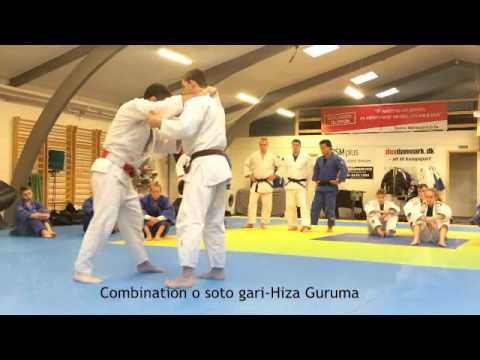
O Soto Otoshi (major outer drop) is an ashi-waza technique closely related to o-soto-gari in which the thrower places the leg behind the opponent's supporting leg as a block or prop rather than reaping it, then drives the opponent backward over the obstruction. [1] The key distinction from o-soto-gari is the leg action — in o-soto-otoshi, the attacking leg does not sweep or reap but simply blocks the opponent's leg in place, and the throwing force comes entirely from the upper-body drive pushing the opponent over the blocked leg. [1],[2] The 'otoshi' (drop) designation indicates that the opponent drops or falls over the blocking leg rather than being swept away by it. [2],[3]
O soto otoshi was classified in the Kodokan system as a distinct technique from o-soto-gari, recognising that the blocking leg action creates different mechanics and tactical applications than the sweeping reap. [1] The technique has been part of the official Kodokan nage-waza catalogue and is widely taught alongside o-soto-gari. [2],[3]
O soto otoshi is part of the Kodokan judo ashi-waza syllabus. [1]
O soto otoshi is scored in IJF competition, often seen in heavyweight divisions. [1]
Изображений для этой техники пока нет.
Войдите, чтобы предложить изображение.
Technical judo
TECHNIQUES JUDO O SOTO OTOSHI- O SOTO GARI
Учебных курсов по этой технике пока нет.
Войдите, чтобы предложить курс.
Риск травмы для человека, к которому применяется техника
O-Soto-Gari is one of judo's most dangerous throws; direct backward fall onto head/spine (Mifune 1956)
Уровень мастерства, необходимый для надёжного выполнения техники
Разрешена ли техника по основным соревновательным правилам
Kodokan Judo — Official Nage-waza Classification
Traditional Judo throwing technique terminology (Kodokan Institute)
Official Kodokan ground technique classification system
Standard Japanese martial arts terminology (kanji/hiragana)
Established Japanese martial arts naming convention — native Japanese term (和語/漢語)
Traditional Judo throwing technique terminology (Kodokan Institute)
precise timing, ankle coordination, upper body kuzushi ability
excellent balance and quick reflexes
tibialis anterior, calves, hip rotators, forearms (grip)
Каждое движение в любом боевом искусстве обладает рядом универсальных свойств. Комбинируйте параметры ниже, чтобы найти нужный инструмент или сравнить аналоги из разных стилей.
O Soto Otoshi (major outer drop) is an ashi-waza technique closely related to o-soto-gari in which the thrower places the leg behind the opponent's supporting leg as a block or prop rather than reaping it, then drives the opponent backward over the obstruction. The key distinction from o-soto-gari is the leg action — in o-soto-otoshi, the attacking leg does not sweep or reap but simply blocks the opponent's leg in place, and the throwing force comes entirely from the upper-body drive pushing the opponent over the blocked leg.
O soto otoshi was classified in the Kodokan system as a distinct technique from o-soto-gari, recognising that the blocking leg action creates different mechanics and tactical applications than the sweeping reap. The technique has been part of the official Kodokan nage-waza catalogue and is widely taught alongside o-soto-gari.
IJF: разрешён — Legal throwing technique; IBJJF: разрешён — Legal at all belt levels; UWW: ограничен — Legal in freestyle, banned in Greco-Roman (no leg attacks below waist); Unified MMA: разрешён — Legal throwing technique; ADCC: разрешён — Legal; FIAS Sport Sambo: разрешён — Legal; FIAS Combat Sambo: разрешён — Legal
Оценка опасности 7/10. Very High — O-Soto-Gari is one of judo's most dangerous throws; direct backward fall onto head/spine (Mifune 1956)
Стандартная цепочка подготовки: Grip Setup (Kumi-kata) → Off-Balance (Kuzushi) → Entry (Tsukuri) → Execution (Kake).
Стандартные контрприёмы: Lower Centre of Gravity — bend knees and drop hips to make the throw harder to execute / Lift the Targeted Leg — raise the foot being attacked above the sweeping action / Counter-Throw — exploit the attacker's committed weight to throw them instead / Grip Break — deny the thrower their preferred gripping configuration.
Распространённые варианты: Forward sweep (sweeping the foot in the direction the opponent is stepping); Rear sweep (sweeping the foot backward as the opponent retreats); Combination sweep (chaining sweeps to both feet); Counter sweep (timing the sweep as the opponent initiates their own attack).
O soto otoshi is scored in IJF competition, often seen in heavyweight divisions.
Основные ошибки, на которые стоит обратить внимание: Trying to sweep or reap — the otoshi version is a block, not a sweep; the leg stays stationary behind the opponent's / Not driving the opponent's upper body down hard enough — the throw requires strong upper body force since the leg is … / Placing the leg too far behind the opponent so there is space between the block and their leg / Not getting close enough — chest-to-chest contact is even more important for otoshi because the upper body does all t….
O Soto Otoshi также известен как Major Outer Drop, Large Outer Drop, O Soto Otoshi.