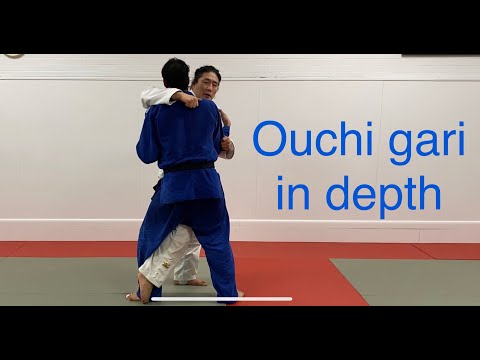
ouchi gari in depth
0
Standard O Uchi Gari·Shintaro Higashi·Added by Admin
Variations of ouchi gari and their finishes. My youtube membership https://www.youtube.com/channel/UC70qwffU7qQvTVm26w…
Перевод: major inner reap
Standard O Uchi Gari executes the classical major inner reap where the thrower steps between the opponent's legs, hooks the far leg's inner ankle or calf with the sole of the foot, and reaps it backward while driving the opponent's upper body rearward with the hands. [1] The opponent, losing their far support, falls backward diagonally over the reaped leg. [1],[2] The throw requires the thrower to commit their weight forward into the space between the opponent's legs while maintaining balance on the support foot. [2],[3]
O uchi gari is one of the most effective combination-starter throws in judo, frequently used to drive the opponent backward and create openings for forward-attacking techniques like seoi nage and uchi mata. [1] As a standalone throw, it produces ippon when the reaping action catches the opponent's full weight on the targeted leg. [2] Its effectiveness is amplified by its low risk — failed attempts rarely result in counter-throws because the attacker maintains an upright posture. [3]
O uchi gari ranks consistently among the most frequently attempted throws at IJF World Championships, though its ippon rate is lower than forward throws because it is more commonly used as a combination setup. [1] Toshihiko Koga (JPN, 1991 World Champion, 1992 Olympic gold) was noted for using o uchi gari as a primary setup for his devastating ippon seoi nage combinations. [2]
Изображений для этой техники пока нет.
Войдите, чтобы предложить изображение.
Variations of ouchi gari and their finishes. My youtube membership https://www.youtube.com/channel/UC70qwffU7qQvTVm26w…
Учебных курсов по этой технике пока нет.
Войдите, чтобы предложить курс.
Риск травмы для человека, к которому применяется техника
O-Uchi-Gari and variants; backward fall risk with head impact (Kano 1986)
Уровень мастерства, необходимый для надёжного выполнения техники
Разрешена ли техника по основным соревновательным правилам
Kodokan Judo — Official Nage-waza Classification
Traditional Judo throwing technique terminology (Kodokan Institute)
Official Kodokan ground technique classification system
Standard Japanese martial arts terminology (kanji/hiragana)
Established Japanese martial arts naming convention — native Japanese term (和語/漢語)
Traditional Judo throwing technique terminology (Kodokan Institute)
driving power, leg strength for the reap, upper body control
long legs for deeper reaping action
glutes, hamstrings, hip adductors, core, shoulders
Shintaro Higashi emphasizes keeping your hand higher to control your opponent's posture better than they can control yours. Position comes first—establish this control before you attack the technique.
No. Shintaro Higashi explains that pulling your opponent toward you breaks their posture forward, which doesn't help you throw them. Instead, drive their weight back, close the distance, and lock your chest up.
Shintaro Higashi teaches that if your opponent shifts away to defend one direction, you can pivot and punch the hand to the chin, push their head to the outside of their foot, and drive them toward you from a different angle.
Shintaro Higashi notes that beginners often lack good off-balance (kuzushi) when setting up o uchi gari, making them vulnerable to the opponent's natural counter—the leg sweep defense is an intuitive, soccer-like movement that's easy to execute without proper technique from the attacker.
Standard O Uchi Gari executes the classical major inner reap where the thrower steps between the opponent's legs, hooks the far leg's inner ankle or calf with the sole of the foot, and reaps it backward while driving the opponent's upper body rearward with the hands. The opponent, losing their far support, falls backward diagonally over the reaped leg.
The standard form of o uchi gari has been a core Kodokan technique since the art's founding, taught as one of the essential attacks for breaking an opponent's balance to the rear. It remains one of the most commonly scored throws in competition judo at all levels.
IJF: разрешён — Legal throwing technique; IBJJF: разрешён — Legal at all belt levels; UWW: ограничен — Legal in freestyle, banned in Greco-Roman (no leg attacks below waist); Unified MMA: разрешён — Legal throwing technique; ADCC: разрешён — Legal; FIAS Sport Sambo: разрешён — Legal; FIAS Combat Sambo: разрешён — Legal
Оценка опасности 6/10. High — O-Uchi-Gari and variants; backward fall risk with head impact (Kano 1986)
Стандартная цепочка подготовки: Grip Setup (Kumi-kata) → Off-Balance (Kuzushi) → Entry (Tsukuri) → Execution (Kake).
Стандартные контрприёмы: Lower Centre of Gravity — bend knees and drop hips to make the throw harder to execute / Lift the Targeted Leg — raise the foot being attacked above the sweeping action / Counter-Throw — exploit the attacker's committed weight to throw them instead / Grip Break — deny the thrower their preferred gripping configuration.
Распространённые варианты: Standing reap (full commitment reap with maximum body weight behind the …); Hopping reap (hopping forward while reaping for deeper penetration); Combination reap (chaining inside and outside reaps to catch the opponent a…); Counter reap (reaping as the opponent steps forward or attacks).
O uchi gari ranks consistently among the most frequently attempted throws at IJF World Championships, though its ippon rate is lower than forward throws because it is more commonly used as a combination setup. Toshihiko Koga (JPN, 1991 World Champion, 1992 Olympic gold) was noted for using o uchi gari as a primary setup for his devastating ippon seoi nage combinations.
Основные ошибки, на которые стоит обратить внимание: Not stepping between the opponent's feet first — reaping from outside range results in a weak, glancing reap / Reaping upward instead of backward — the calf sweeps the ankle backward, not upward / Not pushing the opponent's shoulders backward in coordination with the reap / Reaping too high on the leg — the ankle is the target for maximum mechanical advantage.
Standard O Uchi Gari также известен как O Uchi Gari, Classical Major Inner Reaping Throw, Standard Large Inner Reap, Standard Inside Leg Reap.