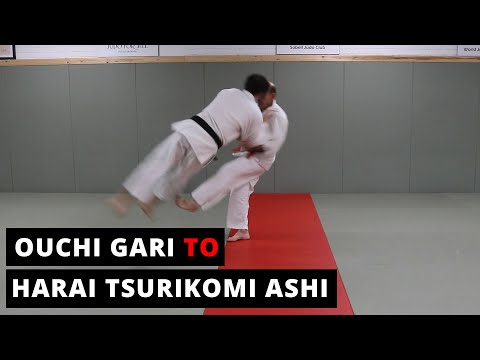
Ouchi Gari setup for Harai Tsurikomi Ashi
0
Harai Tsurikomi Ashi·Sampson Judo
Here's a beautiful combination that I am a very big fan of - Ouchi Gari into Harai Tsurikomi Ashi. This combination is e…
Перевод: sweeping drawing ankle
Harai Tsurikomi Ashi (lifting-pulling foot sweep) is a judo foot technique in which the thrower combines a strong tsurikomi (lifting-pulling) hand action with a sweeping action of the foot against the opponent's lead ankle. [1] Unlike de ashi barai, which relies primarily on catching the opponent's foot mid-step, harai tsurikomi ashi uses the hands to actively lift and pull the opponent forward and onto their toes, then sweeps the loaded foot out from under them. [1],[2] The lifting action of the tsurite (lapel hand) elevates the opponent's centre of gravity while the hikite (sleeve hand) pulls them laterally, creating a diagonal force line that the foot sweep completes. [2],[3]
Harai tsurikomi ashi was included in the Kodokan gokyo as a second-set technique, representing a more advanced application of the foot sweep concept that integrates active hand manipulation. [1] The technique's emphasis on tsurikomi (lifting-pulling) action reflects Kano's pedagogical progression from simple sweeps to more complex hand-foot coordination. [2],[3]
Harai tsurikomi ashi is a regular scoring technique in IJF judo competition. [1]
Изображений для этой техники пока нет.
Войдите, чтобы предложить изображение.
Here's a beautiful combination that I am a very big fan of - Ouchi Gari into Harai Tsurikomi Ashi. This combination is e…
Учебных курсов по этой технике пока нет.
Войдите, чтобы предложить курс.
Риск травмы для человека, к которому применяется техника
Foot sweeps use timing over force; lower impact but head strike risk remains
Уровень мастерства, необходимый для надёжного выполнения техники
Разрешена ли техника по основным соревновательным правилам
Kodokan Judo — Official Nage-waza Classification
Traditional Judo throwing technique terminology (Kodokan Institute)
Official Kodokan ground technique classification system
Standard Japanese martial arts terminology (kanji/hiragana)
Established Japanese martial arts naming convention — native Japanese term (和語/漢語)
Traditional Judo throwing technique terminology (Kodokan Institute)
precise timing, ankle coordination, upper body kuzushi ability
excellent balance and quick reflexes
tibialis anterior, calves, hip rotators, forearms (grip)
Каждое движение в любом боевом искусстве обладает рядом универсальных свойств. Комбинируйте параметры ниже, чтобы найти нужный инструмент или сравнить аналоги из разных стилей.
Sampson Judo emphasizes that the lower your foot is, the more leverage you have on the throw. If you come up too high, the technique won't work effectively, so you need to push as far back as possible from a low position.
According to Sampson Judo, the action is a two-step motion: first you kick, then you sweep. The leg comes up to kick and then executes the sweep as one continuous flowing action.
Sampson Judo stresses that 'a lot of pushing' is required—you need to push your opponent backwards with significant force, similar to how you would control them in ashiwaza, to generate the momentum needed for the throw.
Harai Tsurikomi Ashi (lifting-pulling foot sweep) is a judo foot technique in which the thrower combines a strong tsurikomi (lifting-pulling) hand action with a sweeping action of the foot against the opponent's lead ankle. Unlike de ashi barai, which relies primarily on catching the opponent's foot mid-step, harai tsurikomi ashi uses the hands to actively lift and pull the opponent forward and onto their toes, then sweeps the loaded foot out from under them.
Harai tsurikomi ashi was included in the Kodokan gokyo as a second-set technique, representing a more advanced application of the foot sweep concept that integrates active hand manipulation. The technique's emphasis on tsurikomi (lifting-pulling) action reflects Kano's pedagogical progression from simple sweeps to more complex hand-foot coordination.
IJF: разрешён — Legal throwing technique; IBJJF: разрешён — Legal at all belt levels; UWW: ограничен — Legal in freestyle, banned in Greco-Roman (no leg attacks below waist); Unified MMA: разрешён — Legal throwing technique; ADCC: разрешён — Legal; FIAS Sport Sambo: разрешён — Legal; FIAS Combat Sambo: разрешён — Legal
Оценка опасности 4/10. Moderate — foot sweeps use timing over force; lower impact but head strike risk remains
Стандартная цепочка подготовки: Grip Setup (Kumi-kata) → Off-Balance (Kuzushi) → Entry (Tsukuri) → Execution (Kake).
Стандартные контрприёмы: Lower Centre of Gravity — bend knees and drop hips to make the throw harder to execute / Lift the Targeted Leg — raise the foot being attacked above the sweeping action / Counter-Throw — exploit the attacker's committed weight to throw them instead / Grip Break — deny the thrower their preferred gripping configuration.
Распространённые варианты: Forward sweep (sweeping the foot in the direction the opponent is stepping); Rear sweep (sweeping the foot backward as the opponent retreats); Combination sweep (chaining sweeps to both feet); Counter sweep (timing the sweep as the opponent initiates their own attack).
Harai tsurikomi ashi is a regular scoring technique in IJF judo competition.
Основные ошибки, на которые стоит обратить внимание: Not lifting the opponent before sweeping — the lift is what makes the foot light enough to sweep / Sweeping the wrong foot — target the foot that the opponent's weight is moving toward / Lifting without sweeping, or sweeping without lifting — both components must be simultaneous / Pulling the opponent downward instead of upward — the lift must elevate them before the sweep takes their base.
Harai Tsurikomi Ashi также известен как Harai Tsurikomi Ashi, Lifting Pulling Foot Sweep, Harai Tsuri Komi Ashi, Sweeping Drawing Ankle.