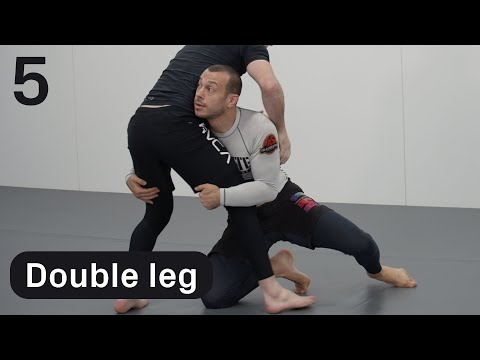
Basic Double Leg Takedown
0
Standard Run-The-Pipe Double·Absolute MMA St Kilda - Melbourne
Full Course Playlist → https://youtube.com/playlist?list=PLDrQXekZsfYZfV1QZ4T5UkxLwFwQ12EbP Find the Introduction course…
Перевод: standard run-the-pipe double
The Standard Run-The-Pipe Double executes the fundamental lateral-finish double leg where the attacker secures both legs after a penetration step, lifts them to one side, and then runs in a circular arc while keeping the legs elevated. [1] The running motion generates centrifugal force that makes it impossible for the opponent to maintain balance on one or no legs. [1],[2] The attacker maintains head position on the inside hip, chest pressure against the opponent's thighs, and continuous circular movement until the opponent topples. [2] This finish is the standard secondary option when a blast-through fails. [2],[3]
Running the pipe is one of the most reliable double-leg finishes because the continuous forward drive prevents the opponent from establishing a defensive base. [1] The technique converts horizontal momentum into a takedown by keeping the head tight and the feet driving in short, choppy steps through the opponent. [1] It is particularly effective against opponents who square their hips after initial contact rather than sprawling immediately. [2]
The run-the-pipe double is a standard finish seen in NCAA and freestyle competition. [1]
Изображений для этой техники пока нет.
Войдите, чтобы предложить изображение.
Full Course Playlist → https://youtube.com/playlist?list=PLDrQXekZsfYZfV1QZ4T5UkxLwFwQ12EbP Find the Introduction course…
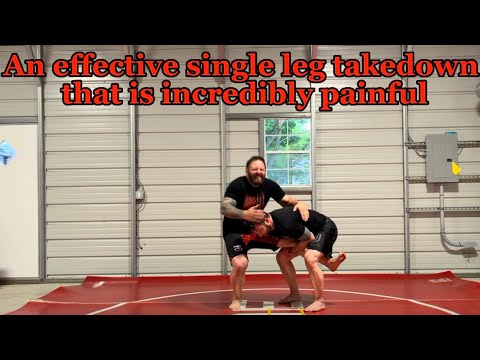
All of us will get into a position called the “mid level” where we get the single leg off the floor, and our hands are l…
No surprise here. It's nothing but high level takedowns as athletes gather at Legion to learn the world's greatest taked…
The standard run-the-pipe double is a mid-level single-leg finishing technique used when the attacker cannot achieve the outside corner position during a double-leg takedown entry. Breza-Grappling explains that run-the-pipe involves circling toward the opponent's heel to eliminate their balance, then pulling the leg straight down in a piping motion—named after the mechanics of moving pipe through a trench. The technique can be combined with a humeral bone (arm bone) to femur pressure application: the attacker locks their upper arm against the opponent's thigh and squats, creating intense pressure that encourages the opponent to drop. Breza-Grappling emphasizes maintaining head position in the ribs, keeping the back straight, and moving quickly to prevent the opponent from establishing base. The instructor notes this finish is particularly effective when athletic opponents defend the standard run-the-pipe pull by bouncing on their toes, as the pressure variation forces capitulation. Absolute MMA St Kilda's foundational double-leg coverage establishes the entry mechanics—dropping level, stepping with the lead leg, placing the lead knee down, and driving through with the back leg—principles that underpin successful mid-level transitions. Legion AJJ's training emphasis on stance work, balance disruption, and footwork supports the positional requirements for effective run-the-pipe execution.
Сформировано на основе 3 инструкторов
Учебных курсов по этой технике пока нет.
Войдите, чтобы предложить курс.
Риск травмы для человека, к которому применяется техника
Double leg drives through opponent; moderate impact on landing
Уровень мастерства, необходимый для надёжного выполнения техники
Разрешена ли техника по основным соревновательным правилам
Japanese amateur wrestling terminology
Japanese amateur wrestling terminology
Standard katakana transliteration of Western martial arts terminology (外来語) — used in Japanese MMA, boxing, and BJJ communities
Standard katakana transliteration used in Japanese wrestling (レスリング)
explosive lower body power, level change speed, forward drive
stocky build with strong legs and low centre of gravity
quadriceps, glutes, hamstrings, core, shoulders
According to Absolute MMA St Kilda, you should position yourself just outside of striking/reaching range. Use the arm-length test: extend your arm straight—if you can't reach your opponent, they can't reach you. You want to be close enough to avoid covering too much ground, but far enough that they can't block your legs or strike you.
Lead with your lead leg (front leg) rather than your trail leg, as Absolute MMA St Kilda explains. Your lead leg is already forward and will cover ground faster, making the entry quicker and more effective.
Stepping deep ensures proper posture and drive. Absolute MMA St Kilda notes that a deep step allows you to keep your upper body tall and generates better drive to complete the takedown, whereas shallow steps result in poor posture and reduced effectiveness against sprawls.
Absolute MMA St Kilda points out that beginners often drop their back knee to the ground instead of their front knee, which eliminates your driving power and makes the takedown less effective and more dangerous.
The Standard Run-The-Pipe Double executes the fundamental lateral-finish double leg where the attacker secures both legs after a penetration step, lifts them to one side, and then runs in a circular arc while keeping the legs elevated. The running motion generates centrifugal force that makes it impossible for the opponent to maintain balance on one or no legs.
Run-the-pipe finishing was systematised in American folkstyle wrestling as coaches identified the lateral finish as a reliable backup to forward-drive doubles. The technique is now taught as part of the standard double-leg finishing curriculum worldwide.
IJF: запрещён — Banned since 2010 leg grab prohibition — direct hansoku-make for touching opp…; IBJJF: разрешён — Legal at all belt levels, scored as takedown (2 points); UWW: ограничен — Legal in freestyle (2-4 points), banned in Greco-Roman (no attacks below waist); Unified MMA: разрешён — Legal takedown technique; ADCC: разрешён — Legal, scored 2-4 points in second half of match; FIAS Sport Sambo: разрешён — Legal — all takedowns permitted; FIAS Combat Sambo: разрешён — Legal; NCAA Folkstyle: разрешён — Legal, scored as takedown (2 points)
Оценка опасности 4/10. Moderate — double leg drives through opponent; moderate impact on landing
Стандартная цепочка подготовки: Establish Contact → Create Off-Balance → Execute the Takedown → Follow to Ground.
Стандартные контрприёмы: Sprawl — drop hips back and drive weight down to stuff the takedown attempt / Underhook — establish inside position to control distance and prevent the takedown entry / Post and Circle — post on the attacker's head and circle away to break their angle / Level Change Defence — recognize the shot early and react with appropriate hip defence.
Распространённые варианты: Blast double (high-impact forward drive through the opponent without ch…); Snatch double (pulling both legs together and driving laterally); Run-the-pipe double (running through the opponent in a linear drive); Low double (deep penetration step attacking below the knees).
The run-the-pipe double is a standard finish seen in NCAA and freestyle competition.
Основные ошибки, на которые стоит обратить внимание: Slow, heavy steps that give the opponent time to post a hand and brace / Running the arc too wide — stay tight to the opponent's body / Not pinching the legs together, letting one slip free during the run / Head position away from the opponent instead of driving into their hip.
Standard Run-The-Pipe Double также известен как Ran Za Paipu Daburu, Lateral Finish Double TD, Running Double Leg, Circle-Out Double.