Aiki Wrist Locks for BJJ: Kote Gaeshi
0
Kote Gaeshi·Robert Silas (Aiki_and_Jiu)
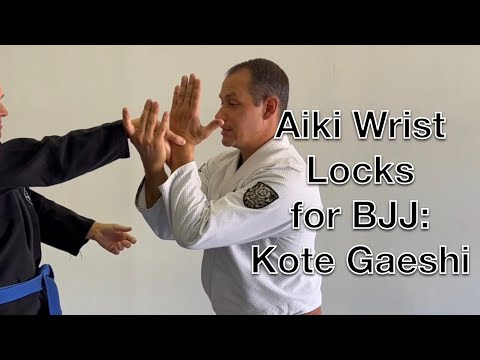
Aiki Wrist Locks for BJJ: Kote Gaeshi In this video I show two variations of kote gaeshi, a wrist lock known in aikijuj…
Перевод: wrist turn-out
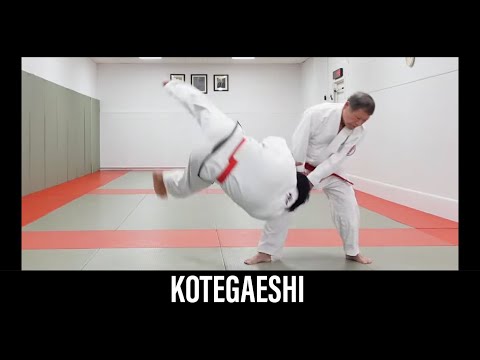
Kote Gaeshi (小手返し, "wrist turn-out") is an outward-rotating wrist technique in which the practitioner turns the opponent's hand outward — combining forearm supination with wrist flexion — to load the radiocarpal and distal radioulnar joints and break the opponent's balance toward their little-finger side. [1] One hand wraps the back of the opponent's hand so the thumb sits across the base of the knuckles and the fingers cup the little-finger edge, while the other hand fixes the forearm; rotating the hand outward and down drives the torsion through the wrist and forearm. [2] In aikido, aikijujutsu, and classical jujutsu it is most often expressed as a throw: the wrist torsion off-balances the attacker and projects them to the ground, where the same grip is retained as a pin or wrist submission. [1],[3] In Brazilian jiu-jitsu and submission grappling — and as self-defence in judo, where its competitive use is restricted — the identical mechanic is applied as a standing or ground wrist lock. [4] Because the wrist is a small joint with little muscular protection, kote gaeshi can be effective at low force, so controlling the speed of the rotation is essential to avoid injury.
Kote gaeshi is a foundational technique of Daitō-ryū Aiki-jūjutsu, from which Morihei Ueshiba systematised it into modern aikido as one of the core wrist techniques. [1],[2] In aikido it appears in both entering (omote) and turning (ura) forms and is central to empty-hand and weapon-disarming (tanto-dori) practice. [1] The same outward wrist-turn appears in classical jujutsu and in Korean hapkido, where comparable wrist reversals are core curriculum. [3] In Kodokan judo the wrist is excluded from competition joint-locking — kansetsu-waza is limited to the elbow — so kote gaeshi survives there as self-defence (goshin-jutsu) rather than a contest technique, while in Shodokan (Tomiki) aikido it is one of the techniques permitted in tanto randori competition. [4] Comparison to Chinese Qin Na: the same outward wrist reversal is documented in Chinese Qin Na (擒拿, the joint-locking art embedded in many Chinese martial styles) as Small Wrap Hand (小纏手, Xiǎo Chán Shǒu), recorded by Dr. Yang Jwing-Ming as a form of White Crane (Bai He) 'crane wing dropping.' [5] Both share the identical outward rotation but are named from opposite ends: the Japanese 小手返 names the motion (返, 'to turn back / reverse'), whereas the Chinese 小纏手 names the grip (纏, 'to coil / entwine'), reflecting a more wrapping, meshing hold rather than aikido's open blade-hand. That open hand is consistent with aikido and Daitō-ryū's documented sword-influenced method — the hand held as tegatana (手刀, 'hand-sword'), the doctrine of riai that empty-hand technique mirrors the sword, and kote gaeshi's own use as a weapon disarm (tanto-dori) — against the backdrop of jūjutsu's origins as battlefield grappling for an armed and armoured warrior. [6],[7],[8] Full disclosure on the limits of this comparison: no source derives either technique from the other, and none attributes the Japanese open-hand form specifically to weapon retention — Ellis Amdur, the leading historian of aiki's weapon origins, cautions that the broad 'empty hand comes from the sword' claim is overstated. The shared mechanics are best read as convergent joint-locking, and the weapon-context reading of the grip as an informed interpretation, not a documented fact. [6]
As a throw, kote gaeshi is highly effective against committed grabs and strikes because it uses the attacker's forward momentum, projecting them with little strength once balance is broken. [1] As a submission it is a low-force wrist lock that is reliable from standing exchanges and against a posted hand on the ground, though in live grappling it is harder to finish on a relaxed, well-postured opponent who can rotate with the pressure. [2] Its dual nature — throw and lock from the same grip — makes it valuable in transition: a defended throw flows into a wrist submission, and a defended submission flows back into the projection.
Daitō-ryū Aiki-jūjutsu → aikido (Ueshiba); parallel forms in classical jujutsu and Korean hapkido.
Restricted in Kodokan/IJF judo (wrist excluded from kansetsu-waza). Applied as a wrist-lock submission in BJJ (typically brown/black belt) and occasionally MMA; a sanctioned technique in Shodokan (Tomiki) aikido tanto randori. [4]
Изображений для этой техники пока нет.
Войдите, чтобы предложить изображение.
Aiki Wrist Locks for BJJ: Kote Gaeshi In this video I show two variations of kote gaeshi, a wrist lock known in aikijuj…
KOTEGEASHI is a popular write throwing technique in Japanese Jiujitsu and Aikido. Here is a classic move from Tradition…
Учебных курсов по этой технике пока нет.
Войдите, чтобы предложить курс.
Риск травмы для человека, к которому применяется техника
Outward wrist torsion loads the small radiocarpal and distal radioulnar joints; effective at low force and capable of ligament damage or fracture if applied explosively
Уровень мастерства, необходимый для надёжного выполнения техники
Разрешена ли техника по основным соревновательным правилам
Aikido / Daitō-ryū Aiki-jūjutsu — Kote Gaeshi (小手返し)
[1] Westbrook, A. & Ratti, O., Aikido and the Dynamic Sphere: An Illustrated Introduction (Tuttle Publishing, 1970) — illustrates kote gaeshi as throw and pin
[2] Shioda, Gozo, Dynamic Aikido (Kodansha International, 1968) — execution mechanics of the wrist turn-out
[3] Saito, Morihiro, Traditional Aikido (Minato Research & Publishing, 1973–76) — omote/ura forms and tanto-dori
[4] Kano, Jigoro, Kodokan Judo (Kodansha, 1986) — kansetsu-waza scope (elbow only), explaining judo's restriction
Official Kodokan ground technique classification system
Aikido technique naming conventions
Standard Japanese martial arts terminology (kanji/hiragana)
Established Japanese martial arts naming convention — native Japanese term (和語/漢語)
[5] Yang, Jwing-Ming, Comprehensive Applications of Shaolin Chin Na (YMAA Publication Center, 1995) — Ch. 6, Technique #5 'Small Wrap Hand' (小纏手, Xiao Chan Shou), p. 254, classed as a White Crane wrist Qin Na (full text available via archive.org)
[6] Amdur, Ellis, 'The Use of Weapons in Aikidō Training' (kogenbudo.org) and Hidden in Plain Sight — documents that the sword-derivation of aikido's empty-hand technique (riai) is the dominant doctrine while cautioning that it is overstated
[1] Westbrook, A. & Ratti, O., Aikido and the Dynamic Sphere: An Illustrated Introduction (Tuttle Publishing, 1970) — illustrates kote gaeshi as throw and pin
[2] Shioda, Gozo, Dynamic Aikido (Kodansha International, 1968) — execution mechanics of the wrist turn-out
[3] Saito, Morihiro, Traditional Aikido (Minato Research & Publishing, 1973–76) — omote/ura forms and tanto-dori
[4] Kano, Jigoro, Kodokan Judo (Kodansha, 1986) — kansetsu-waza scope (elbow only), explaining judo's restriction
[5] Yang, Jwing-Ming, Comprehensive Applications of Shaolin Chin Na (YMAA Publication Center, 1995) — Ch. 6, Technique #5 'Small Wrap Hand' (小纏手, Xiao Chan Shou), p. 254, classed as a White Crane wrist Qin Na (full text available via archive.org)
[6] Amdur, Ellis, 'The Use of Weapons in Aikidō Training' (kogenbudo.org) and Hidden in Plain Sight — documents that the sword-derivation of aikido's empty-hand technique (riai) is the dominant doctrine while cautioning that it is overstated
[7] Tegatana (手刀, 'hand-sword') and ken-tai-jō riai — the open blade-hand as sword substitute in aikido pedagogy (Iwama/Saitō tradition; British Aikido Board glossary)
[8] Erard, Guillaume, 'A Thorough Look into the Secret Scrolls of Daitō-ryū, Part 4' (guillaumeerard.com) — ryōte-dori kote-gaeshi in the Daitō-ryū hiden mokuroku scroll; kote (小手) = forearm/wrist
timing, off-balancing (kuzushi), grip sensitivity
relaxed power and footwork over hand strength
forearm flexors and supinators, intrinsic hand muscles, core for the turn
Robert Silas emphasizes grabbing the "meat" of the hand with your thumb on the back, rather than just gripping the wrist itself. If you only grab the wrist, your opponent can pull out, but controlling the meat of the hand makes it much harder for them to escape.
Robert Silas explains that while traditional Aikido emphasizes bending the wrist forward and backward, turning the wrist out (externally) and bending it down is more painful and harder to escape than the traditional "goose neck" position.
The key is to keep your opponent's palm pressed toward the mat and maintain control—even without bicep pressure, just pinning the palm down completes the technique. Do not let go, as your opponent can turn their hand back out and create a scramble.
Yes—by engaging the wrist and elbow, you can create an unbalancing throw that can be very painful. However, Robert Silas cautions that if you launch your opponent too far away, you lose control; it's better to drop them straight down if you want to pin them afterward.
Kote Gaeshi (小手返し, "wrist turn-out") is an outward-rotating wrist technique in which the practitioner turns the opponent's hand outward — combining forearm supination with wrist flexion — to load the radiocarpal and distal radioulnar joints and break the opponent's balance toward their little-finger side. One hand wraps the back of the opponent's hand so the thumb sits across the base of the knuckles and the fingers cup the little-finger edge, while the other hand fixes the forearm; rotating the hand outward and down drives the torsion through the wrist and forearm.
Kote gaeshi is a foundational technique of Daitō-ryū Aiki-jūjutsu, from which Morihei Ueshiba systematised it into modern aikido as one of the core wrist techniques. In aikido it appears in both entering (omote) and turning (ura) forms and is central to empty-hand and weapon-disarming (tanto-dori) practice.
IBJJF: разрешён — Legal at all adult belt levels (wrist locks are permitted; only finger/toe sm…; IJF: запрещён — Judo restricts kansetsu-waza to the elbow; wrist locks such as kote gaeshi ar…; ADCC: разрешён — Legal — all submissions permitted; Unified MMA: разрешён — Legal submission (not small-joint manipulation); Shodokan Aikido: разрешён — Permitted technique in tanto randori competition (Tomiki system)
Оценка опасности 6/10. Outward wrist torsion loads the small radiocarpal and distal radioulnar joints; effective at low force and capable of ligament damage or fracture if applied explosively
Стандартная цепочка подготовки: Off-balance (kuzushi) → Capture the hand → Fix the forearm → Turn outward and down → Retain for the finish.
Стандартные контрприёмы: Follow the rotation — turn with the wrist and breakfall (ukemi) to relieve the torsion before it reaches threshold / Post and posture early — recognise the hand-wrap and straighten the arm to deny the bend / Close the distance — step in toward the thrower to collapse the rotation angle / Free the trapped hand — strip the grip before the forearm is fixed.
Распространённые варианты: Omote / irimi form (entering version: step toward the attacker and project th…); Ura / tenkan form (turning version: pivot off-line and lead the attacker aro…); Standing wrist lock (apply the outward rotation as a controlling submission wi…); Ground wrist lock (catch a posted hand from guard, mount, or side control an…); Tanto-dori application (disarming version against a knife thrust in aikido).
Restricted in Kodokan/IJF judo (wrist excluded from kansetsu-waza). Applied as a wrist-lock submission in BJJ (typically brown/black belt) and occasionally MMA; a sanctioned technique in Shodokan (Tomiki) aikido tanto randori.
Основные ошибки, на которые стоит обратить внимание: Muscling the wrist instead of breaking balance first — without kuzushi the opponent simply steps out of the rotation / Gripping only the hand — the forearm must be controlled or the torsion is absorbed by the elbow and shoulder / Rotating explosively — the crossing forearm bones can fracture; pressure should be steady and increasing / Turning the wrist the wrong way — kote gaeshi is an outward (supinating) turn; flexing it the other direction becomes….
Kote Gaeshi также известен как Kote Gaeshi, Kotegaeshi, Kote-gaeshi, Wrist-turn throw, Outward wrist throw.