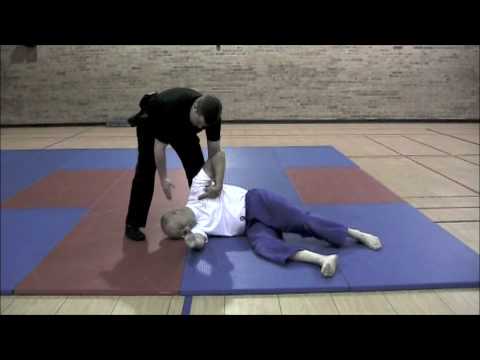
Figure Four Throw
0
From Prone Control·SpartanCops·Added by Admin
Перевод: from prone control
The figure-four wrist lock from prone control is applied by trapping the face-down opponent's wrist and locking a figure-four grip configuration to apply concentrated flexion force. [1],[2] The prone position prevents the opponent from rotating to relieve pressure, and the figure-four grip provides enough leverage to bend the wrist against muscular resistance. [1] The technique is commonly applied when the opponent extends an arm to post or attempt a turnover, exposing the wrist to the figure-four trap. [1],[2]
Figure-four wrist locks from prone control positions are widely used in law enforcement and military restraint training, where the face-down handcuffing position naturally exposes the wrist to manipulation. [1],[2] In sport grappling, the technique developed as top players found the figure-four provided enough mechanical advantage to finish wrist locks through the resistance of prone opponents. [1] The method bridges tactical restraint and sport submission. [1],[2]
Prone control submissions attack a face-down opponent with chokes, cranks, and arm locks, exploiting a position where the bottom player has limited defensive options. [1]
Prone control attacks were developed in catch wrestling (the 'chain wrestling' system) and adopted into modern BJJ. [1]
Prone position chokes and cranks are used in both MMA (ground-and-pound to submission sequences) and advanced BJJ competition. [1]
Изображений для этой техники пока нет.
Войдите, чтобы предложить изображение.
Учебных курсов по этой технике пока нет.
Войдите, чтобы предложить курс.
Риск травмы для человека, к которому применяется техника
Wrist lock variant targeting carpal and radioulnar joints through forced deviation or torsion
Уровень мастерства, необходимый для надёжного выполнения техники
Разрешена ли техника по основным соревновательным правилам
Japanese pro wrestling/judo standard terminology; widely used in Japanese grappling
Japanese pro wrestling/judo standard terminology; widely used in Japanese grappling
Standard Japanese martial arts terminology (kanji/hiragana)
Established Japanese martial arts naming convention — native Japanese term (和語/漢語)
Japanese terminology sourced from Japanese pro wrestling/judo standard terminology; widely used in Japanese grappling
fine motor control, grip sensitivity, quick hand transitions
dexterous hands with strong fingers
forearm flexors and extensors, intrinsic hand muscles
Avoid coming in at a 90-degree angle from the side, as the opponent's shoulder will block your knee from penetrating deep. Instead, come from a different angle so you can rest the point of your knee on top of their head for better control (SpartanCops).
Go shallow with your arm entry, positioning your hand just past the opponent's forearm where your thumb starts to curve their arm, then roll it in tightly to take away space (SpartanCops).
Use your forearm as a lever against their shoulder to push it forward while moving their hand behind their shoulder—this removes their position of strength (SpartanCops).
The figure-four wrist lock from prone control is applied by trapping the face-down opponent's wrist and locking a figure-four grip configuration to apply concentrated flexion force. The prone position prevents the opponent from rotating to relieve pressure, and the figure-four grip provides enough leverage to bend the wrist against muscular resistance.
Figure-four wrist locks from prone control positions are widely used in law enforcement and military restraint training, where the face-down handcuffing position naturally exposes the wrist to manipulation. In sport grappling, the technique developed as top players found the figure-four provided enough mechanical advantage to finish wrist locks through the resistance of prone opponents.
IBJJF: разрешён — Legal at all belt levels; IJF: запрещён — Only elbow joint locks (kansetsu-waza) permitted in judo — all other joint lo…; ADCC: разрешён — Legal — all submissions legal in ADCC; Unified MMA: разрешён — Legal submission technique; FIAS Sport Sambo: разрешён — Legal; FIAS Combat Sambo: разрешён — Legal
Оценка опасности 5/10. Wrist lock variant targeting carpal and radioulnar joints through forced deviation or torsion
Стандартная цепочка подготовки: Establish Position → Create the Threat → Secure the Hold → Finish.
Стандартные контрприёмы: Early Recognition — identify the submission attempt early and begin defence immediately / Posture and Base — maintain strong posture and base to prevent submission setups / Grip Fight — deny the attacker their preferred gripping configuration.
Распространённые варианты: Standard wrist lock (kote gaeshi) (two-handed rotational lock on the wrist); Gooseneck wrist lock (flexion lock bending the wrist down toward the forearm); Standing wrist lock (applied during grip fighting or a standing exchange); Ground wrist lock (catching the opponent's posted hand from mount, side cont…).
Prone position chokes and cranks are used in both MMA (ground-and-pound to submission sequences) and advanced BJJ competition.
Основные ошибки, на которые стоит обратить внимание: Not maintaining control while attacking — the prone opponent will scramble to escape; maintain chest-to-back contact … / Attempting submissions before establishing control — secure the riding position first, then identify which limbs are … / Not using body weight — from prone control, body weight is your primary tool; lifting off to apply a technique allows… / Ignoring the back-take — from prone control, the back take is often the highest-percentage option; don't skip it for ….
From Prone Control также известен как Fuse Seigyo kara, Ground Figure-Four Wrist Lock, Prone Figure-4 Lock.