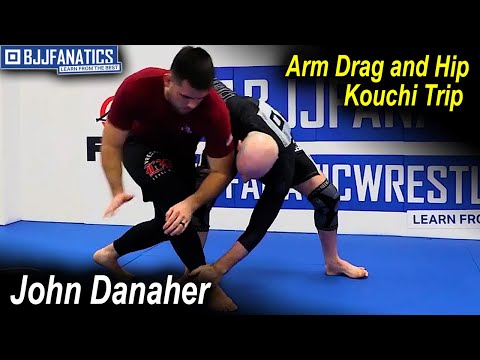
Arm Drag and Hip Kouchi Trip by John Danaher
0
Arm Drag Gi Specific Grip·BJJ Fanatics
ARM DRAG AND HIP KOUCHI TRIP https://bjjfanatics.com John Danaher teaches how to do the Arm Drag and Hip Kouchi Trip BJ…
Перевод: arm drag gi-specific grip
The arm drag with gi-specific grip uses the lapel, sleeve, or cuff of the gi uniform to secure the controlling grip for both the drag and the wrist lock, creating friction-based control that is impossible to replicate without the gi. [1],[2] The gi fabric allows the attacker to maintain the wrist in flexion even against resistance, as the sleeve grip prevents the opponent from rotating the hand free. [1] The combination of cloth friction and wrist flexion makes this a particularly effective variant in gi grappling competition. [1],[2]
Gi-based grip manipulation for joint locks is a hallmark of judo and classical jujutsu, where the uniform was designed in part to facilitate grip-based technique practice. [1],[2] The arm drag with gi-specific gripping evolved in BJJ as practitioners combined the wrestling arm drag concept with the traditional Japanese emphasis on sleeve and lapel control. [1] This variant exemplifies the gi-versus-nogi technical divide in modern grappling, where fabric grips create distinct submission opportunities. [1],[2]
Gi-specific arm drags utilise sleeve and lapel grips to generate more control and pulling force than no-gi arm drags. [1]
Gi arm drag variations were developed in BJJ competition where sleeve and lapel grips provide additional control options. [1]
Gi-specific arm drags are commonly used at IBJJF gi competitions at all belt levels. [1]
Изображений для этой техники пока нет.
Войдите, чтобы предложить изображение.
ARM DRAG AND HIP KOUCHI TRIP https://bjjfanatics.com John Danaher teaches how to do the Arm Drag and Hip Kouchi Trip BJ…
Учебных курсов по этой технике пока нет.
Войдите, чтобы предложить курс.
Риск травмы для человека, к которому применяется техника
Wrist lock variant targeting carpal and radioulnar joints through forced deviation or torsion
Уровень мастерства, необходимый для надёжного выполнения техники
Разрешена ли техника по основным соревновательным правилам
Japanese wrestling/BJJ standard terminology; widely used in Japanese competition
Japanese wrestling/BJJ standard terminology; widely used in Japanese competition
Mixed Japanese-Western terminology — combines traditional Japanese terms with katakana loanwords
Japanese terminology sourced from Japanese wrestling/BJJ standard terminology; widely used in Japanese competition
fine motor control, grip sensitivity, quick hand transitions
dexterous hands with strong fingers
forearm flexors and extensors, intrinsic hand muscles
Step in a second time and plant your foot right behind your opponent's foot, then reach down to their ankle and push forward to your chest to knock them down to the mat. John Danaher emphasizes the importance of this foot placement before executing the finishing mechanics.
The arm drag with gi-specific grip uses the lapel, sleeve, or cuff of the gi uniform to secure the controlling grip for both the drag and the wrist lock, creating friction-based control that is impossible to replicate without the gi. The gi fabric allows the attacker to maintain the wrist in flexion even against resistance, as the sleeve grip prevents the opponent from rotating the hand free.
Gi-based grip manipulation for joint locks is a hallmark of judo and classical jujutsu, where the uniform was designed in part to facilitate grip-based technique practice. The arm drag with gi-specific gripping evolved in BJJ as practitioners combined the wrestling arm drag concept with the traditional Japanese emphasis on sleeve and lapel control.
IBJJF: разрешён — Legal at all belt levels; IJF: запрещён — Only elbow joint locks (kansetsu-waza) permitted in judo — all other joint lo…; ADCC: разрешён — Legal — all submissions legal in ADCC; Unified MMA: разрешён — Legal submission technique; FIAS Sport Sambo: разрешён — Legal; FIAS Combat Sambo: разрешён — Legal
Оценка опасности 5/10. Wrist lock variant targeting carpal and radioulnar joints through forced deviation or torsion
Стандартная цепочка подготовки: Establish Position → Create the Threat → Secure the Hold → Finish.
Стандартные контрприёмы: Early Recognition — identify the submission attempt early and begin defence immediately / Posture and Base — maintain strong posture and base to prevent submission setups / Grip Fight — deny the attacker their preferred gripping configuration.
Распространённые варианты: Standard wrist lock (kote gaeshi) (two-handed rotational lock on the wrist); Gooseneck wrist lock (flexion lock bending the wrist down toward the forearm); Standing wrist lock (applied during grip fighting or a standing exchange); Ground wrist lock (catching the opponent's posted hand from mount, side cont…).
Gi-specific arm drags are commonly used at IBJJF gi competitions at all belt levels.
Основные ошибки, на которые стоит обратить внимание: Using a loose sleeve grip — the gi grip must be firm; a loose grip allows the opponent to strip it before the drag / Gripping too far up the sleeve — grip at the wrist for maximum control; gripping at the elbow reduces leverage / Not cross-gripping — the drag works best with a cross-grip (right hand on their right sleeve); same-side grips create… / Holding the sleeve without dragging — the grip is the setup, not the technique; the drag must follow quickly before t….
Arm Drag Gi Specific Grip также известен как Dōgi Gurippu Āmu Doraggu, Gi Grip Arm Drag, Lapel Arm Drag.