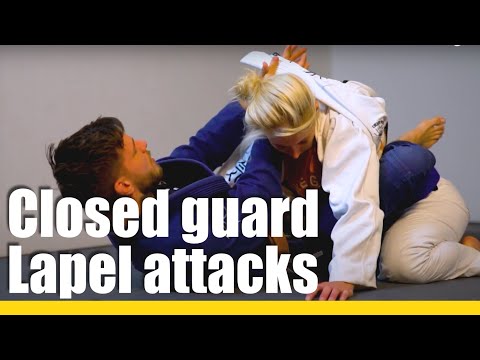
Lapel attacks from closed guard
0
Thrust Lapel Choke From Guard One Hand·Energia Martial Arts
Lapel attacks from closed guard Time for another gi video! This time we look at a form of lapel guard/lapel attacks from…
Перевод: Thrust Strangle — From Guard, One Hand
The one-hand thrust lapel choke from guard is a minimalist gi strangulation where the attacker uses a single hand to thrust the knuckles or fist deep into the opponent's collar, driving the lapel directly into the throat or carotid arteries. [1] From closed guard, the attacker feeds one hand palm-down into the opponent's collar as deep as possible, then straightens the arm or punches the fist forward to thrust the fabric against the neck. [1],[2] The free hand typically controls the opponent's posture — gripping the back of the head, sleeve, or collar to prevent posturing away. [2] The one-hand variant relies on depth of grip and structural alignment rather than bilateral scissoring, making it a power-based choke. [2],[3]
Single-hand lapel thrusts appear in early judo strangulation techniques, where tsuki-komi-jime (thrusting collar choke) was a recognised technique in competition. [1] The guard application became a niche but effective weapon in BJJ, favoured by practitioners with strong grips and deep collar-feeding skills. [2],[3]
The one-hand thrust lapel choke from guard uses a single deep collar grip to choke while the other hand controls posture. [1]
One-hand collar choke variations from guard were developed in BJJ competition. [1]
One-hand thrust chokes from guard are used in gi BJJ competition. [1]
Изображений для этой техники пока нет.
Войдите, чтобы предложить изображение.
Lapel attacks from closed guard Time for another gi video! This time we look at a form of lapel guard/lapel attacks from…
Учебных курсов по этой технике пока нет.
Войдите, чтобы предложить курс.
Риск травмы для человека, к которому применяется техника
One-hand variant reduces control but allows the free hand for additional attacks
Уровень мастерства, необходимый для надёжного выполнения техники
Разрешена ли техника по основным соревновательным правилам
Kodokan Judo — Tsukkomi-jime
Japanese terminology sourced from Kodokan Judo — Tsukkomi-jime
Official Kodokan ground technique classification system
Standard Japanese martial arts terminology (kanji/hiragana)
Established Japanese martial arts naming convention — native Japanese term (和語/漢語)
Japanese terminology sourced from Kodokan Judo — Tsukkomi-jime
grip or squeeze strength, positional control
strong upper body for sustained compression
forearms, biceps, pectorals, core stabilisers
Even if you use your abs to sit up, your opponent's head is too far away if they keep good posture, so you need to control their arm and posture first before attempting the choke.
Place your foot on their hip to maintain distance and prevent them from advancing or stacking you, which allows you to keep control and slide away as needed.
Sit up and crunch your body to trap their arm so they cannot pull it out, and use your shoulder to choke them on the other side while controlling their posture with your grip.
Pop their elbow to the inside and switch to taking the back, where you can secure hooks—getting back control is your main objective if the initial choke is defended.
The one-hand thrust lapel choke from guard is a minimalist gi strangulation where the attacker uses a single hand to thrust the knuckles or fist deep into the opponent's collar, driving the lapel directly into the throat or carotid arteries. From closed guard, the attacker feeds one hand palm-down into the opponent's collar as deep as possible, then straightens the arm or punches the fist forward to thrust the fabric against the neck.
Single-hand lapel thrusts appear in early judo strangulation techniques, where tsuki-komi-jime (thrusting collar choke) was a recognised technique in competition. The guard application became a niche but effective weapon in BJJ, favoured by practitioners with strong grips and deep collar-feeding skills.
IBJJF: разрешён — Legal at all belt levels, gi and no-gi — chokes are the safest submission cat…; IJF: разрешён — Legal (shime-waza) — strangulation techniques are one of three permitted subm…; ADCC: ограничен — N/A (no-gi competition only — technique requires gi); Unified MMA: ограничен — N/A (technique requires gi — not applicable in MMA); FIAS Sport Sambo: запрещён — All chokes prohibited in Sport Sambo; FIAS Combat Sambo: разрешён — Legal
Оценка опасности 7/10. One-hand variant reduces control but allows the free hand for additional attacks
Стандартная цепочка подготовки: Achieve Controlling Position → Isolate the Neck → Set the Grip → Apply Pressure.
Стандартные контрприёмы: Tuck Chin — protect the neck by lowering the chin to prevent the choke from sinking / Two-on-One Grip Fight — use both hands to strip the choking grip before it locks / Turn Into — rotate toward the choking arm to relieve carotid pressure / Posture Up — straighten the spine and create distance to break the choking angle.
Распространённые варианты: Standard grip variation (primary hand configuration for maximum choking pressure); Gi variation (uses the lapel or collar as an anchor for additional fric…); No-gi variation (adapted grip and positioning for submission grappling wit…); Transition finish (applied during a positional change to catch the opponent …).
One-hand thrust chokes from guard are used in gi BJJ competition.
Основные ошибки, на которые стоит обратить внимание: Using a shallow grip — the hand must be deep enough that the knuckle ridge contacts the lateral neck; shallow grips p… / Not using the free hand for head control — without controlling the head, the opponent turns away from the thrust / Attempting multiple times without changing the angle — if the first thrust fails, the opponent anticipates the same a… / Thrusting too gently — the one-hand thrust requires commitment; a tentative push doesn't generate sufficient pressure.
Thrust Lapel Choke From Guard One Hand также известен как Tsukkomi-jime — From Guard, One Hand, One-Hand Guard Thrust Choke, Single-Hand Tsukkomi-jime.