Удар и защитаЗамкиБлижний бойБой против нескольких
Дистанция
БлижняяСредняяДальняя
Целевая зона
Верхняя частьСредняя частьНижняя часть
Обзор
The one-wing collar choke combines an underhook through the opponent's armpit ('wing' control) with a cross-collar grip on the opposite side to create an asymmetric strangle from back control or mount. [1],[2] The underhook arm threads under the armpit and reaches the collar, while the choking hand grips the far collar across the neck. [1],[3] The wing control traps one defensive arm and anchors the attacker's position, while the collar grip applies the primary choking pressure. [1] This creates a highly controlled position where the opponent has only one free hand to defend. [2],[4]
The one-wing collar choke derives from judo's kata-ha-jime (片羽絞め, 'single wing strangle'), a classical shime-waza combining arm trapping with collar strangulation. [2],[3] Kata-ha-jime was codified in the Kodokan's katame-waza curriculum and has been a competition staple in judo. [2] BJJ refined the technique for modern back control systems where trapping one arm is a standard step toward securing the choke. [1],[4],[5]
Страна происхождения· показано в случайном порядке
The one wing (single lapel) collar choke from the back uses one hand deep in the collar with the other hand controlling the opponent's arm or collar, creating an asymmetric strangle. [1] It is a practical alternative when the bow and arrow grip is not available. [1]
Родословная
The one-wing collar choke uses a single deep collar grip combined with the opposite hand framing against the opponent's arm. [1]
Соревновательные результаты
One-wing collar chokes are used in gi BJJ competition as a variation on standard collar choke attacks. [1]
Изображения
Изображений для этой техники пока нет.
Войдите, чтобы предложить изображение.
Биомеханический механизм
Primary Action — Bilateral compression of the carotid arteries — restricts blood flow to the brain, causing unconsciousness within seconds
Joints Involved — Cervical spine (lateral flexion), glenohumeral joint of the trapped arm (if arm-in), nuchal region
Force Vector — Lateral squeeze creates inward pressure on both sides of the neck simultaneously
Choking Mechanism — Vascular strangle — occludes carotid arteries and jugular veins, distinct from airway (tracheal) chokes
Позиция и вход
From back control with seatbelt — Establish hooks or body triangle, slide choking arm under the chin, connect hands and squeeze
From turtle top (back take) — Break down the turtle, insert hooks, secure seatbelt grip, slide to back control and apply the choke
From standing back clinch — Secure rear body lock, drag opponent to the mat while inserting hooks, transition to choking position
Варианты
Standard grip variation — primary hand configuration for maximum choking pressure
Gi variation — uses the lapel or collar as an anchor for additional friction and control
No-gi variation — adapted grip and positioning for submission grappling without the gi
Transition finish — applied during a positional change to catch the opponent off-guard
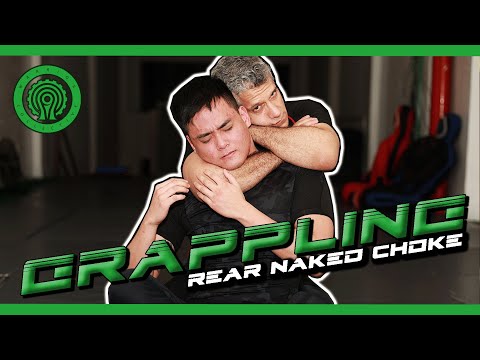
Grappling Concepts for MMA or Self Defence - Develop a FAST Rear Naked Choke with Rene Dreifuss
0
One Wing Collar Choke·Stuart Tomlinson
The rear naked choke is well regarded as one of the high percentage submissions within the world of grappling based spor…
1 / 2
3 videos
Что говорят инструкторы
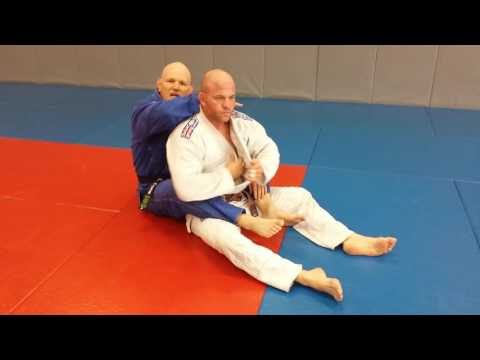
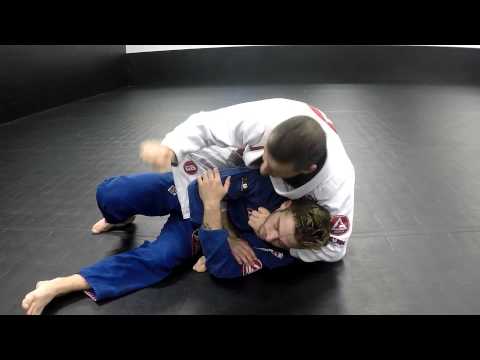
The one-wing collar choke is a back-control submission that emphasizes securing a dominant grip on the opponent's lapel before executing the finish. Code 4 Concepts Chad Lyman describes the technique as beginning with proper back mount positioning, where the attacker's top-side arm is hidden in the opponent's armpit to protect the grip during hand-fighting. The critical first step is obtaining the "first relevant lapel grip" with thumb inside and fingers outside, a position Lyman treats as the foundation for multiple finishing options. Once secured, the primary single-wing variation involves falling to the side with the lapel grip to complete the choke. Lyman demonstrates that if the opponent escapes, the same lapel grip can chain into alternative submissions including stacked double-lapel tilts, bow-and-arrow chokes, and clock chokes, emphasizing that grip retention is essential throughout transitions. Gracie Barra O'Fallon presents the single-wing choke from a mounted or seated-mount position, where the attacker feeds the gi collar (thumb in, wrapping through the hand hole), passes it across with the second hand, and finishes by sitting up and driving the hips forward. Stuart Tomlinson (via Rene Dreifuss) addresses the physiological mechanism of choking generally, explaining that unconsciousness results primarily from pressure on the baroreceptor nerve rather than oxygen deprivation, and that rotational shear force combined with head misalignment and radius bone pressure is more effective than pure squeezing. All three instructors agree on grip security and technical precision, though they differ in positional context—back mount versus mount position.
Сформировано на основе 3 инструкторов
Code 4 Concepts Chad Lyman — 4 ways to finish a collar choke off of the 1st relevant grip...: Establishes the single-wing collar choke from back mount, stressing the importance of securing the first relevant lapel grip with proper hand placement (thumb in, fingers out) and demonstrating how to maintain grip security during hand-fighting. Shows the primary single-wing finish by falling to the side, plus three additional chain techniques (stacked double-lapel, bow-and-arrow, clock choke) from the same initial grip.
Gracie Barra O'Fallon — Single Wing & Bow Choke from the Mount - Jiu Jitsu Training: Presents the single-wing choke from mounted or seated-mount position, detailing stabilization points (hip pressure, knee placement, heel positioning), proper gi-feeding technique (thumb in, wrapping through the hand hole), and the finish mechanics of sitting up and pushing hips forward. Also demonstrates a bow-and-arrow variation from the same position.
Stuart Tomlinson (Rene Dreifuss) — Grappling Concepts for MMA or Self Defence - Develop a FAST Rear Naked Choke with Rene Dreifuss: Explains the neurophysiological basis of choking, identifying the baroreceptor nerve as the primary target rather than oxygen deprivation, and emphasizing rotational shear force, head misalignment, and radius bone pressure as more effective mechanics than simple squeezing.
Изучить технику
Учебных курсов по этой технике пока нет.
Войдите, чтобы предложить курс.
Оценки
Уровень опасности
Риск травмы для человека, к которому применяется техника
8
Очень высокий8/10
Single wing variant uses one lapel grip with shoulder pressure to complete the strangle
Сложность
Уровень мастерства, необходимый для надёжного выполнения техники
Продвинутый
Допустимость на соревнованиях
Разрешена ли техника по основным соревновательным правилам
Запрещено
— FIAS Sport Sambo — All chokes prohibited in Sport Sambo
✓The one-wing collar choke traps one of the opponent's arms while applying a collar strangle — the 'wing' refers to the trapped arm that cannot defend the choke (Danaher, Back Attacks: Enter the System, 2018)
✓From back control: overhook one of the opponent's arms (trapping the 'wing'), then use the free hand to establish a deep collar grip on the exposed side of the neck
✓Trapping the arm is the key innovation: by immobilising one arm, you remove 50% of the opponent's defensive capability — they can only fight the choke with one hand
✓The overhook on the trapped arm also creates a frame that pushes the opponent's shoulder into their own neck — adding compressive force to the collar strangle
✓The choke finishes by pulling the collar grip while maintaining the arm trap — the opponent is caught between the collar tension and the shoulder compression
✓This is a systematic back attack: if the collar choke fails, the trapped arm creates opportunities for armbars and other submissions
✓Marcelo Garcia and Roger Gracie both utilised arm-trapping collar chokes as primary back-attack strategies
Типичные ошибки
!Not securing the arm trap before attacking the collar — if the arm isn't controlled, the opponent strips the collar grip immediately
!Using a loose overhook — the arm trap must be tight; a loose overhook allows the opponent to extract their arm
!Neglecting to maintain back hooks while trapping the arm — positional control comes first; losing back mount negates the arm trap
!Attacking the collar on the same side as the trapped arm — the collar grip should be on the opposite side, where the opponent cannot defend
!Not using the trapped arm as a lever — push the shoulder into the neck using the overhook; this adds to the choking pressure
!Releasing the arm trap to adjust the collar grip — maintain the trap throughout; brief releases allow the opponent to recover both arms
!Forgetting to control the opponent's remaining free hand — the one free hand will fight desperately; be prepared to manage it
Standard Japanese martial arts terminology (kanji/hiragana)
4ДругоеJapanese Martial Arts Standard Terminology (武道用語)
Established Japanese martial arts naming convention — native Japanese term (和語/漢語)
5ЦитатаKodokan Judo — Official Shime-waza #8
Japanese terminology sourced from Kodokan Judo — Official Shime-waza #8
Сообщество
Атлетизм
Requires
grip or squeeze strength, positional control
Favours
strong upper body for sustained compression
Key muscles
forearms, biceps, pectorals, core stabilisers
Часто задаваемые вопросы
What's the correct hand position for the one wing collar choke grip?
Your hand should be in a 'rev on' position (like revving a motorcycle) behind the neck and under the chin, with your thumb in and pinky on for a solid grip. Avoid bowing your hand forward, as this weakens the choke—instead, snap your hand back for proper pressure. (Gracie Barra O'Fallon)
Why do I lose my collar choke grip when my opponent hand fights?
A common mistake is leaving your top-side arm in the middle where your opponent can control it. Instead, hide that arm in their armpit and reach it across so your other hand goes on top, giving you a better chance to clear their grip when they fight. (Code 4 Concepts Chad Lyman)
What should I do if my opponent escapes the collar choke to the side?
Feint an armbar while maintaining your collar grip, then transition to a bow and arrow choke or any of its variations. This keeps your opponent committed to defending the wrong technique. (Code 4 Concepts Chad Lyman)
How important is it to maintain my grip once I have it?
Once you establish your grip, never give it back unless you're intentionally trading it for another grip—your opponent will follow you wherever you go. (Code 4 Concepts Chad Lyman)
Как работает One Wing Collar Choke?
The one-wing collar choke combines an underhook through the opponent's armpit ('wing' control) with a cross-collar grip on the opposite side to create an asymmetric strangle from back control or mount. The underhook arm threads under the armpit and reaches the collar, while the choking hand grips the far collar across the neck.
Откуда происходит One Wing Collar Choke?
The one-wing collar choke derives from judo's kata-ha-jime (片羽絞め, 'single wing strangle'), a classical shime-waza combining arm trapping with collar strangulation. Kata-ha-jime was codified in the Kodokan's katame-waza curriculum and has been a competition staple in judo.
Разрешён ли One Wing Collar Choke на соревнованиях?
IBJJF: разрешён — Legal at all belt levels, gi and no-gi — chokes are the safest submission cat…; IJF: разрешён — Legal (shime-waza) — strangulation techniques are one of three permitted subm…; ADCC: ограничен — N/A (no-gi competition only — technique requires gi); Unified MMA: ограничен — N/A (technique requires gi — not applicable in MMA); FIAS Sport Sambo: запрещён — All chokes prohibited in Sport Sambo; FIAS Combat Sambo: разрешён — Legal
Насколько опасен One Wing Collar Choke?
Оценка опасности 8/10. Single wing variant uses one lapel grip with shoulder pressure to complete the strangle
Как подготовить One Wing Collar Choke?
Стандартная цепочка подготовки: Achieve Controlling Position → Isolate the Neck → Set the Grip → Apply Pressure.
Как защититься от One Wing Collar Choke?
Стандартные контрприёмы: Tuck Chin — protect the neck by lowering the chin to prevent the choke from sinking / Two-on-One Grip Fight — use both hands to strip the choking grip before it locks / Turn Into — rotate toward the choking arm to relieve carotid pressure / Posture Up — straighten the spine and create distance to break the choking angle.
Какие есть варианты One Wing Collar Choke?
Распространённые варианты: Standard grip variation (primary hand configuration for maximum choking pressure); Gi variation (uses the lapel or collar as an anchor for additional fric…); No-gi variation (adapted grip and positioning for submission grappling wit…); Transition finish (applied during a positional change to catch the opponent …).
Насколько эффективен One Wing Collar Choke на соревнованиях?
One-wing collar chokes are used in gi BJJ competition as a variation on standard collar choke attacks.
Какие типичные ошибки при выполнении One Wing Collar Choke?
Основные ошибки, на которые стоит обратить внимание: Not securing the arm trap before attacking the collar — if the arm isn't controlled, the opponent strips the collar g… / Using a loose overhook — the arm trap must be tight; a loose overhook allows the opponent to extract their arm / Neglecting to maintain back hooks while trapping the arm — positional control comes first; losing back mount negates … / Attacking the collar on the same side as the trapped arm — the collar grip should be on the opposite side, where the ….
Какие ещё названия есть у One Wing Collar Choke?
One Wing Collar Choke также известен как Kata-ha-jime, Single Wing Choke, Half-Wing Lapel Choke.