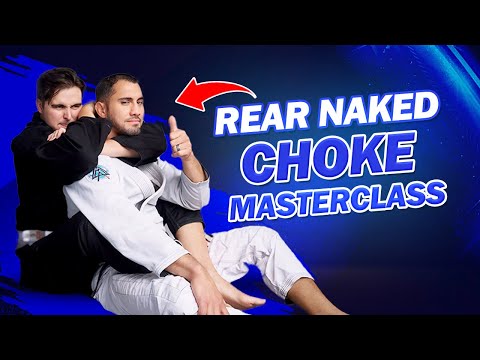
This arm trap makes getting the Rear Naked Choke easy
0
One Arm Rear Naked Choke·Mastermind Martial Arts·Added by Admin
There are many ways to trap the arm when on someone’s back, most involve using one’s legs to trap opponents arms, and wh…
Перевод: One-Arm Naked Strangle
The one-arm rear naked choke is a variation where the attacker finishes the strangle using only the choking arm without the standard figure-four reinforcement from the second arm. [1],[2] The choking arm wraps around the opponent's neck under the chin with the bicep and forearm targeting the carotid arteries on the sides of the neck rather than the trachea, and the attacker creates compression on the opposite carotid using a structural anchor — pinning the opponent's shoulder, posting against their own shoulder or hip, or using a rotational scoop with the radius bone. [1] This variation is used when the second arm is occupied controlling the opponent's body or when the figure-four grip cannot be established due to defensive hand-fighting. [1],[3]
The one-arm rear naked choke developed as a practical adaptation when the standard two-arm RNC was defended. [1],[2] In judo, single-arm strangles from behind were recognized as valid hadaka-jime variations. [2],[3] MMA fighters popularized the one-arm finish when opponents successfully blocked the reinforcing hand, proving that positional pressure alone could complete the strangle. [1],[4]
The one-arm RNC is effective in scrambles and MMA where gloves prevent figure-four grips. Requires more arm strength than the standard version but catches opponents during transitions before full back control is established. [1]
Rooted in catch wrestling and judo (hadaka-jime variations). Adapted for MMA by fighters who found figure-four grips difficult with gloves. [1]
Common finish in MMA when fighters secure partial back control. Less frequent in pure grappling where the figure-four RNC is preferred. [1]
Изображений для этой техники пока нет.
Войдите, чтобы предложить изображение.
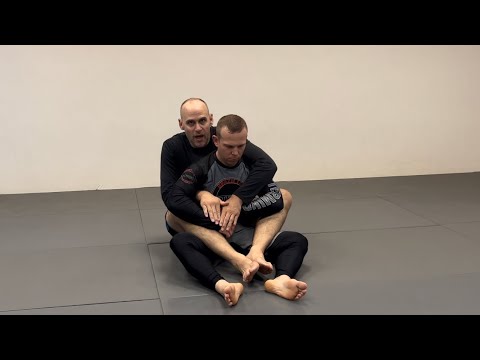
There are many ways to trap the arm when on someone’s back, most involve using one’s legs to trap opponents arms, and wh…
Join My Online Academy to Improve Your Jiu Jitsu FAST!!! https://www.skool.com/mattarroyojiujitsu/about Looking to MAS…
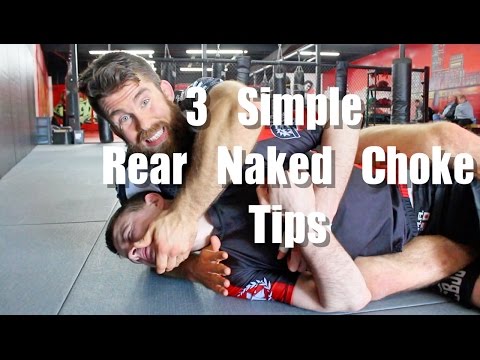
Here are at least 3 effective tips to help you finish your Rear Naked Choke once you've achieved Back Mount in BJJ. I di…
The one-arm rear naked choke represents a practical variation of the traditional rear naked choke that addresses real-world defensive scenarios where an opponent resists submission attempts. Mastermind Martial Arts emphasizes arm-trapping mechanics using an open seatbelt grip without requiring high flexibility, executing a wrist control that neutralizes one opponent arm by rotating it behind their back and using chest pressure to trap both limbs. Chewjitsu teaches the halfback position application, where one hook replaces two, using a forward-leaning chest drive to hide the choking arm from the opponent's grip awareness until the critical moment of execution; this instructor stresses keeping the hand low behind the head to prevent defensive grabs and employs a "saw" motion with the thumb to establish proper positioning under the chin. Matt Arroyo Jiu Jitsu provides comprehensive finishing mechanics applicable across positions: proper elbow-under-chin placement, steady 60-70% pressure held for 10-15 seconds rather than maximum effort, and systematic grip-breaking via wrist lock ("may I help you") followed by leg entrapment to create the one-arm-versus-zero-arms advantage before executing the final choke. All three instructors converge on the principle that trapping or controlling the defending arm is essential before committing to the final choke, though they approach this objective through different positional frameworks and hand-placement strategies.
Сформировано на основе 3 инструкторов
Учебных курсов по этой технике пока нет.
Войдите, чтобы предложить курс.
Риск травмы для человека, к которому применяется техника
Single-arm variant of RNC, less control but still dangerous
Уровень мастерства, необходимый для надёжного выполнения техники
Разрешена ли техника по основным соревновательным правилам
Extension of Kodokan Judo terminology (裸絞め); Japanese BJJ community
Official Kodokan ground technique classification system
Standard Japanese martial arts terminology (kanji/hiragana)
Established Japanese martial arts naming convention — native Japanese term (和語/漢語)
Japanese terminology sourced from Extension of Kodokan Judo terminology (裸絞め); Japanese BJJ community
upper body squeeze strength, bicep/forearm endurance
shorter, thicker arms for tighter squeeze
biceps, forearms, pectorals, deltoids
Каждое движение в любом боевом искусстве обладает рядом универсальных свойств. Комбинируйте параметры ниже, чтобы найти нужный инструмент или сравнить аналоги из разных стилей.
Matt Arroyo Jiu Jitsu emphasizes three main finishing motions: push your elbow down into the opponent's chest, bring your elbows together, and make a muscle while applying steady pressure. Additionally, place your head against theirs to block them from reaching back and grabbing your choking hand.
Matt Arroyo Jiu Jitsu recommends getting a good chunk of your bicep with your grip hand—your wrist should be on the bicep with your hand wrapped around it for a strong, tight grip, rather than using just your fingers.
Matt Arroyo Jiu Jitsu states that the elbow pit—the small piece of skin separating your forearm and bicep—should be directly touching the opponent's neck with no space between them.
Mastermind Martial Arts shows that you can establish a seat belt grip and use your chest to pack both arms without needing high flexibility—when you fall to the side, you can harass the head until you get the choke regardless of arm length or flexibility limitations.
The one-arm rear naked choke is a variation where the attacker finishes the strangle using only the choking arm without the standard figure-four reinforcement from the second arm. The choking arm wraps around the opponent's neck under the chin with the bicep and forearm targeting the carotid arteries on the sides of the neck rather than the trachea, and the attacker creates compression on the opposite carotid using a structural anchor — pinning the opponent's shoulder, posting against their own shoulder or hip, or using a rotational scoop with the radius bone.
The one-arm rear naked choke developed as a practical adaptation when the standard two-arm RNC was defended. In judo, single-arm strangles from behind were recognized as valid hadaka-jime variations.
IBJJF: разрешён — Legal at all belt levels, gi and no-gi — chokes are the safest submission cat…; IJF: разрешён — Legal (shime-waza) — strangulation techniques are one of three permitted subm…; ADCC: разрешён — Legal; Unified MMA: разрешён — Legal — choke submissions are among the most common finishes in MMA; FIAS Sport Sambo: запрещён — All chokes prohibited in Sport Sambo; FIAS Combat Sambo: разрешён — Legal
Оценка опасности 7/10. Very High — single-arm variant of RNC, less control but still dangerous
Стандартная цепочка подготовки: Achieve Controlling Position → Isolate the Neck → Set the Grip → Apply Pressure.
Стандартные контрприёмы: Tuck Chin — protect the neck by lowering the chin to prevent the choke from sinking / Two-on-One Grip Fight — use both hands to strip the choking grip before it locks / Turn Into — rotate toward the choking arm to relieve carotid pressure / Posture Up — straighten the spine and create distance to break the choking angle.
Распространённые варианты: Short choke (palm-to-palm grip) (compact grip for tight spaces when the chin is partially …); Gable grip RNC (interlocked fingers behind the head for maximum squeeze p…); Body triangle RNC (adds body triangle control for stronger hip management du…); One-arm RNC (single arm under the chin when the second arm cannot reac…).
Common finish in MMA when fighters secure partial back control. Less frequent in pure grappling where the figure-four RNC is preferred.
Основные ошибки, на которые стоит обратить внимание: Attempting without driving the head forward — the chest and head must push the opponent's neck into the choking arm; … / Not having the choking arm deep enough — the arm must be fully around the neck with the crook at the throat; shallow … / Releasing back hooks to focus on the choke — maintain positional control; one arm choking while the other controls ma… / Expecting the same finishing speed as the figure-four RNC — the one-arm version takes longer; be patient and maintain….
One Arm Rear Naked Choke также известен как Kata-ude Hadaka-jime, One-Arm RNC, Single-Arm Rear Naked Choke, One-Hand Choke from Back.