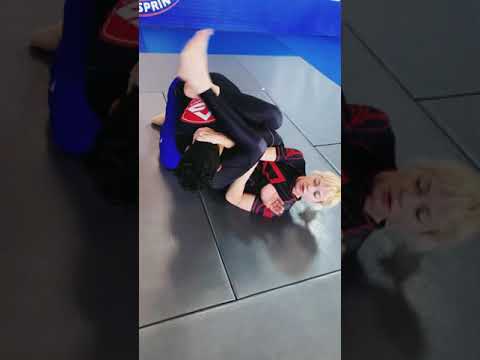
How to Reverse Triangle Choke from Closed Guard for BJJ
0
Arm Triangle Choke — From Guard·Brazilian Jiu-Jitsu & Submission Grappling
Перевод: Shoulder Hold / Arm-and-Head Lock — From Guard
A head-and-arm choke applied from the guard position, where the attacker traps the opponent’s arm and head between their own arm and torso. The attacker pivots their hips and angles to the side to compress the opponent’s carotid arteries using the shoulder and opponent’s own arm. Effective when transitioning from failed triangle choke or armbar attempts.
Adaptation of Kata Gatame for use from the guard, popularized in BJJ as a counter to posture breaks and failed submissions.
The arm triangle from guard bottom uses the legs and arms to create a head-and-arm strangle configuration from below. [1]
Guard-bottom arm triangles are used in BJJ competition, though less common than from top positions. [1]
Изображений для этой техники пока нет.
Войдите, чтобы предложить изображение.
Учебных курсов по этой технике пока нет.
Войдите, чтобы предложить курс.
Риск травмы для человека, к которому применяется техника
Can render unconscious quickly; requires careful training and fast tap awareness.
Уровень мастерства, необходимый для надёжного выполнения техники
Разрешена ли техника по основным соревновательным правилам
Kodokan Judo — Official Katame-waza Classification (肩固め Kata-gatame)
Japanese terminology sourced from Kodokan Judo — Official Katame-waza Classification (肩固め Kata-gatame)
Official Kodokan ground technique classification system
Established Japanese martial arts naming convention — native Japanese term (和語/漢語)
Japanese terminology sourced from Kodokan Judo — Official Katame-waza Classification (肩固め Kata-gatame)
hip flexibility, long legs relative to torso
longer limbs for easier figure-four lock around head and arm
hip adductors, hamstrings, quadriceps
Often chained after failed triangle or armbar; useful against strong posture-breaking opponents.
Switch to the reverse triangle when your opponent starts to posture up, stack, or pull their arm out during an armbar attempt from closed guard. According to Brazilian Jiu-Jitsu & Submission Grappling, this is especially effective when you're smaller than your opponent, as one arm climbs while the other catches across the neck.
From the reverse triangle, you can attack a kimura, perform a fist choke if your opponent is blocking, execute a leg attack, or transition to a telephone arm. Brazilian Jiu-Jitsu & Submission Grappling notes that it's actually easier to hit leg attacks from the reverse triangle than from a traditional triangle.
Yes, the reverse triangle works as a finishing choke against larger opponents, with significant shoulder pressure applied. It also requires a shorter distance to execute compared to a traditional triangle, making it accessible regardless of size difference.
A head-and-arm choke applied from the guard position, where the attacker traps the opponent’s arm and head between their own arm and torso. The attacker pivots their hips and angles to the side to compress the opponent’s carotid arteries using the shoulder and opponent’s own arm.
Adaptation of Kata Gatame for use from the guard, popularized in BJJ as a counter to posture breaks and failed submissions.
Danger: 9/10 | Can render unconscious quickly; requires careful training and fast tap awareness.
Стандартная цепочка подготовки: closed guard → Isolate opponent’s arm, control head, pivot hips outward, lock head-and-arm position, squeeze → failed triangle → Slide arm under opponent’s trapped arm, angle hips, lock and finish.
Стандартные контрприёмы: Tuck Chin — protect the neck by lowering the chin to prevent the choke from sinking / Two-on-One Grip Fight — use both hands to strip the choking grip before it locks / Turn Into — rotate toward the choking arm to relieve carotid pressure / Posture Up — straighten the spine and create distance to break the choking angle.
Распространённые варианты: From closed guard; From failed triangle; From failed armbar; High guard arm triangle.
Guard-bottom arm triangles are used in BJJ competition, though less common than from top positions.
Основные ошибки, на которые стоит обратить внимание: Not angling hips enough / Leaving space under the shoulder / Failing to control opponent’s trapped arm / Rushing the choke without proper head-arm seal.
Arm Triangle Choke — From Guard также известен как Kata Gatame — From Guard, Arm Triangle from Guard, Guard Kata Gatame, Head-and-Arm Choke from Guard.