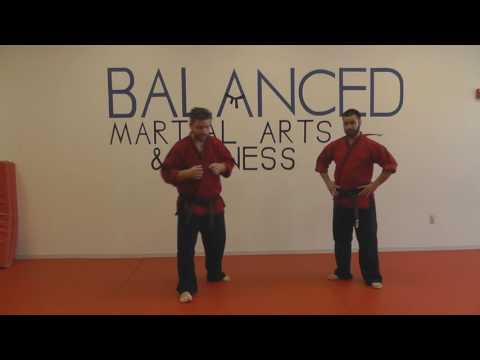
CoachesVideo; How to do the Cross Hook Balanced Martial Arts Eastchester NY
0
Standard Cross·BalancedMartialArts·Added by Admin
Coaches Video on how to do a cross hook combination. This is a follow along video, so to get the full effect get up and …
Перевод: standard cross
The standard cross is the basic execution of the rear straight punch, delivered with full hip rotation and weight transfer from the rear foot through to the fist. [1] Dempsey provided the definitive biomechanical description in Championship Fighting, identifying the 'falling step' principle where the fighter's body weight drops forward into the punch. [1] Haislet documented the standard cross as requiring the rear shoulder to rotate fully forward, with the fist turning over just before impact. [2] The standard cross is the most common knockout punch in professional boxing, as the full kinetic chain generates greater peak force than any other straight punch. [3]
The cross is the primary power punch in boxing and MMA, generating the highest peak forces among straight punches due to full hip rotation, weight transfer from rear foot, and shoulder drive through the target. [1] Biomechanical studies have measured cross punch forces exceeding 4,000 newtons in elite boxers. [2] Dempsey identified the cross as the 'power line' punch, where body mechanics align to deliver maximum force along a straight trajectory. [1]
The rear cross developed as gloved boxing matured under the Queensberry Rules, with bare-knuckle fighters having previously favoured hooks and uppercuts to avoid hand injuries. [1] Bob Fitzsimmons (1863-1917) pioneered the use of body rotation to power the straight right hand, a principle later refined by Jack Dempsey and codified in his 1950 manual. [1]
The rear cross is the single most common knockout punch in professional boxing history. [1] In UFC competition, the straight right/left (cross) accounts for the largest percentage of punch knockouts according to Fight Metric data. [2] Deontay Wilder built a 41-0-1 record (with 41 KOs) largely on the devastating power of his right cross. [1]
Изображений для этой техники пока нет.
Войдите, чтобы предложить изображение.
Coaches Video on how to do a cross hook combination. This is a follow along video, so to get the full effect get up and …
Учебных курсов по этой технике пока нет.
Войдите, чтобы предложить курс.
Риск травмы для человека, к которому применяется техника
Jab/cross; fundamental striking tool, cumulative brain trauma risk
Уровень мастерства, необходимый для надёжного выполнения техники
Разрешена ли техника по основным соревновательным правилам
Karate-Do Kyohan: The Master Text (Gichin Funakoshi, 1935)
Alias sources — [1] Championship Fighting (Dempsey, 1950) [2] Karate-Do Kyohan (Funakoshi, 1935) [3] Boxing (Fleischer, 1958)
Effectiveness sources — [1] Championship Fighting (Dempsey, 1950) [2] Biomechanics of Striking Arts, in Martial Arts Medicine (Kordi et al., 2009)
Standard katakana transliteration of Western martial arts terminology (外来語) — used in Japanese MMA, boxing, and BJJ communities
Alias sources — [1] Championship Fighting (Dempsey, 1950) [2] Karate-Do Kyohan (Funakoshi, 1935) [3] Boxing (Fleischer, 1958)
Effectiveness sources — [1] Championship Fighting (Dempsey, 1950) [2] Biomechanics of Striking Arts, in Martial Arts Medicine (Kordi et al., 2009)
hip rotation power, rear foot pivot, full kinetic chain coordination
reach advantage, strong hips for power transfer
glutes, obliques, pectorals, triceps, deltoids
Stay on the balls of your feet with knees slightly bent, and keep your weight moving rather than planted on your heels. Balanced Martial Arts emphasizes that you should always feel balanced during the technique, and if you lose balance, stop briefly to reset your feet before continuing.
According to Balanced Martial Arts, breathing out as you punch improves your endurance and helps you generate more power in the technique.
Keep your elbow bent when throwing the punch to avoid injuring yourself. Balanced Martial Arts advises against extending with a straight arm.
Focus on keeping the movement smooth rather than rushing for power; Balanced Martial Arts notes that power will develop naturally over time as your technique improves.
The fundamental rear-hand straight punch thrown with full hip and shoulder rotation, transferring weight from the back foot through the kinetic chain.
The standard cross is the basic execution of the rear straight punch, delivered with full hip rotation and weight transfer from the rear foot through to the fist. Dempsey provided the definitive biomechanical description in Championship Fighting, identifying the 'falling step' principle where the fighter's body weight drops forward into the punch.
Unified MMA: разрешён — Legal striking technique; WBC/Boxing: разрешён — Legal — punches are the core technique of boxing; WKF: разрешён — Legal, jodan/chudan punch scores 1 point (yuko) — controlled contact required; Kyokushin: ограничен — Body punches legal at full power, head punches banned; WT: ограничен — Punches to trunk only (1 point), punches to head banned; ITF: разрешён — Legal — hand techniques to head and body both permitted; WAKO: разрешён — Legal in Full Contact and Low Kick formats; K: разрешён — 1/GLORY — Legal — full power punches to head and body; IFMA: разрешён — Legal
Оценка опасности 5/10. High — jab/cross; fundamental striking tool, cumulative brain trauma risk
Стандартная цепочка подготовки: Fighting Stance → Weight Transfer → Extend → Snap Back.
Стандартные контрприёмы: Slip — move the head off the centre line to evade the punch / Parry — deflect the incoming punch with a quick hand redirection / Counter Cross — time a straight punch over the incoming attack.
Распространённые варианты: Standard cross (rear-hand straight punch with full hip rotation); Counter cross (pull counter) (leaning back to avoid the jab, firing the cross as a counter); Step-in cross (stepping forward with the punch for added reach and power); Body cross (targeting the solar plexus or liver with the straight rea…).
The rear cross is the single most common knockout punch in professional boxing history. In UFC competition, the straight right/left (cross) accounts for the largest percentage of punch knockouts according to Fight Metric data.
Основные ошибки, на которые стоит обратить внимание: Standing tall and punching with the arm only, without sitting down on the punch with a knee bend / Telegraphing by dropping the rear hand before throwing — the cross should fire from its guard position / Over-rotating so the rear foot spins completely and you end up squared or facing sideways / Locking the elbow on full extension, which risks hyperextension injury, especially on a miss.
Standard Cross также известен как Sutandādo Kurosu, Standard Rear Straight, Standard Gyaku Tsuki, Straight Right.