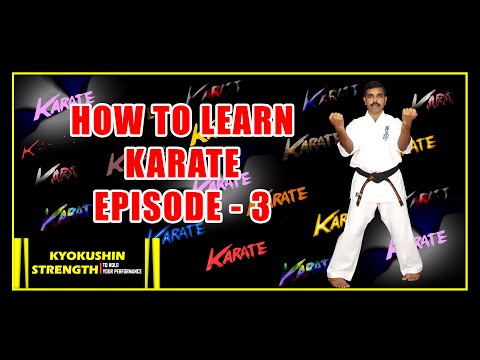
SANCHIN DACHI & SEIKEN CHUDAN TSUKI
0
Seiken Chudan Tsuki·Kyokushin Strength (Children Dojo, Marthandam)
In this video, you can see, why should we do Sanjin Dachi while you practicing Kihons. And you can see about, how to pra…
Перевод: Seiken (正拳) = fore-fist/correct fist, Chudan (中段) = middle level, Tsuki (突き) = thrust/punch — a straight punch with the front two knuckles to the midsection
Seiken Chudan Tsuki is the fundamental middle-level straight punch in traditional karate, delivering the fore-fist (seiken — the front two knuckles of the index and middle fingers) to the opponent's midsection, targeting the solar plexus, floating ribs, or liver. [1] The technique is one of the most basic and most practised movements in all karate styles, taught from the very first class and refined throughout a practitioner's entire career. [1],[2] In Kyokushin karate, founded by Masutatsu Oyama, the Chudan Tsuki holds special importance because Kyokushin's full-contact ruleset prohibits punches to the face — making body punches the primary hand weapon in competition. [1] This ruleset quirk has produced arguably the most powerful body punchers in martial arts: Kyokushin competitors develop devastating body attacks that would be unnecessary in styles where head punches are the primary target. [1],[2] The mechanical execution follows karate's universal punching principle: the punch begins from the chambered position at the hip (hikite), travels in a straight line toward the target while rotating the fist from palm-up to palm-down (pronation) at the moment of impact, and retracts immediately along the same line — the opposite hand simultaneously retracts to the hip, creating a reciprocal pulling action (hikite) that adds torque to the punching motion. [1],[2] Oyama wrote in This Is Karate (1965) that the Chudan Tsuki should be practised thousands of times daily on the makiwara (striking post) until the knuckles are hardened and the punch can penetrate through the opponent's body. [1] The technique's simplicity is deceptive: while the basic movement can be learned in minutes, the generation of full-body power through hip rotation, stance alignment, and breath control requires years of dedicated practice to master. [1],[2]
The Seiken Chudan Tsuki is one of the original techniques in karate, tracing back to Okinawan te and its Chinese kung fu influences. [2] When Gichin Funakoshi brought karate from Okinawa to mainland Japan in the 1920s, the Chudan Tsuki was among the core techniques he demonstrated. [2] Masutatsu Oyama, founder of Kyokushin Karate, elevated the body punch to central importance by establishing a full-contact ruleset (1964) that prohibited head punches — this decision, which was controversial at the time, produced generations of karateka with body punching power unmatched in any other striking art. [1] Oyama's book This Is Karate (1965) presents the Seiken Chudan Tsuki as a fundamental technique, with extensive instruction on the makiwara conditioning that develops penetrating impact. [1] The technique's importance in Kyokushin is reflected in the style's tournament results: the majority of Kyokushin knockouts come from body punches (Chudan Tsuki and its variants) to the solar plexus and liver, techniques that are under-developed in styles where head punches are the primary target. [1],[2]
In Kyokushin full-contact competition, the Chudan Tsuki (particularly Gyaku-Zuki Chudan to the liver) is one of the highest-percentage knockout techniques, responsible for more knockdowns and knockouts than any individual kick. [1] The solar plexus and liver are physiologically vulnerable targets that respond to concentrated impact with involuntary systemic reactions (breathing paralysis, vasovagal response) that cannot be overcome through willpower alone. [1],[2] In MMA, body punches — which are mechanically identical to the Chudan Tsuki — have produced numerous stoppages, with fighters like Bas Rutten (a Kyokushin black belt) demonstrating the devastating effect of trained body punching at the highest level. [2]
In Kyokushin World Championships and All-Japan Tournaments, the Gyaku-Zuki Chudan (reverse body punch) to the solar plexus or liver is the single most common knockout mechanism. Bas Rutten (Kyokushin black belt, UFC heavyweight champion) used body punches as his primary finishing weapon, most famously defeating Kevin Randleman with liver shots at UFC 20. The technique's competition effectiveness is amplified in Kyokushin because no head punches forces all hand attacks to the body, creating the most conditioned body punchers in martial arts.
Изображений для этой техники пока нет.
Войдите, чтобы предложить изображение.
In this video, you can see, why should we do Sanjin Dachi while you practicing Kihons. And you can see about, how to pra…
Учебных курсов по этой технике пока нет.
Войдите, чтобы предложить курс.
Риск травмы для человека, к которому применяется техника
A full-power Seiken Chudan Tsuki from a trained Kyokushin practitioner to the solar plexus can cause diaphragm spasm (the 'wind knocked out' effect), which temporarily paralyses breathing. To the floating ribs, it can cause rib fractures. To the liver (right side), it can cause a 'liver shot' — a parasympathetic nervous system response that causes immediate, incapacitating pain, nausea, and leg collapse regardless of the recipient's willpower or pain tolerance. [1,2]
Уровень мастерства, необходимый для надёжного выполнения техники
Разрешена ли техника по основным соревновательным правилам
This Is Karate (Oyama, 1965)
description: [1] Oyama 1965, [2] Funakoshi 1973
Official karate technique names (和語/漢語)
Established Japanese martial arts naming convention — native Japanese term (和語/漢語)
description: [1] Oyama 1965, [2] Funakoshi 1973
Accessible to all body types — the basic punch can be performed by anyone
Benefits from strong hip rotators (obliques, gluteus medius) for power generation
Conditioned knuckles from makiwara training (developed over months/years)
Good wrist stability to prevent buckling on impact
Core strength for the kime (focus) at the moment of impact
Chudan tsuki (middle-level punch) appears in 71 passages across our corpus. The most commonly practiced punch in karate — targets the solar plexus, floating ribs, and stomach. The foundation of all karate punching. (71 passages; Nakayama, Dynamic Karate; Funakoshi, Karate-Do Kyohan)
Seiken Chudan Tsuki is the fundamental middle-level straight punch in traditional karate, delivering the fore-fist (seiken — the front two knuckles of the index and middle fingers) to the opponent's midsection, targeting the solar plexus, floating ribs, or liver. The technique is one of the most basic and most practised movements in all karate styles, taught from the very first class and refined throughout a practitioner's entire career.
The Seiken Chudan Tsuki is one of the original techniques in karate, tracing back to Okinawan te and its Chinese kung fu influences. When Gichin Funakoshi brought karate from Okinawa to mainland Japan in the 1920s, the Chudan Tsuki was among the core techniques he demonstrated.
Unified MMA: разрешён — Legal striking technique; WBC/Boxing: разрешён — Legal — punches are the core technique of boxing; WKF: разрешён — Legal, jodan/chudan punch scores 1 point (yuko) — controlled contact required; Kyokushin: ограничен — Body punches legal at full power, head punches banned; WT: ограничен — Punches to trunk only (1 point), punches to head banned; ITF: разрешён — Legal — hand techniques to head and body both permitted; WAKO: разрешён — Legal in Full Contact and Low Kick formats; K: разрешён — 1/GLORY — Legal — full power punches to head and body; IFMA: разрешён — Legal
Оценка опасности 7/10. A full-power Seiken Chudan Tsuki from a trained Kyokushin practitioner to the solar plexus can cause diaphragm spasm (the 'wind knocked out' effect), which temporarily paralyses breathing. To the floating ribs, it can cause rib fractures. To the liver (right side), it can cause a 'liver shot' — a parasympathetic nervous system response that causes immediate, incapacitating pain, nausea, and leg collapse regardless of the recipient's willpower or pain tolerance.
Стандартная цепочка подготовки: From fighting stance: Feint with a kick or jab to draw the opponent's guard high → Drive the rear hip forward (gyaku-zuki) → Deliver Seiken Chudan Tsuki to the exposed solar plexus or liver → Sharp exhalation (kiai) at moment of impact → Retract the fist immediately to guard (hikite) → Follow with a kick (mawashi geri to the head, which is now lowered from the body punch) → From kihon: Step forward into zenkutsu-dachi → Extend oi-zuki to chudan level → Rotate fist to palm-down at extension → Retract sharply → Step forward and repeat.
Стандартные контрприёмы: Soto Uke (outside block) — deflects the incoming punch outward with the forearm / Uchi Uke (inside block) — deflects the incoming punch inward / Gedan Barai (downward sweep) — if the punch is low, sweeps it downward / Body movement (tai sabaki) — stepping off-line to avoid the straight punch while creating a counter-angle.
Распространённые варианты: Oi-Zuki Chudan (stepping middle punch) (delivered while stepping forward, combining the body's fo…); Gyaku-Zuki Chudan (reverse middle punch) (delivered with the rear hand while the body is stationary…); Kizami-Zuki Chudan (lead hand jab to body) (a faster, less powerful version delivered with the front …); Sanbon-Zuki (triple punch) (three consecutive Chudan Tsuki, advancing with each step …); Morote-Zuki (double punch) (both fists punch simultaneously to the midsection); Tate-Zuki Chudan (vertical fist middle punch) (the fist stays vertical rather than pronating, used in so…).
In Kyokushin World Championships and All-Japan Tournaments, the Gyaku-Zuki Chudan (reverse body punch) to the solar plexus or liver is the single most common knockout mechanism. Bas Rutten (Kyokushin black belt, UFC heavyweight champion) used body punches as his primary finishing weapon, most famously defeating Kevin Randleman with liver shots at UFC 20.
Основные ошибки, на которые стоит обратить внимание: Punching with the wrong knuckles — the seiken (fore-fist) uses ONLY the index and middle finger knuckles; punching wi… / Wrist misalignment — if the wrist is not perfectly straight (inline with the forearm), the impact force bends the wri… / No hip rotation — punching with arm strength alone produces a fraction of the power available from full hip rotation.… / Pulling the punch short — in no-contact training environments, practitioners develop the habit of stopping the punch ….
Seiken Chudan Tsuki также известен как Seiken Chudan Tsuki, Middle Level Forefist Punch, Chudan Tsuki, Middle Straight Punch, Solar Plexus Punch.