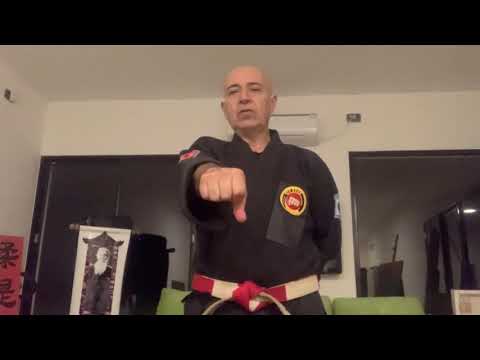
Seiken Uchi
0
Seiken Ago Uchi·Matsumura Seito - Di Giulio
Golpe de puño
Перевод: Seiken (正拳) = fore-fist, Ago (顎) = jaw/chin, Uchi (打ち) = strike — a rising fore-fist strike specifically targeting the chin from below, similar to a boxing uppercut but using the karate fore-fist surface
Seiken Ago Uchi is a Kyokushin karate rising punch specifically targeting the chin from below, driving the fore-fist (seiken — the index and middle finger knuckles) upward into the underside of the opponent's jaw in a trajectory similar to a boxing uppercut but with the karate-specific fist formation and body mechanics. [1] The technique differs from a standard boxing uppercut in several critical ways: the karate version uses the seiken (front two knuckles) rather than the flat of the fist, the arm travels on a more vertical path (rising straight up rather than arcing from below), and the power generation uses the karate hip-rotation and kime (focus) system rather than the boxer's leg-driven rising body mechanics. [1],[2] The chin (ago, 顎) is the primary target because the human jaw acts as a first-class lever: when struck from below, the mandible rotates the head backward and laterally with angular acceleration that exceeds the brain's tolerance for shearing forces, producing immediate knockout via diffuse axonal injury — this is why the chin is called 'the button' in boxing. [1],[2] Masutatsu Oyama demonstrated the Seiken Ago Uchi in This Is Karate (1965) as a fundamental close-range weapon, emphasising that the vertical rising path of the karate version is faster than the looping arc of a standard boxing uppercut because it travels a shorter distance (straight up rather than curving up from the side). [1] In Kyokushin competition, the Ago Uchi is ILLEGAL (face punches prohibited), but it is trained extensively for kata, kihon, and self-defence application — and when Kyokushin fighters cross-train in MMA or kickboxing, the Ago Uchi becomes a devastating tool because the knuckle conditioning from years of makiwara training produces unusually hard and focused impact on the chin. [1] The technique appears in several traditional karate kata, often as a close-range counter executed immediately after a block, targeting the chin of the off-balance attacker. [2]
The Seiken Ago Uchi is a classical karate technique documented in traditional kata since the earliest Okinawan te manuscripts. [2] The rising strike to the chin appears in multiple kata — Bassai Dai, Jion, Tekki/Naihanchi — as a close-range counter following a block, reflecting the historical close-quarters combat situations in which Okinawan te was developed. [2] Gichin Funakoshi included the technique in Karate-Do Kyohan (1935) as a fundamental striking method. [2] Masutatsu Oyama elevated the Ago Uchi in his Kyokushin curriculum, training it extensively on the makiwara despite banning it from Kyokushin competition — he recognised its devastating effectiveness for self-defence while wanting to reduce facial injuries in routine tournament fighting. [1] The technique shares its anatomical targeting principle with the boxing uppercut, which has been a standard weapon since bare-knuckle boxing in the 18th century — both techniques exploit the same lever-effect vulnerability of the human chin. [1],[2]
The chin is biomechanically the most vulnerable target on the human body for producing immediate unconsciousness, and the Seiken Ago Uchi is specifically designed to attack this target with a concentrated knuckle surface from the optimal direction (below). [1],[2] The technique's effectiveness is supported by both traditional martial arts experience and modern sports science: research on boxing knockouts consistently shows that strikes to the chin produce knockouts at lower force thresholds than strikes to any other target, because the mandible's lever arm amplifies the rotational acceleration of the head. [3] The karate-specific advantages of the Ago Uchi over the boxing uppercut are: (1) the concentrated seiken surface produces higher pressure per unit area than the flat boxing fist, (2) the vertical trajectory is faster than the looping arc, and (3) the makiwara-conditioned knuckles provide a harder striking surface. [1]
Banned in Kyokushin competition (face punches prohibited). Primary scoring technique in WKF karate when delivered to the chin with controlled contact. In boxing, the uppercut (functionally identical target and mechanism) is one of the most common knockout punches, responsible for approximately 15-20% of all knockout finishes. In MMA, the uppercut to the chin is a standard knockout technique.
Изображений для этой техники пока нет.
Войдите, чтобы предложить изображение.
Golpe de puño
Учебных курсов по этой технике пока нет.
Войдите, чтобы предложить курс.
Риск травмы для человека, к которому применяется техника
The chin is the human body's 'off switch' — strikes from below the chin produce the highest knockout probability per unit force of any target on the body. The Seiken Ago Uchi's vertical trajectory drives the fist directly into this optimal target from the direction that produces maximum rotational acceleration. A full-power Ago Uchi to the chin from a trained Kyokushin practitioner with conditioned knuckles is a fight-ending weapon capable of producing immediate unconsciousness. [1,2]
Уровень мастерства, необходимый для надёжного выполнения техники
Разрешена ли техника по основным соревновательным правилам
This Is Karate (Oyama, 1965)
description: [1] Oyama 1965, [2] Funakoshi 1973, [3] Viano 2005 knockout biomechanics
Official karate technique names (和語/漢語)
Established Japanese martial arts naming convention — native Japanese term (和語/漢語)
description: [1] Oyama 1965, [2] Funakoshi 1973, [3] Viano 2005 knockout biomechanics
Conditioned knuckles from makiwara training (the mandible is a hard target)
Good shoulder mobility for the rising trajectory
Hip rotation modified for an upward vector
Core strength for the kime at impact
The technique is accessible to all body types — shorter practitioners have a natural advantage for the rising angle
Seiken ago uchi (fist jaw strike / uppercut) drives the fist upward into the chin — the karate equivalent of the boxing uppercut. In Kyokushin, this is the primary head-targeting technique since straight punches to the head are banned. (Oyama, This Is Karate; Kyokushin competition rules)
Seiken Ago Uchi is a Kyokushin karate rising punch specifically targeting the chin from below, driving the fore-fist (seiken — the index and middle finger knuckles) upward into the underside of the opponent's jaw in a trajectory similar to a boxing uppercut but with the karate-specific fist formation and body mechanics. The technique differs from a standard boxing uppercut in several critical ways: the karate version uses the seiken (front two knuckles) rather than the flat of the fist, the arm travels on a more vertical path (rising straight up rather than arcing from below), and the power generation uses the karate hip-rotation and kime (focus) system rather than the boxer's leg-driven rising body mechanics.
The Seiken Ago Uchi is a classical karate technique documented in traditional kata since the earliest Okinawan te manuscripts. The rising strike to the chin appears in multiple kata — Bassai Dai, Jion, Tekki/Naihanchi — as a close-range counter following a block, reflecting the historical close-quarters combat situations in which Okinawan te was developed.
Unified MMA: разрешён — Legal striking technique; WBC/Boxing: разрешён — Legal — punches are the core technique of boxing; WKF: разрешён — Legal, jodan/chudan punch scores 1 point (yuko) — controlled contact required; Kyokushin: ограничен — Body punches legal at full power, head punches banned; WT: ограничен — Punches to trunk only (1 point), punches to head banned; ITF: разрешён — Legal — hand techniques to head and body both permitted; WAKO: разрешён — Legal in Full Contact and Low Kick formats; K: разрешён — 1/GLORY — Legal — full power punches to head and body; IFMA: разрешён — Legal
Оценка опасности 9/10. The chin is the human body's 'off switch' — strikes from below the chin produce the highest knockout probability per unit force of any target on the body. The Seiken Ago Uchi's vertical trajectory drives the fist directly into this optimal target from the direction that produces maximum rotational acceleration. A full-power Ago Uchi to the chin from a trained Kyokushin practitioner with conditioned knuckles is a fight-ending weapon capable of producing immediate unconsciousness.
Стандартная цепочка подготовки: From fighting stance: Seiken Chudan Tsuki to the solar plexus → Opponent's guard drops to protect the body → Chin is exposed → IMMEDIATELY drive Seiken Ago Uchi upward into the exposed chin → Fore-fist contacts the underside of the mandible → Head snaps backward from the lever effect → Kiai at impact → Retract to guard → In self-defence: Block incoming attack (age uke, soto uke) → Attacker is momentarily exposed → Rise Seiken Ago Uchi into their chin → Follow up with additional techniques.
Стандартные контрприёмы: Chin tuck — the simplest defence: tucking the chin prevents the Ago Uchi from contacting the underside of the mandible / Distance — maintaining range beyond the punch's reach / Otoshi Uke (downward block) — blocking the rising fist downward before it reaches the chin / Lean back — pulling the chin backward takes it out of the punch's path.
Распространённые варианты: Standard Seiken Ago Uchi (vertical rising fore-fist to the chin from rear hand); Lead hand Ago Uchi (faster rising punch from the lead hand (analogous to a le…); Stepping Ago Uchi (delivered while stepping forward to close distance); Tate-Zuki variation (using a vertical fist (thumb up) rather than the pronated…); Short-range Ago Uchi (an abbreviated version from very close range (clinch dist…); Double Ago Uchi (two rapid successive rising punches to the chin from alte…).
Banned in Kyokushin competition (face punches prohibited). Primary scoring technique in WKF karate when delivered to the chin with controlled contact.
Основные ошибки, на которые стоит обратить внимание: Creating a looping arc (boxing uppercut trajectory) — the karate Ago Uchi travels STRAIGHT UP, not in a loop from bel… / Punching with the wrong knuckle surface — the fore-fist (index and middle knuckles) must contact the chin, not the fl… / Lifting the chin during the punch — as the body rises for the Ago Uchi, the puncher's own chin tends to lift, exposin… / Insufficient kime at impact — the mandible is a hard, curved surface; without maximal fist rigidity at impact, the kn….
Seiken Ago Uchi также известен как Seiken Ago Uchi, Forefist Jaw Strike, Chin Punch, Rising Jaw Punch, Karate Uppercut.