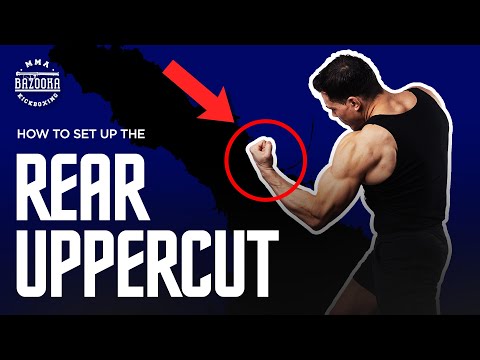
Top 5 Ways To Setup The REAR UPPERCUT | BAZOOKATRAINING.COM
0
Rear Uppercut·Bazooka Joe Valtellini·Added by Admin
SUBSCRIBE NOW: http://www.bazookatraining.com USE PROMO CODE: BAZOOKA25 FOR 25% OFF YOUR FIRST MONTH! Learn world class…
Перевод: rear uppercut
The rear uppercut generates greater power than the lead variant by engaging the full kinetic chain from the rear foot through the hips and into the rising fist. [1] Dempsey identified the rear uppercut as one of the heaviest punches in boxing when thrown correctly, combining upward force with full body rotation. [1] The rear uppercut was a signature weapon of fighters such as Mike Tyson, who used it from his crouching peek-a-boo guard to devastating effect — his rear uppercut knockout of Marvis Frazier (1986) landed in 30 seconds. [2] Haislet documented the rear uppercut as requiring a significant dip in the knees and a corkscrewing upward motion to generate maximum vertical force. [3]
The rear uppercut uses the power hand for maximum upward force. [1]
George Foreman's rear uppercut was a devastating weapon throughout his career, contributing to 76 knockout victories. [1]
Изображений для этой техники пока нет.
Войдите, чтобы предложить изображение.
SUBSCRIBE NOW: http://www.bazookatraining.com USE PROMO CODE: BAZOOKA25 FOR 25% OFF YOUR FIRST MONTH! Learn world class…
Учебных курсов по этой технике пока нет.
Войдите, чтобы предложить курс.
Риск травмы для человека, к которому применяется техника
Hooks/uppercuts; generate rotational force, high KO rate (Walilko et al. 2005)
Уровень мастерства, необходимый для надёжного выполнения техники
Разрешена ли техника по основным соревновательным правилам
Karate-Do Kyohan: The Master Text (Gichin Funakoshi, 1935)
Alias sources — [1] Championship Fighting (Dempsey, 1950) [2] Karate-Do Kyohan (Funakoshi, 1935) [3] Boxing (Fleischer, 1958)
Effectiveness sources — [1] Championship Fighting (Dempsey, 1950)
Standard katakana transliteration of Western martial arts terminology (外来語) — used in Japanese MMA, boxing, and BJJ communities
Alias sources — [1] Championship Fighting (Dempsey, 1950) [2] Karate-Do Kyohan (Funakoshi, 1935) [3] Boxing (Fleischer, 1958)
Effectiveness sources — [1] Championship Fighting (Dempsey, 1950)
leg drive, upward hip thrust, tight vertical alignment
shorter reach fighters effective at inside range
quadriceps, glutes, deltoids, biceps, core
According to Bazooka Joe Valtellini, hide your rear shoulder by using your lead side as a screen and setting up with good punches beforehand. This prevents your opponent from jamming up the middle and countering the technique.
Keep your elbow rubbing the side of your body as it comes up rather than throwing with too much angle and space, as Bazooka Joe Valtellini emphasizes. This positioning, sometimes called a 'corkscrew,' generates the most damage.
Bazooka Joe Valtellini stresses that without proper setup, the rear uppercut is easily countered. Use combinations like jab-overhand-jab before the uppercut, or set it up with techniques like inside low kicks to create defensive responses that open the angle.
An uppercut thrown with the rear hand, generating greater power through full hip rotation and weight transfer while driving upward from the back leg.
The rear uppercut generates greater power than the lead variant by engaging the full kinetic chain from the rear foot through the hips and into the rising fist. Dempsey identified the rear uppercut as one of the heaviest punches in boxing when thrown correctly, combining upward force with full body rotation.
Unified MMA: разрешён — Legal striking technique; WBC/Boxing: разрешён — Legal — punches are the core technique of boxing; WKF: разрешён — Legal, jodan/chudan punch scores 1 point (yuko) — controlled contact required; Kyokushin: ограничен — Body punches legal at full power, head punches banned; WT: ограничен — Punches to trunk only (1 point), punches to head banned; ITF: разрешён — Legal — hand techniques to head and body both permitted; WAKO: разрешён — Legal in Full Contact and Low Kick formats; K: разрешён — 1/GLORY — Legal — full power punches to head and body; IFMA: разрешён — Legal
Оценка опасности 6/10. High — hooks/uppercuts; generate rotational force, high KO rate (Walilko et al. 2005)
Стандартная цепочка подготовки: Assume Fighting Stance → Generate Power → Execute Strike → Recover to Guard.
Стандартные контрприёмы: Block — absorb the strike with a protective guard position / Evasion — move the target out of the strike's path / Counter-Attack — time an offensive response during the recovery phase of the strike.
Распространённые варианты: Standard uppercut (rising punch from below targeting the chin); Short uppercut (compact version for clinch range); Body uppercut (targeting the solar plexus with the rising punch); Lead uppercut (using the lead hand for a faster, less-telegraphed rising…).
George Foreman's rear uppercut was a devastating weapon throughout his career, contributing to 76 knockout victories.
Основные ошибки, на которые стоит обратить внимание: Winding up by pulling the hand down to the hip — the uppercut should fire from guard level with only a slight dip / Swinging the fist in a wide U-shape instead of a short, compact upward line / Squaring the stance to throw the uppercut, which removes the bladed position and exposes the centre line / Not bending the knees to generate upward drive — arm-only uppercuts have no power.
Rear Uppercut также известен как Ria Appā, Right Uppercut, Rear Age Tsuki, Power Uppercut.