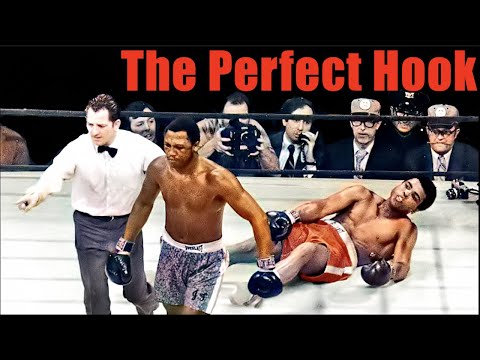
Smokin Joe Frazier's Terrifying Hook & Head Movement Explained - Technique Breakdown
0
Wide Hook·The Modern Martial Artist
http://www.modernmartialartist.com/downloads/power-of-the-pros/ There’s a line from a classic martial arts film “When my…
Перевод: wide hook
The wide hook is a long-arc hook thrown with a more extended arm, generating power through the larger rotational arc at the cost of speed and defensive exposure. [1] The wide hook was more common in the bare-knuckle era of boxing, when fighters stood more upright and threw sweeping blows. [2] Dempsey cautioned against the wide hook in Championship Fighting, noting that the extended arm reduces power (by distributing force over a longer arc) and leaves the fighter vulnerable to counter-punches. [1] Despite these tactical disadvantages, the wide hook remains effective when used selectively, particularly as a surprise punch from unusual angles. [3]
The wide hook travels in a longer arc for maximum power. [1]
A boxing power punch. [1]
Used in boxing and MMA. [1]
Изображений для этой техники пока нет.
Войдите, чтобы предложить изображение.
http://www.modernmartialartist.com/downloads/power-of-the-pros/ There’s a line from a classic martial arts film “When my…
Учебных курсов по этой технике пока нет.
Войдите, чтобы предложить курс.
Риск травмы для человека, к которому применяется техника
Hooks/uppercuts; generate rotational force, high KO rate (Walilko et al. 2005)
Уровень мастерства, необходимый для надёжного выполнения техники
Разрешена ли техника по основным соревновательным правилам
Karate-Do Kyohan: The Master Text (Gichin Funakoshi, 1935)
Alias sources — [1] Championship Fighting (Dempsey, 1950) [2] Boxing (Fleischer, 1958) [3] Boxing Mastery (Hatmaker, 2004)
History sources — [1] Championship Fighting (Dempsey, 1950) [2] The Art of Boxing and Manual of Training (Price, 1867) [3] Boxing (Haislet, 1940)
Standard katakana transliteration of Western martial arts terminology (外来語) — used in Japanese MMA, boxing, and BJJ communities
Alias sources — [1] Championship Fighting (Dempsey, 1950) [2] Boxing (Fleischer, 1958) [3] Boxing Mastery (Hatmaker, 2004)
History sources — [1] Championship Fighting (Dempsey, 1950) [2] The Art of Boxing and Manual of Training (Price, 1867) [3] Boxing (Haislet, 1940)
hip rotation, horizontal arm acceleration, tight elbow angle
compact build for short-range hooks, strong core
obliques, hip rotators, pectorals, biceps, forearms
According to The Modern Martial Artist, Frazier's hook was devastating because it was built on exceptional rhythm and timing rather than pure power. He maintained an unpredictable, inconsistent tempo—"dancing to a song only he could hear"—which made it nearly impossible for opponents to time their defense against his strikes.
The Modern Martial Artist emphasizes that Frazier relied almost entirely on head movement to set up his hooks, using it to corner opponents by moving forward while dodging every punch thrown at him. This defensive head movement created the angles and openings needed to land his hook effectively.
A hook thrown with a more extended arm and wider arc, generating greater force at medium range but with more telegraphing.
The wide hook is a long-arc hook thrown with a more extended arm, generating power through the larger rotational arc at the cost of speed and defensive exposure. The wide hook was more common in the bare-knuckle era of boxing, when fighters stood more upright and threw sweeping blows.
Unified MMA: разрешён — Legal striking technique; WBC/Boxing: разрешён — Legal — punches are the core technique of boxing; WKF: разрешён — Legal, jodan/chudan punch scores 1 point (yuko) — controlled contact required; Kyokushin: ограничен — Body punches legal at full power, head punches banned; WT: ограничен — Punches to trunk only (1 point), punches to head banned; ITF: разрешён — Legal — hand techniques to head and body both permitted; WAKO: разрешён — Legal in Full Contact and Low Kick formats; K: разрешён — 1/GLORY — Legal — full power punches to head and body; IFMA: разрешён — Legal
Оценка опасности 6/10. High — hooks/uppercuts; generate rotational force, high KO rate (Walilko et al. 2005)
Стандартная цепочка подготовки: Setup with Straight Punch → Pivot the Lead Foot → Arc the Arm → Follow Through.
Стандартные контрприёмы: Slip — move the head off the centre line to evade the punch / Parry — deflect the incoming punch with a quick hand redirection / Counter Cross — time a straight punch over the incoming attack.
Распространённые варианты: Standard hook (horizontal-arc punch targeting the jaw or temple); Tight hook (compact, short-range hook for close-quarters fighting); Body hook (targeting the ribs or liver with a downward-angled hook); Check hook (pivoting on the lead foot while throwing the hook as a co…).
Used in boxing and MMA.
Основные ошибки, на которые стоит обратить внимание: Using the wide hook as a primary weapon — it is the slowest hook variant and the easiest to counter / Throwing the wide hook without a setup, giving the opponent time to duck under or step inside the arc / Dropping the opposite hand during the wind-up, which is a large exposed window due to the long travel time / Over-rotating and spinning if the punch misses — the wide arc carries significant momentum that pulls you past the ta….
Wide Hook также известен как Waido Fukku, Looping Hook, Round Hook, Haymaker.