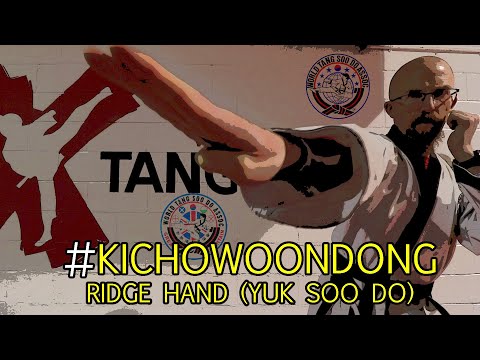
Ki Cho Woon Dong - Ridge Hand Tutorial
0
Standard Ridge Hand Strike·Heads of the Valleys Tang Soo Do·Added by Admin
Here is a short tutorial for the Ridge Hand (Yuk Soo Do ) Technique
Перевод: standard ridge hand strike
The basic ridge hand technique swinging the hand inward with the thumb tucked, striking with the inner edge of the hand between the base of the index finger and wrist.
The standard ridge hand strike is the basic technique using the inner edge of the hand to strike the opponent's temple or neck in a sweeping arc. [1] Nakayama described the correct execution as requiring the four fingers to be extended and pressed together with the thumb tightly folded, delivering power through a full hip rotation and arm extension. [2] In point karate competition, the ridge hand strike became a signature technique of fighters such as Bill 'Superfoot' Wallace, whose flexibility allowed him to deliver the technique to head height with devastating effect. [1]
A standard ridge hand technique. [1]
From karate. [1]
Used in competition. [1]
Изображений для этой техники пока нет.
Войдите, чтобы предложить изображение.
Here is a short tutorial for the Ridge Hand (Yuk Soo Do ) Technique
Учебных курсов по этой технике пока нет.
Войдите, чтобы предложить курс.
Риск травмы для человека, к которому применяется техника
Reverse knife hand; targets temple/jaw
Уровень мастерства, необходимый для надёжного выполнения техники
Разрешена ли техника по основным соревновательным правилам
Karate-Do Kyohan: The Master Text (Gichin Funakoshi, 1935)
Alias sources — [1] Karate-Do Kyohan (Funakoshi, 1935) [2] Kukkiwon Taekwondo Textbook (Kukkiwon, 2006) [3] Dynamic Karate (Nakayama, 1966)
History sources — [1] The Art of Striking (Blauer, 2004) [2] Best Karate Vol. 3 (Nakayama, 1978)
Official karate technique names (和語/漢語)
Established Japanese martial arts naming convention — native Japanese term (和語/漢語)
Alias sources — [1] Karate-Do Kyohan (Funakoshi, 1935) [2] Kukkiwon Taekwondo Textbook (Kukkiwon, 2006) [3] Dynamic Karate (Nakayama, 1966)
History sources — [1] The Art of Striking (Blauer, 2004) [2] Best Karate Vol. 3 (Nakayama, 1978)
speed, power generation through kinetic chain, striking surface conditioning
athletic build with fast-twitch muscle fibres
varies by strike — hip rotators, shoulders, core
The most common mistake is leaving the thumb out instead of tucking it in. Heads of the Valleys Tang Soo Do emphasizes that junior belts consistently make this error, so ensuring the thumb is tucked is the main foundational correction.
The hand should be turned over with the thumb pointed slightly downward at approximately a 10-degree angle inward—not level. Make sure to tuck the thumb in and maintain a slight micro bend in the arm.
Body rotation is essential; the arm should twist as it comes out, with a twist to the hip and a flick of the wrist rather than the arm moving like a plank of wood. Heads of the Valleys Tang Soo Do notes that many practitioners neglect this twist, which reduces power and effectiveness.
Yes, you should practice on both sides since the form typically teaches the technique in only one direction, and consistent practice on both sides ensures balanced skill development.
The basic ridge hand technique swinging the hand inward with the thumb tucked, striking with the inner edge of the hand between the base of the index finger and wrist.
The standard ridge hand strike is the basic technique using the inner edge of the hand to strike the opponent's temple or neck in a sweeping arc. Nakayama described the correct execution as requiring the four fingers to be extended and pressed together with the thumb tightly folded, delivering power through a full hip rotation and arm extension.
Unified MMA: разрешён — Legal (palm strikes, slaps permitted); WBC/Boxing: запрещён — Only closed-fist punches permitted; WKF: ограничен — Varies by technique — some open-hand strikes legal in kata, generally restric…; Kyokushin: запрещён — Only closed-fist strikes to body permitted; WT: запрещён — Prohibited; ITF: ограничен — Some knife hand techniques legal; WAKO: запрещён — Closed fist only; K: запрещён — 1/GLORY — Closed fist only; IFMA: разрешён — Legal — palm strikes permitted in Muay Thai
Оценка опасности 5/10. High — reverse knife hand; targets temple/jaw
Стандартная цепочка подготовки: Assume Fighting Stance → Generate Power → Execute Strike → Recover to Guard.
Стандартные контрприёмы: Block — absorb the strike with a protective guard position / Evasion — move the target out of the strike's path / Counter-Attack — time an offensive response during the recovery phase of the strike.
Распространённые варианты: Standard variation (primary execution of the strike from the most common stance); Power variation (modified mechanics for maximum force generation); Speed variation (minimised telegraph for a faster, harder-to-read attack); Counter variation (timed to exploit the opponent's offensive commitment).
Used in competition.
Основные ошибки, на которые стоит обратить внимание: Allowing the thumb to extend at any point during the strike — this is the single most common and painful mistake / Hitting flat with the palm and not presenting the ridge / Not rotating the body — the hip and shoulder must turn to generate force / Reaching with a straight arm instead of maintaining the hooked arm position.
Standard Ridge Hand Strike также известен как Haitō-uchi (Kihon-gata), Standard Haito Uchi, Standard Sonnal Deung, Standard Inside Knife Hand Strike.