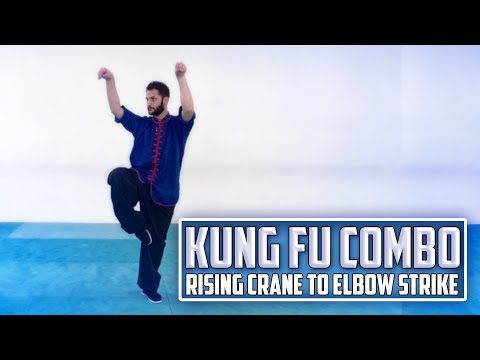
Kung Fu Combo - Rising Crane to Elbow Strike
0
Rising Elbow·Sifu Kuttel
In this video we use one of the most signature positions in any martial arts and that is the one legged Crane, or rising…
Перевод: rising elbow
The Rising Elbow subfamily covers uppercut-trajectory elbow strikes that travel upward from a low starting position to target the chin, jaw, or underside of the opponent's face. [1] The rising elbow is driven by an explosive upward thrust of the hips and legs combined with shoulder elevation, launching the elbow point vertically into the target. [1],[2] This technique is particularly dangerous because it attacks the chin from below, an angle associated with high knockout rates due to the rotational acceleration imparted to the head and the resulting shearing forces on the brainstem. [2],[3]
Rising elbow strikes have been used in Muay Thai clinch fighting for centuries, where the upward elbow from within the plum clinch is one of the most celebrated offensive techniques. [1] The rising elbow is also found in various Southeast Asian martial arts including Lethwei and pencak silat. [2],[3]
The rising elbow strikes upward under the opponent's chin or jaw. [1]
From Muay Thai's sok ngat. [1]
Used in Muay Thai and MMA. [1]
Изображений для этой техники пока нет.
Войдите, чтобы предложить изображение.
In this video we use one of the most signature positions in any martial arts and that is the one legged Crane, or rising…
Учебных курсов по этой технике пока нет.
Войдите, чтобы предложить курс.
Риск травмы для человека, к которому применяется техника
Rising elbow; targets chin from below
Уровень мастерства, необходимый для надёжного выполнения техники
Разрешена ли техника по основным соревновательным правилам
Muay Thai: The Art of Fighting (Yod Ruerngsa, Khun Kao Charuad & James Cartmell, 2002)
Alias sources — [1] Muay Thai Unleashed (Delp, 2006) [2] Muay Thai: The Art of Fighting (Kraitus & Kraitus, 1988) [3] WBC Muay Thai Rules (2014)
Effectiveness sources — [1] Muay Thai Unleashed (Delp, 2006)
Official karate technique names (和語/漢語)
Established Japanese martial arts naming convention — native Japanese term (和語/漢語)
Alias sources — [1] Muay Thai Unleashed (Delp, 2006) [2] Muay Thai: The Art of Fighting (Kraitus & Kraitus, 1988) [3] WBC Muay Thai Rules (2014)
Effectiveness sources — [1] Muay Thai Unleashed (Delp, 2006)
leg drive, upward hip thrust, tight vertical alignment
shorter reach fighters effective at inside range
quadriceps, glutes, deltoids, biceps, core
Каждое движение в любом боевом искусстве обладает рядом универсальных свойств. Комбинируйте параметры ниже, чтобы найти нужный инструмент или сравнить аналоги из разных стилей.
The Rising Elbow subfamily covers uppercut-trajectory elbow strikes that travel upward from a low starting position to target the chin, jaw, or underside of the opponent's face. The rising elbow is driven by an explosive upward thrust of the hips and legs combined with shoulder elevation, launching the elbow point vertically into the target.
Rising elbow strikes have been used in Muay Thai clinch fighting for centuries, where the upward elbow from within the plum clinch is one of the most celebrated offensive techniques. The rising elbow is also found in various Southeast Asian martial arts including Lethwei and pencak silat.
Unified MMA: разрешён — Legal — all elbow strikes permitted; WBC/Boxing: запрещён — All elbow strikes prohibited in boxing; WKF: запрещён — Elbow strikes not a legal technique in sport karate; Kyokushin: запрещён — Elbow strikes prohibited; WT: запрещён — Prohibited; ITF: запрещён — Prohibited; WAKO: запрещён — Prohibited in all kickboxing formats; K: запрещён — 1/GLORY — Prohibited — key difference from Muay Thai; IFMA: разрешён — Legal — elbows are a core Muay Thai weapon (art of eight limbs)
Оценка опасности 7/10. Very High — rising elbow; targets chin from below
Стандартная цепочка подготовки: Close Distance → Hip Rotation → Strike with Elbow Point.
Стандартные контрприёмы: Lean Back — pull the head out of elbow range to avoid the short-range strike / Clinch Tie-Up — close to body-to-body range to smother elbow strikes / Push Kick (Teep) — maintain distance to prevent elbow range from being established.
Распространённые варианты: Standard uppercut (rising punch from below targeting the chin); Short uppercut (compact version for clinch range); Body uppercut (targeting the solar plexus with the rising punch); Lead uppercut (using the lead hand for a faster, less-telegraphed rising…).
Used in Muay Thai and MMA.
Основные ошибки, на которые стоит обратить внимание: Rising too slowly and losing the explosive upward snap that makes this technique effective / Using the arm only without engaging the legs and hips — the power must come from the ground up / Aiming the elbow at the chest or body instead of driving up under the chin / Leaning back during the upward drive, which disconnects the body from the elbow.
Rising Elbow также известен как Age Hiji, Uppercut Elbow, Sok Ngat, Upward Elbow.