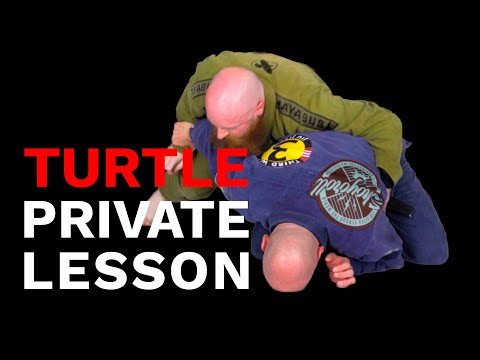
Private Lesson: Turtle Position
0
Standard Tight Turtle·The Art of Skill·Added by Admin
OLD GRAPPLER SUMMIT IS HAPPENING! An all-inclusive immersion retreat on Halloween weekend 2025. https://oldgrapplersummi…
Перевод: standard tight turtle
The Standard Tight Turtle compresses the body to its smallest configuration, with elbows pressed to knees, forehead on the mat, hands protecting the neck, and hips as low as possible. [1] This ultra-compressed turtle provides maximum protection at the expense of mobility, used when the defender is under heavy attack and needs to prevent hooks, chokes, and turnovers. [1],[2] The tight turtle is the grappling equivalent of a defensive shell — survive until an escape opportunity presents itself. [2],[3]
The standard tight turtle is the baseline maximally-tucked defensive position. [1]
A refined defensive turtle variant. [1]
Used in competition for defensive purposes. [1]
Изображений для этой техники пока нет.
Войдите, чтобы предложить изображение.
OLD GRAPPLER SUMMIT IS HAPPENING! An all-inclusive immersion retreat on Halloween weekend 2025. https://oldgrapplersummi…
Учебных курсов по этой технике пока нет.
Войдите, чтобы предложить курс.
Риск травмы для человека, к которому применяется техника
Turtle is a defensive shell position; vulnerable to back takes and chokes
Уровень мастерства, необходимый для надёжного выполнения техники
Разрешена ли техника по основным соревновательным правилам
Jiu-Jitsu University (Saulo Ribeiro, 2008)
Alias sources — [1] Jiu-Jitsu University (Ribeiro, 2008) [2] Mastering Jujitsu (Gracie & Danaher, 2003)
Effectiveness sources — [1] Jiu-Jitsu University (Ribeiro, 2008)
Official Kodokan ground technique classification system
Mixed Japanese-Western terminology — combines traditional Japanese terms with katakana loanwords
Alias sources — [1] Jiu-Jitsu University (Ribeiro, 2008) [2] Mastering Jujitsu (Gracie & Danaher, 2003)
Effectiveness sources — [1] Jiu-Jitsu University (Ribeiro, 2008)
core strength, tight elbow position, neck protection
compact build with strong core for stability
core stabilisers, shoulders, neck, hip flexors
According to The Art of Skill instructor, you don't want your opponent positioned between your armpits and knee—keep that space protected. The key is maintaining integrated systems where all your defensive elements work together to keep opponents out of that critical zone.
Foot engagement is crucial for generating drive and preventing your opponent from taking your back. The Art of Skill instructor emphasizes that having that foot contact gives you options—you can either defend or create space to move away if needed.
The Art of Skill instructor explains that you can release your back leg to allow yourself to come in closer, which gives you better control and positioning once you've established your initial catch.
The Standard Tight Turtle compresses the body to its smallest configuration, with elbows pressed to knees, forehead on the mat, hands protecting the neck, and hips as low as possible. This ultra-compressed turtle provides maximum protection at the expense of mobility, used when the defender is under heavy attack and needs to prevent hooks, chokes, and turnovers.
The standard tight turtle represents the maximum-protection variant of the defensive turtle, used as a survival position across all grappling disciplines. Its emphasis on total protection over escape reflects its role as the last defensive option.
IBJJF: разрешён — Legal — common transitional position; IJF: ограничен — Legal position but extended turtle without attacking penalized for non-combat…; ADCC: разрешён — Legal; Unified MMA: разрешён — Legal; UWW: разрешён — Legal — bottom position, opponent works to turn/pin; FIAS Sport Sambo: разрешён — Legal
Оценка опасности 3/10. Moderate — turtle is a defensive shell position; vulnerable to back takes and chokes
Стандартная цепочка подготовки: Achieve Position → Stabilize → Maintain → Attack.
Стандартные контрприёмы: Posture Control — maintain strong posture to limit the opponent's offensive options / Escape to Neutral — work back to standing or a neutral position.
Распространённые варианты: Standard turtle (hands and knees with elbows tight, head protected); Flattened turtle (driven to the mat from turtle, attempting to re-turtle); Active turtle (using sit-outs or rolls from the turtle position).
Used in competition for defensive purposes.
Основные ошибки, на которые стоит обратить внимание: Leaving the elbows raised away from the thighs — the elbows must be sealed against the inner thighs / Not crossing the forearms at the neck — the cross provides double protection against choke entries / Uncurling the body under pressure — maintain the tight ball despite the opponent's attacks / Not breathing properly — controlled breathing is essential in the compressed position.
Standard Tight Turtle также известен как Sutandādo Taito Kame, Classic Tight Turtle, Basic Compact Turtle.