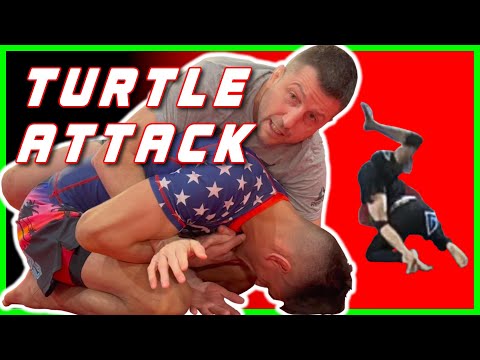
Turtle Position... What to do!
0
Defensive Turtle·TeachMeGrappling Coach Brian
This video I work with my students on a basic system of what to do with your turtled opponent. Enjoy! If you have any q…
Перевод: defensive turtle
The Defensive Turtle family covers the turtle positions from the perspective of the defending fighter, who uses the curled-up posture to protect against submissions, pins, and strikes while working to escape. [1] Defensive turtle positions prioritise protecting the neck and arms from attacks while maintaining a stable base that is difficult to flatten or turn over. [1],[2] This family includes the standard turtle (basic defensive posture) and the tight turtle (compressed defensive posture with maximum protection). [2],[3]
Defensive turtle positions have been fundamental to wrestling and judo, where the bottom fighter's ability to maintain the turtle and prevent being turned or pinned is a critical defensive skill. [1] BJJ added neck protection as a primary defensive concern due to the choke threat from behind. [2],[3]
The defensive turtle is emphasised in judo ne-waza as protection against turnovers and in BJJ as a guard recovery position. [1]
The defensive turtle is commonly used in judo and BJJ competition when guard is lost. [1]
Изображений для этой техники пока нет.
Войдите, чтобы предложить изображение.
This video I work with my students on a basic system of what to do with your turtled opponent. Enjoy! If you have any q…
Учебных курсов по этой технике пока нет.
Войдите, чтобы предложить курс.
Риск травмы для человека, к которому применяется техника
Turtle is a defensive shell position; vulnerable to back takes and chokes
Уровень мастерства, необходимый для надёжного выполнения техники
Разрешена ли техника по основным соревновательным правилам
Jiu-Jitsu University (Saulo Ribeiro, 2008)
Alias sources — [1] Jiu-Jitsu University (Ribeiro, 2008) [2] Jiu-Jitsu University (Ribeiro, 2008) [3] Jiu-Jitsu University (Ribeiro, 2008)
Effectiveness sources — [1] Jiu-Jitsu University (Ribeiro, 2008) [2] Kodokan Judo (Kano, 1986)
Official Kodokan ground technique classification system
Standard Japanese martial arts terminology (kanji/hiragana)
Established Japanese martial arts naming convention — native Japanese term (和語/漢語)
Alias sources — [1] Jiu-Jitsu University (Ribeiro, 2008) [2] Jiu-Jitsu University (Ribeiro, 2008) [3] Jiu-Jitsu University (Ribeiro, 2008)
Effectiveness sources — [1] Jiu-Jitsu University (Ribeiro, 2008) [2] Kodokan Judo (Kano, 1986)
core strength, tight elbow position, neck protection
compact build with strong core for stability
core stabilisers, shoulders, neck, hip flexors
Каждое движение в любом боевом искусстве обладает рядом универсальных свойств. Комбинируйте параметры ниже, чтобы найти нужный инструмент или сравнить аналоги из разных стилей.
The Standard Turtle subfamily covers the basic defensive turtle position with the fighter on hands and knees, elbows tight to the body, chin tucked, and head down to protect against chokes and submissions. [1] The standard turtle provides a stable defensive base while keeping the arms close to prevent arm attacks and the chin tucked to prevent choke entries. [1,2] From standard turtle, the defender works to escape via sit-outs, rolls, guard pulls, or stand-ups. [2,3]
The Tight Turtle subfamily covers the defensive turtle variation where the fighter compresses the body as much as possible, tucking the elbows to the knees, chin to chest, and hips low, creating the smallest possible target and maximum protection. [1] The tight turtle sacrifices escape mobility for maximum protection, used when the opponent has a strong attacking position and the defender needs to survive before creating an escape opportunity. [1,2] The tight turtle makes it extremely difficult for the attacker to insert hooks, slide in chokes, or flatten the defender. [2,3]
The defensive turtle (balling up on hands and knees) appears in 362 passages under 'turtle' across 80 books. The most common defensive recovery position in grappling — protects the neck and prevents the opponent from establishing mount or side control. The weakness is vulnerability to back takes and chokes. (80 books; Ribeiro, Jiu-Jitsu University)
Use a distraction by going around their face with one hand, then punch your hand through their defense to get inside and secure the seatbelt grip.
According to Coach Brian, the scissor choke fails because most people don't position correctly—you end up on the opponent's face without a proper choke, usually just resulting in them escaping. The key is using it as a distraction while your actual control comes from your knee on their chest.
Coach Brian emphasizes pulling your opponent to prevent them from returning to turtle, and positioning yourself tightly by getting up on your knee to maintain control and prevent them from jumping their body over yours.
Coach Brian recommends going for the choke as the simpler and safer approach because it keeps you in a better position rather than taking the risk of transitioning to an armbar.
The Defensive Turtle family covers the turtle positions from the perspective of the defending fighter, who uses the curled-up posture to protect against submissions, pins, and strikes while working to escape. Defensive turtle positions prioritise protecting the neck and arms from attacks while maintaining a stable base that is difficult to flatten or turn over.
Defensive turtle positions have been fundamental to wrestling and judo, where the bottom fighter's ability to maintain the turtle and prevent being turned or pinned is a critical defensive skill. BJJ added neck protection as a primary defensive concern due to the choke threat from behind.
IBJJF: разрешён — Legal — common transitional position; IJF: ограничен — Legal position but extended turtle without attacking penalized for non-combat…; ADCC: разрешён — Legal; Unified MMA: разрешён — Legal; UWW: разрешён — Legal — bottom position, opponent works to turn/pin; FIAS Sport Sambo: разрешён — Legal
Оценка опасности 3/10. Moderate — turtle is a defensive shell position; vulnerable to back takes and chokes
Стандартная цепочка подготовки: Achieve Position → Stabilize → Maintain → Attack.
Стандартные контрприёмы: Posture Control — maintain strong posture to limit the opponent's offensive options / Escape to Neutral — work back to standing or a neutral position.
Распространённые варианты: Standard turtle (hands and knees with elbows tight, head protected); Flattened turtle (driven to the mat from turtle, attempting to re-turtle); Active turtle (using sit-outs or rolls from the turtle position).
The defensive turtle is commonly used in judo and BJJ competition when guard is lost.
Основные ошибки, на которые стоит обратить внимание: Staying in turtle for more than a few seconds — escape immediately; turtle is emergency-only / Flattening from turtle to a belly-down position — maintain the all-fours structure; flat means defeated / Not protecting the neck — the chin must be tucked and hands near the neck at all times / Reaching backward for the opponent — keep the arms in front; reaching back exposes the neck.
Defensive Turtle также известен как Bōgyo Kame, Defensive Shell, Balled Turtle, Protective Turtle.